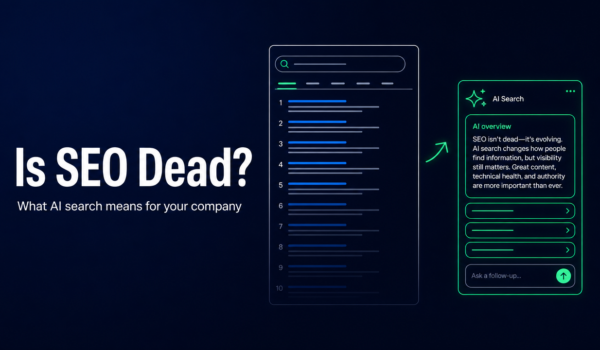
SEO is not dead, but the payoff from it has changed. Google still sends the large majority of search referrals on the web, and AI tools pull much of what they say from pages that search engines can crawl and trust. What has shrunk is the click: more searches now end on the results page, and an AI answer at the top takes a large share of the visits a top-ranking page used to earn. For most companies the answer is to keep SEO as the base and add work aimed at being named inside AI answers.
What the data says about search today
Google is still where most searching happens. Statcounter data compiled by Searchlab shows Google with 91.05% of search engine referrals worldwide in October 2026, with Bing at 4.8%. The same page cites SparkToro figures showing that 68.01% of US Google searches ended without a click between January and April 2026, up from 60.45% for the comparable 2024 period.
AI tools are growing alongside search, not instead of it. Searchlab reports OpenAI’s figure of 900 million weekly ChatGPT users in February 2026, and notes that no reliable public measure exists for ChatGPT’s share of all searches. So the honest picture is two channels: Google remains the main one, and AI assistants are now a second place buyers ask for recommendations.
What has changed: fewer clicks per ranking
The bigger shift is inside Google itself. Ahrefs’ study AI Overviews Reduce Clicks by 58%, published February 2026, compared 300,000 keywords using Search Console click data from December 2023 and December 2025. For keywords that show an AI Overview, the top result’s click-through rate fell from 0.073 to 0.016, about 58% below what Ahrefs forecast without the AI summary. Ahrefs had measured a 34.5% drop in April 2025, so the effect grew over the year.
The study lists other research that points the same way, including Seer Interactive (organic click-through down 49.4% to 65.2%) and Authoritas (47.5%). Even keywords without an AI Overview lost clicks, which Ahrefs puts down to other features on the results page such as featured snippets and local packs.
In plain terms: ranking first still matters, but it brings fewer visitors than it did two years ago, and being the source the AI answer quotes now matters as much as the blue link. Our guide to zero-click search covers how to plan for that.
What still works
- Crawlable, fast pages. AI features in Google and most AI assistants read the open web. A site that search engines struggle to crawl is hard for AI tools to use too.
- Pages that answer real questions. Clear answers near the top of a page help with both rankings and AI citations.
- Authority from other sites. Links and mentions on trusted sites still help rankings, and mentions in reviews, roundups and forums feed AI answers.
- Bottom-of-funnel pages. Searches like “pricing”, “alternatives” and “near me” still send buyers with intent, and they convert.
What to add for AI search
SEO alone no longer covers how buyers find you. Add three things:
- A prompt list. Write down the questions buyers ask AI tools before choosing a provider like you, and check monthly which brands the answers name.
- Off-site presence. Get mentioned where AI answers draw from: review sites, industry roundups, directories and community threads such as Reddit.
- AI referral tracking. Separate visits from ChatGPT, Perplexity, Gemini and Copilot in your analytics so you can see the channel grow.
Our comparison of SEO vs GEO explains how the two fit together, and ChatGPT search vs Google covers how buyers use each.
How to adjust your budget
There is no fixed split, but a sensible starting point for most companies is to keep core technical SEO and content in place, then move a portion of the budget that used to go to chasing informational rankings toward AI visibility work: answer-first pages, third-party mentions and monthly prompt tracking. Review the split each quarter against two numbers: leads from organic search and how often AI tools name you for your top buyer questions.
To see which buyer questions your company is missing from today, get a free AI Search Opportunity Report.
Frequently asked questions
Is SEO dead in 2026?
No. Google still sends most search referrals, and AI tools rely on the same crawlable pages. What has declined is the number of clicks each ranking earns.
Will AI replace SEO?
AI is changing what SEO has to cover, not replacing it. The work now includes being cited in AI answers, which builds on the same foundations: crawlable pages, clear answers and authority.
Is ChatGPT replacing Google?
Not as a whole. Google still handles most search activity, while ChatGPT has become a second place people ask for advice and recommendations.
Should I stop investing in SEO?
No. Cut spending on content that only chases broad informational keywords if it no longer brings leads, and keep the pages that answer buyer questions, rank for high-intent searches and give AI tools something to cite.