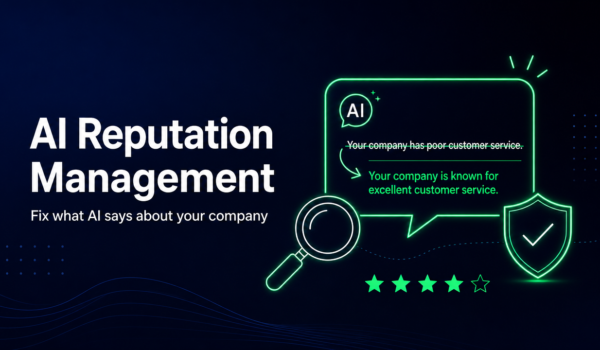
AI reputation management is the work of finding out what ChatGPT, Google AI Overviews, Perplexity, Gemini and other AI tools say about your company, tracing each wrong or unflattering claim to the pages it came from, and fixing those pages so the next answer is better. You cannot edit an AI answer directly. You can change the sources it reads, add clearer facts of your own, and report answers that are plainly wrong.
Why AI tools get your company wrong
Most AI answers about a company are built from what is published on the web: your own site, review sites, directories, news, forums and comparison articles. When those sources are thin, old or contradictory, the answer is too.
Google has said as much about its own AI feature. In AI Overviews: About last week, published in May 2024, Elizabeth Reid, Google’s VP of Search, wrote that AI Overviews generally do not make things up, and that errors usually come from misreading the query, misreading the wording on a page, or a “data void” where little good information exists. She also pointed to sarcastic forum posts that were treated as advice.
For a business, the common causes are:
- Old facts that were never replaced. A former price, a discontinued product or a past address still sitting on a directory or an old press release.
- Name confusion. Another company with a similar name, or a parent and a subsidiary mixed up.
- Thin information about you. If few pages describe what you do, an AI tool fills the gap from whatever it finds, including competitors’ comparison pages.
- Negative threads and reviews. A popular Reddit thread or a run of bad reviews can shape how an answer describes you.
- Unclear pages of your own. Pricing, policies and features spread across many pages are easy to summarize wrongly.
Step 1: Audit what AI tools say about you
Write 15 to 25 questions a buyer, journalist or job seeker might ask: “What is [company]?”, “Is [company] legit?”, “[company] pricing”, “[company] vs [competitor]”, “Best [category] for [use case]”. Run them in ChatGPT, Google (AI Overviews and AI Mode), Perplexity, Gemini and Copilot. Record each answer, every claim about you, and the sources cited. Our AI visibility audit guide has a template for this.
Mark each claim as correct, outdated, wrong or negative. That list is your work queue.
Step 2: Trace each claim to its source
Perplexity, ChatGPT search and Google’s AI features usually show the pages they drew on. Open them. For claims without a visible source, search the exact wording on Google to find where it appears. You will usually find one of three things: your own outdated page, a third-party page with old or wrong facts, or an opinion in a review or forum thread.
Step 3: Fix the source, not the answer
- Your own site. Put the correct facts in one clear place: an about page with founding date, leadership, locations and what you do, a current pricing page, and an FAQ that answers the questions you saw handled badly. Remove or redirect outdated pages.
- Directories and profiles. Update Google Business Profile, LinkedIn, Crunchbase, industry directories and review profiles so your name, description and details match everywhere.
- Third-party articles. Email the publisher with the correct facts and a source. Many will update an outdated line.
- Name confusion. Use your full legal name, location and category together on your pages so the difference from the similarly named company is obvious.
Step 4: Report answers that are plainly wrong
Google lets you flag an AI Overview from the overview itself. Search Engine Roundtable’s write-up of Google’s feedback steps lists them: open the menu at the top right of the overview, choose Feedback, select the part it concerns, pick a category, add a description and send. ChatGPT, Perplexity and Gemini have similar thumbs-down or report options on each answer. Reports help, but they rarely fix an answer on their own if the sources still say the wrong thing.
Step 5: Handle negative threads and reviews honestly
You cannot remove fair criticism, and trying to bury it with fake reviews or sock-puppet accounts breaks platform rules and the law. What works is responding in public, fixing the problem the thread describes, and earning more recent, specific reviews from real customers. Our guide to Reddit reputation management covers how to reply to a thread without making it worse.
Step 6: Keep watching
Answers change as models and sources update. Re-run the same questions every month, log what changed, and keep the list of fixed and open claims. Our guide to tracking brand mentions in AI search covers tools and a simple spreadsheet setup.
To see which buyer questions your company is missing from today, get a free AI Search Opportunity Report.
Frequently asked questions
Can I ask OpenAI to correct what ChatGPT says about my company?
There is no general correction form for businesses. You can report a specific answer in ChatGPT, but the dependable fix is to correct the sources ChatGPT reads.
How long does it take for AI answers to change?
Answers that use live web search can change within days or weeks of a source being fixed. Facts learned during model training can take longer, until the next model update.
Is AI reputation management the same as online reputation management?
It builds on it. Reviews, press and forum threads still matter, but the goal now includes what AI tools say when someone asks about you.
What is AI brand monitoring?
Regularly asking AI tools a fixed set of questions about your company and category, and recording how you are described, which competitors appear and which sources are cited.