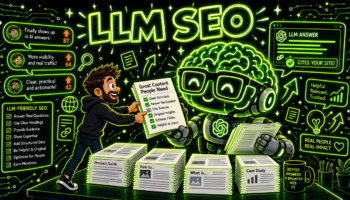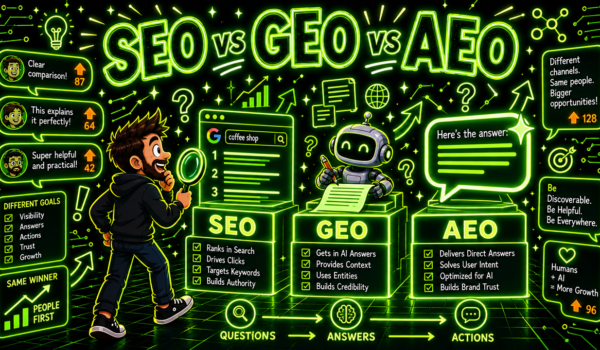
SEO vs GEO comes down to where you want to be found. SEO (search engine optimization) ranks your pages in search results so people click through. GEO (generative engine optimization) and AEO (answer engine optimization) get your business named and cited inside answers written by AI tools such as ChatGPT, Claude, Perplexity and Google’s AI Overviews. Most of the groundwork is shared. The main differences are how success is measured and how much mentions on other sites count.
This guide compares SEO vs GEO vs AEO side by side, explains where each term came from, lists the five differences that change your work, and ends with a simple way for a small team to split its time.
SEO vs GEO vs AEO at a glance
The quickest way to understand SEO vs GEO is to put the three terms next to each other. GEO and AEO sit very close together; SEO is the older foundation both build on.
| SEO | GEO | AEO | |
|---|---|---|---|
| Full name | Search engine optimization | Generative engine optimization | Answer engine optimization |
| Where you show up | Search results pages (Google, Bing) | AI-written answers (ChatGPT, Claude, Perplexity, Gemini, AI Overviews) | Direct answers: AI answers, featured snippets, voice assistants |
| What the user sees | A list of links | One written answer, often with sources | One direct answer |
| Typical query | Short keywords | Long questions and requests | Questions |
| Main signals | Relevant pages, links, technical health | Clear, quotable content and mentions across many sources | Answer-first content, structure, consistent facts |
| Main measure | Rankings, clicks, traffic | Mentions, citations, share of answers | Answers won, mentions, citations |
What is SEO?
SEO is the work of helping your pages rank in search engines so people find and click them. It covers three areas: technical health (search engines can crawl and index your site), content (pages that answer what people search for) and authority (other sites link to and mention you).
SEO has a long track record and clear tools. You can see rankings, clicks and queries in Google Search Console, and you can tie traffic to sales. That measurability is one reason SEO still matters in any SEO vs GEO discussion.
What is GEO?
GEO is the work of getting your business included in answers written by generative AI tools. The term comes from a research paper, “GEO: Generative Engine Optimization” by Pranjal Aggarwal and colleagues from Princeton and other universities, which tested how changes to a web page affect whether AI answer engines use it.
GEO focuses on two things: making your content easy for AI tools to retrieve and quote, and making sure the wider web describes you accurately, since these tools blend many sources into one answer. Our full explainer on what generative engine optimization is walks through how a generative answer is built.
What is AEO?
AEO is the work of becoming the direct answer to a question. The term predates today’s chat assistants. It grew out of featured snippets and voice search, where one answer is shown or spoken instead of a list. Today AEO covers AI answers as well, which is why it overlaps so much with GEO. See our guide What is AEO? for the definition and a starter checklist.
AEO vs GEO: is there a real difference?
In practice, AEO and GEO describe the same work. Agencies, tools and writers use the terms interchangeably, and Wikipedia’s article on generative engine optimization lists answer engine optimization as another name for it.
If you want a distinction, it is one of emphasis. AEO people tend to talk about direct answers, question headings and featured snippets. GEO people tend to talk about how AI tools pick and combine sources, and about mentions on other sites. Both end up recommending the same steps. When you compare SEO vs GEO, you can read AEO into the GEO column without losing much.
SEO vs GEO: the 5 differences that matter
Many lists of SEO vs GEO differences run to a dozen points. These five are the ones that change what you do day to day.
1. The result: a list of links vs one written answer
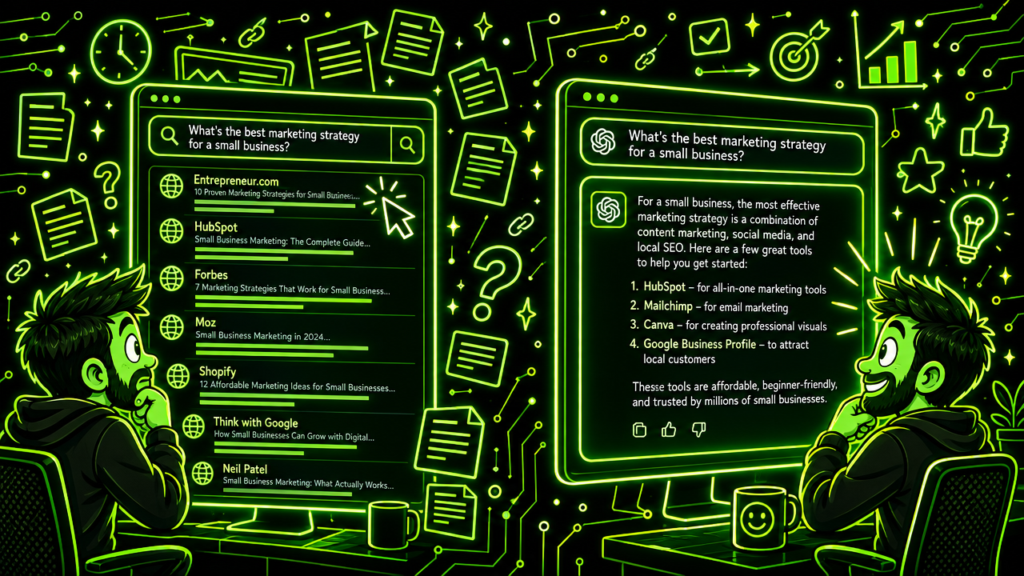
A search engine shows ranked links and lets the reader choose. A generative engine writes one answer and decides for the reader which businesses to mention. In SEO, position eight still gets some attention. In GEO, you are either in the answer or you are not.
2. The query: keywords vs full questions
People type short phrases into search engines: “crm small agency”. They ask AI tools full questions with context: “I run a five-person design agency and need a CRM that integrates with our invoicing tool. What should I use?” GEO content needs to answer specific situations as well as the head term.
3. The click: visits vs zero-click mentions
SEO success usually means a visit to your site. GEO success often means being named in an answer the reader takes at face value, with no click at all. Some readers will search for you afterwards or click a cited source, but many will not. Traffic alone undercounts the value.
4. The signals: your pages vs the whole web
SEO weighs your own page heavily: its relevance, structure and the links pointing to it. GEO draws on many sources at once, so reviews, comparison articles, directories and community threads that mention you carry more weight. A business with a perfect website and no outside mentions can rank in Google and still be missing from AI answers.
5. The metric: rankings vs mentions and accuracy
SEO has rankings, clicks and conversions, all visible in standard tools. GEO is measured by how often you are mentioned or cited for a fixed set of questions, how accurately you are described, and which sources the answers draw on. Our AI visibility audit guide explains how to track that.
What stays the same between SEO and GEO?
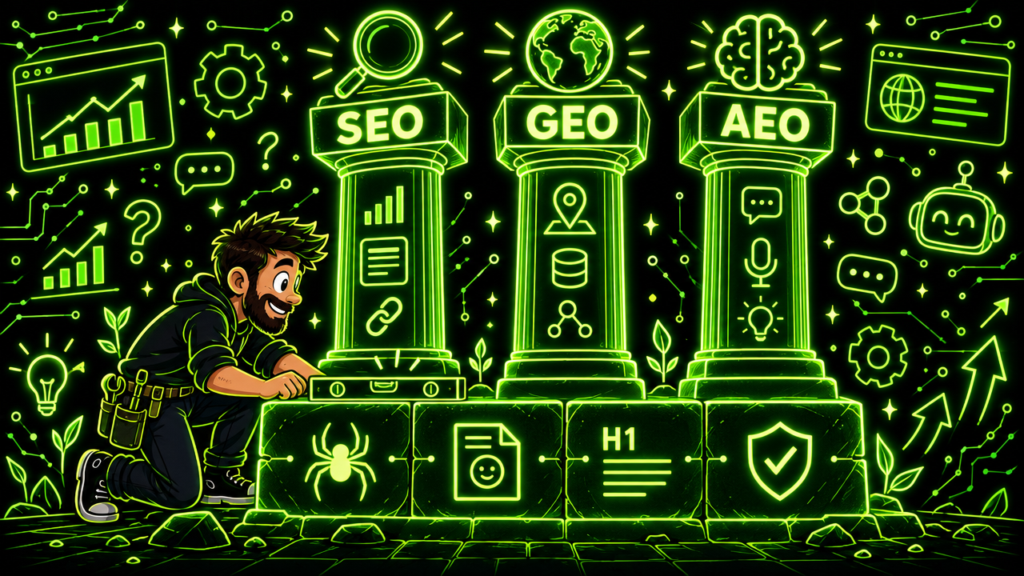
The foundations stay the same, and that is the most useful thing to know about SEO vs GEO. AI tools that search the web still depend on pages they can crawl, read and trust. Google states this directly in its guidance on AI features: there are no extra requirements to appear in AI Overviews or AI Mode beyond normal SEO best practices.
These SEO habits all carry over to GEO:
- A site that crawlers can reach, with fast, clean pages.
- Helpful content written for people, with clear headings.
- Accurate, consistent information about your business.
- Authority earned through mentions and links from trusted sites.
- Structured data that describes what is on the page.
If your SEO is weak, start there. GEO built on a site that search engines cannot read will not get far.
Where do community discussions fit in SEO vs GEO?
Community discussions sit on both sides of SEO vs GEO. Reddit threads and forum posts rank in Google for many buying questions, and AI tools read the same threads when they write recommendations. A helpful, accurate mention in the right thread can help you in both places.
Our post on Reddit SEO covers the search side, and Does ChatGPT use Reddit? covers the AI side with the published studies and their dates. How often each AI tool cites Reddit changes over time, so plan around the steady part: these tools value first-hand discussion, and threads are where buyers compare options in their own words.
To find the threads that matter for your business, start with the ones already ranking for your keywords. Our guide on how to find Reddit threads already ranking takes about five minutes.
SEO vs GEO in practice: one business, two results
An example makes the SEO vs GEO difference concrete. Picture a small accounting firm that serves freelancers in one city.
The SEO view. Someone searches “freelancer accountant Manchester”. Google shows a map pack, a few directory listings and the firm’s own page in fifth place. The searcher scans the list, clicks two or three results and compares. The firm wins if its page ranks well and its listing looks better than the others.
The GEO view. Someone asks an AI assistant: “I’m a freelance designer in Manchester and my tax return is a mess. Should I hire an accountant, and who do people recommend?” The assistant explains when an accountant is worth it, then names two or three local firms, describing each in a sentence. It builds those descriptions from the firms’ websites, review sites, a local business directory and a thread where freelancers swapped recommendations.
In the SEO view, the firm’s page did most of the work. In the GEO view, the firm’s reputation did. If the reviews were thin, the directory listing was out of date and nobody had mentioned the firm in a discussion, the assistant may have named a competitor even though the firm ranked in Google. The fix is the same groundwork plus attention to how the firm is described elsewhere.
How to measure SEO vs GEO side by side
You measure SEO vs GEO with different tools, so set both up from the start.
| What to track | SEO | GEO |
|---|---|---|
| Visibility | Rankings and impressions in Google Search Console | How often you are named for a fixed set of questions in each AI tool |
| Quality | Click-through rate and time on page | Whether the description of your business is accurate |
| Sources | Which of your pages rank | Which pages and sites the AI answers cite |
| Traffic | Organic search visits | Referral visits from AI tools (for example chatgpt.com or perplexity.ai in analytics) |
| Business result | Leads and sales from organic search | Leads who say they heard of you from an AI assistant |
One easy addition: ask new leads how they found you, and include “an AI assistant like ChatGPT” as an option. It catches the zero-click value that analytics misses.
Common mistakes when comparing SEO vs GEO
A few errors come up again and again when businesses weigh SEO vs GEO:
- Dropping SEO to chase GEO. AI tools that search the web need pages they can find. Without SEO foundations, GEO has nothing to work with.
- Treating GEO as a technical trick. There is no tag or file that makes AI tools recommend you. Google says no special markup is needed for its AI features.
- Judging GEO by traffic alone. Many AI answers never produce a click. Track mentions and accuracy as well as visits.
- Ignoring the rest of the web. Your own site is one source among many. Reviews, comparisons and community threads shape the answer too.
- Checking once and concluding. AI answers vary from day to day. Run the same questions on a schedule and look at the trend.
Is GEO replacing SEO?
No. GEO adds to SEO rather than replacing it. AI answer engines that search the web rely on search indexes and on the same pages SEO produces. Google’s AI features are built into Google Search. Many people still use classic search results every day, often alongside AI tools.
What is changing is the share of questions answered without a click, especially simple informational ones. That shifts some value from traffic to mentions, which is why GEO deserves a place in your plan. Treat the SEO vs GEO question as a matter of balance between the two.
Is SEO still worth doing?
Yes. SEO still drives measurable traffic and sales, and it feeds GEO, because AI tools find and trust pages through the same signals. The businesses that do best in AI answers usually have solid SEO plus a strong reputation elsewhere on the web.
The part of SEO worth rethinking is content aimed only at keyword volume with no real answer behind it. Pages that exist to rank but say nothing new are the ones most likely to lose traffic to AI summaries, and the least likely to be cited.

How to split your time between SEO and GEO
For a small team, the SEO vs GEO split does not need to be a big strategy decision. A sensible starting point:
- Fix the shared foundations first. Crawlability, page speed, clear structure and consistent business facts help both. Do these before anything else.
- Rewrite your most important pages answer-first. Lead with the direct answer, use question headings and keep sections self-contained. This helps featured snippets, AI Overviews and chat assistants at once.
- Keep publishing SEO content that answers real questions. Each useful page can rank and be cited.
- Add a weekly block for off-site work. Reviews, a comparison article pitch, or an hour in the communities where your customers ask questions. This is the part SEO plans often skip and GEO depends on.
- Track both. Search Console for SEO; a monthly run of a fixed question set in the main AI tools for GEO.
Our guide to AI search optimization turns this into ten detailed steps.
SEO vs GEO in one sentence
If you remember one thing from this SEO vs GEO comparison: SEO earns you a place in the list, GEO earns you a place in the answer, and the same good work feeds both. Be careful with anyone who tells you that one has made the other pointless.
SEO vs GEO: frequently asked questions
Is GEO replacing SEO?
No. GEO builds on SEO. AI answer engines that search the web depend on crawlable, trustworthy pages, which is what SEO produces. Most businesses need both.
What is GEO in SEO?
GEO, or generative engine optimization, is the part of search work aimed at AI-written answers rather than ranked links. It uses the same foundations as SEO and adds a focus on quotable content and mentions across the web.
Is AI replacing SEO?
AI is changing how some searches end, with more answers given without a click. It is not replacing the need for pages that search engines and AI tools can find and trust. SEO is adapting to it.
Is AEO the same as GEO?
Mostly. The terms overlap and are often used for the same work. AEO started with featured snippets and voice answers; GEO came from research into generative AI answers.
Do I need a separate GEO strategy?
For most small businesses, no. Add GEO habits to your existing SEO plan: answer-first pages, consistent business facts, off-site mentions and a monthly check of AI answers.
Which is better, SEO or GEO?
Neither wins on its own. SEO brings measurable traffic from people who click; GEO puts you in front of people who take the AI answer without clicking. The two share most of their groundwork, so doing one well makes the other easier.
Should a new business start with SEO or GEO?
Start with the shared foundations: a crawlable site, clear answer-first pages about what you do, and consistent business details everywhere. Then build reviews and mentions. That order serves both SEO and GEO from day one.
Can I do GEO without a website?
Partly. AI tools can describe you from reviews, directories and community discussions. But a clear website gives them an accurate source to quote, and it is the one source you fully control.
Does SEO still matter for AI answers?
Yes. Google says normal SEO best practices are what its AI features rely on, and other AI tools find pages through search indexes. Strong SEO makes it easier to be cited.
Want to see where your customers are already asking? Get a free Reddit Opportunity Report showing which Reddit threads already rank for your keywords.