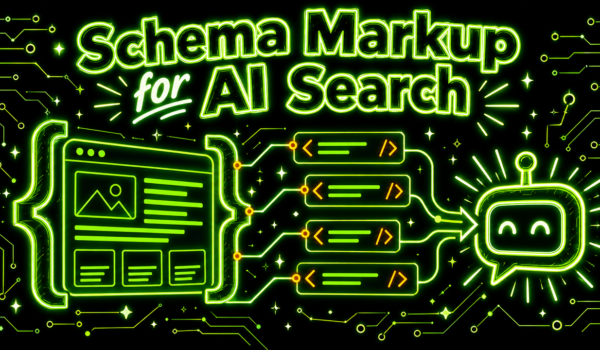
Schema markup is structured data you add to a web page, usually as JSON-LD, to tell machines exactly what the page is about: a business with an address, a product with a price, an article with an author. Schema markup for AI search is about giving AI systems, and the search engines they rely on, clean and unambiguous facts about your brand and content. It will not make an AI assistant cite you on its own. It does remove guesswork about who you are and what you offer, which helps every system that reads your site.
This guide explains how schema markup relates to AI search, which types are worth adding, which ones matter less than people claim, and how to implement and test it.

What schema markup does
A human reading your homepage can tell that “Open Mon to Fri, 9 to 5” refers to opening hours and that the number in the footer is a phone number. Machines have to infer that. Schema markup states it directly using a shared vocabulary from Schema.org, which major search engines support. Google recommends the JSON-LD format, a block of code in the page that does not change what visitors see.
Search engines use schema markup to understand pages and, for some types, to show rich results such as star ratings, prices or event dates. That understanding feeds into their knowledge of entities: your business, your products, your people.
How schema markup relates to AI search
AI search tools find information in two main ways: from what their models learned during training, and from live retrieval of web pages when they answer. Schema markup can help in a few indirect ways:
- Search engines that power AI answers, such as Google for AI Overviews and AI Mode and Bing for Copilot, use structured data to understand pages and entities.
- Clear entity information, like your organization’s name, logo, social profiles and founders, helps systems connect mentions of your brand across the web.
- Product, pricing and review data in a consistent format reduces the chance of wrong details being repeated.
Be careful with bigger claims. Google has said that there is no special schema markup required to appear in its AI features, and that the usual SEO best practices apply. Some AI retrieval systems read page text and may not use structured data at all. So treat schema markup for AI search as a clarity tool that supports good content, not a ranking switch. Our guide to entity SEO explains why clear entities matter for AI.
Schema markup types that help most
Organization
Organization markup describes your company: legal name, logo, URL, contact points and, importantly, sameAs links to your official profiles on other sites. This is the foundation of brand identity in structured data. Put it on your homepage or about page. Of all schema markup types, this one does the most to establish who you are, so complete every field you can, including founding date, address and contact options where they apply.
LocalBusiness
For businesses with a physical location, LocalBusiness markup, or a more specific subtype such as Dentist or Restaurant, adds address, opening hours, phone, geo coordinates and service area. It should match your Google Business Profile and other listings exactly.
Product and Offer
Product markup describes items you sell, with Offer details for price, currency and availability, and AggregateRating or Review data when you show genuine reviews on the page. This helps search engines, and the AI features built on them, describe products accurately.
Article and author information
Article or BlogPosting markup identifies the headline, publish and update dates, and author. Linking authors to Person markup with their credentials and profiles helps systems understand who wrote the content, which supports trust signals.
BreadcrumbList
Breadcrumb markup shows how a page fits into your site structure. It helps search engines understand relationships between pages, such as which category a product belongs to. Most SEO plugins add it automatically once breadcrumbs are enabled in the theme.
SoftwareApplication, Event, VideoObject and others
Use the specific type that fits your content. Software companies can describe applications with operating systems, categories and offers. Event pages can include dates and locations. Pages built around a video can describe it with VideoObject. Specific types carry more meaning than generic ones. Browse the Schema.org type list before you settle on a generic option, since there are specific types for hundreds of businesses and content formats.
Schema markup types that matter less than people claim

FAQPage
FAQ markup was once popular because it produced expandable rich results. Google later limited FAQ rich results to well-known, authoritative government and health websites. You can still use FAQPage markup to describe genuine question-and-answer content, but do not expect visible rich results, and do not add it to pages where the questions are not real.
HowTo
Google deprecated HowTo rich results. The markup is still valid Schema.org vocabulary, but adding it mainly for search features no longer pays off.
Markup that does not match the page
Any schema markup describing content that visitors cannot see, such as fake reviews or ratings, violates search engine guidelines and can lead to penalties. Structured data must reflect what is on the page.
How to implement schema markup
- List your key page types: homepage, about page, product or service pages, articles, location pages.
- Choose the most specific Schema.org type for each.
- Write JSON-LD that matches the visible content exactly, including names, prices and hours.
- Add Organization markup with
sameAslinks to your official profiles. - Use your CMS or SEO plugin where possible. Many SEO plugins generate Organization, Article, Breadcrumb and Product markup automatically, which keeps it consistent as content changes.
- Keep it updated. Stale prices or hours in structured data cause the same problems as stale text.
Example Organization markup
A simple Organization block looks like this, with your own details filled in:
{
  "@context": "https://schema.org",
  "@type": "Organization",
  "name": "Example Co",
  "url": "https://www.example.com",
  "logo": "https://www.example.com/logo.png",
  "sameAs": [
    "https://www.linkedin.com/company/example-co",
    "https://www.youtube.com/@exampleco"
  ]
}
Keep the name identical to the one you use everywhere else, and list only profiles you control.
Structured data by business type
Local businesses
Start with the most specific LocalBusiness subtype available, such as Dentist, Plumber or Restaurant. Include name, address, phone, opening hours, geo coordinates, price range and a link to your main listing profiles. Keep every field identical to your Google Business Profile, Bing Places and Apple Business Connect entries. Mismatches between listings and on-page data create exactly the confusion structured data is meant to remove.
Ecommerce stores
Add Product markup to every product page with name, image, description, brand, SKU or GTIN where you have them, and an Offer with price, currency and availability. Include ratings only when genuine reviews appear on the page. Most ecommerce platforms and plugins generate this automatically, so your main job is to make sure the data is complete and accurate.
Software companies
Use SoftwareApplication on product pages with the application category, operating systems and offers. Add Organization markup with links to your profiles on review platforms, code repositories and social networks. Clear pricing pages in plain text matter as much as any markup, since AI answers often quote pricing.
Publishers and content sites
Article or BlogPosting markup with accurate dates and author details is the priority. Build author pages that describe each writer’s expertise and link to their other profiles, and connect them with Person markup. This helps systems understand who stands behind your content.
Professional services
Combine Organization or a ProfessionalService subtype with Person markup for key experts. Describe services clearly in page text, and link to directory profiles, speaking pages and published work in sameAs where they belong.
Connecting your brand across the web
Much of the value for AI comes from connecting your brand to the rest of the web. The sameAs property lists the official profiles that represent the same organization: social accounts, review platform pages, a Wikipedia or Wikidata entry if one exists, and major directory listings. When those profiles describe you consistently, systems can merge them into one clear picture. When they disagree, systems may treat them as different entities or repeat the wrong details.
Audit those profiles at the same time you add markup. Make the name, description, logo and website URL match everywhere. That work often improves how AI assistants describe a brand more than any single code change. Our guide to LLM visibility explains how consistency shapes AI answers.
What we know about AI systems and structured data
Public information about how AI assistants use structured data is limited, so be wary of confident claims. A few points are reasonably clear. Search engines use structured data, and AI features built on those search engines benefit from the understanding it creates. Knowledge graphs, which feed entity information into many systems, are built partly from structured sources. Some AI retrieval pipelines convert pages to plain text and may ignore markup entirely, which is why the visible text must carry the same facts.
The practical takeaway: add accurate markup because it is cheap and helps search engines, but put most of your effort into clear page content and consistent information across the web.
Common mistakes
- Marking up content that does not appear on the page, such as hidden reviews or prices.
- Using generic types like Thing or WebPage when a specific type exists.
- Letting plugins output duplicate or conflicting blocks, such as two Organization entries with different names.
- Forgetting to update prices, hours or availability in the markup when they change.
- Adding FAQ markup to every page in the hope of rich results that no longer appear for most sites.
- Expecting markup alone to earn citations without strong content and third-party mentions.
A priority order for small teams
- Organization markup on the homepage with sameAs links.
- The specific type for your main pages: LocalBusiness, Product or SoftwareApplication.
- Article markup with authors on blog posts.
- Breadcrumbs across the site.
- Extra types such as Event or VideoObject where they fit real content.
Most of this can be handled by a good SEO plugin plus a short review of its settings. Spend the time you save on writing pages that answer customer questions clearly.
Example LocalBusiness markup
A local business block adds address, hours and contact details. Fill in your own information and keep it identical to your listings:
{
  "@context": "https://schema.org",
  "@type": "Dentist",
  "name": "Example Family Dental",
  "url": "https://www.example.com",
  "telephone": "+1-555-010-0000",
  "address": {
    "@type": "PostalAddress",
    "streetAddress": "100 Main Street",
    "addressLocality": "Springfield",
    "addressRegion": "IL",
    "postalCode": "62701",
    "addressCountry": "US"
  },
  "openingHours": "Mo-Fr 08:00-17:00"
}
Keeping structured data accurate over time
Markup is only useful while it stays true. Assign someone to check it whenever key facts change, such as a new address, new pricing, a rebrand or a product launch. Add a quarterly review to your SEO checklist: run your main templates through a validator, compare the output with the visible page, and confirm that sameAs links still point to active profiles. Sites that change platforms or themes should retest everything, since migrations often drop or duplicate markup without anyone noticing.
Watch Search Console’s enhancement reports for new errors after site updates. A sudden drop in valid items usually means a template changed, and fixing it early prevents months of missing or incorrect data.
Keep a short record of which templates output which schema markup types. When something breaks, that record shows where to look first and saves hours of guesswork.
How to test schema markup

Use Google’s Rich Results Test to see which rich results a page qualifies for and whether there are errors. Use the Schema Markup Validator from Schema.org to check general validity for any type. In Google Search Console, the enhancements reports show structured data issues across your site. Google’s own introduction to structured data explains the guidelines. Test a sample of each page template rather than every page, since schema markup is usually generated by templates and an error in one template repeats across the site.
Schema markup is one part of AI visibility
Structured data helps machines read what you publish. It cannot replace what makes AI tools recommend a brand: clear content that answers buyer questions, consistent facts across the web, and mentions in trusted third-party sources such as reviews, articles and community discussions. Our guides to AI search optimization and AI brand visibility cover the rest of the picture. If you also publish an llms.txt file, our guide on what llms.txt is explains how it differs from schema markup.
Think of structured data as the label on the box. A clear label helps, but people still judge what is inside, and AI systems lean heavily on what others say about the contents. Pair your markup work with a plan to earn reviews, press coverage and genuine community mentions, since those sources carry the most weight in recommendations.
Schema markup FAQ
Does schema markup help with AI search?
It helps search engines and some AI systems understand your brand, products and content more clearly. It does not guarantee citations or rankings on its own.
Which schema markup is most important for AI search?
Organization markup with sameAs links, plus the specific types that match your pages, such as LocalBusiness, Product, Article and BreadcrumbList.
Does Google require schema markup for AI Overviews?
No. Google has said no special markup is needed to appear in its AI features. Standard SEO practices apply.
Is FAQ schema still worth adding?
Only for genuine question-and-answer content. Google now shows FAQ rich results only for a narrow set of authoritative sites.
What format should schema markup use?
Google recommends JSON-LD, added as a script block in the page.
How do I check if my schema markup works?
Use Google’s Rich Results Test, the Schema Markup Validator and the enhancement reports in Google Search Console.
Can structured data fix wrong information in AI answers?
It can help, as part of a wider fix. Correct the visible facts on your site, update your structured data to match, and correct the third-party profiles and listings that AI tools cite. The answers usually change once the sources they read agree.
Do I need a developer to add structured data?
Not always. Many content management systems and SEO plugins generate common types automatically and let you fill in details through settings. A developer helps for custom templates, complex product catalogs or unusual page types.
Is microdata or RDFa still supported?
Search engines still read microdata and RDFa, but JSON-LD is easier to maintain because it sits in one block rather than being woven through the page’s HTML. Most new implementations use JSON-LD.
Should every page have structured data?
Every important page should have the markup that fits its content. Organization data belongs on the homepage, and breadcrumbs help across the site. Thin or utility pages, such as login screens, do not need much.
Want to see where your customers are already asking? Get a free Reddit Opportunity Report showing which Reddit threads already rank for your keywords.