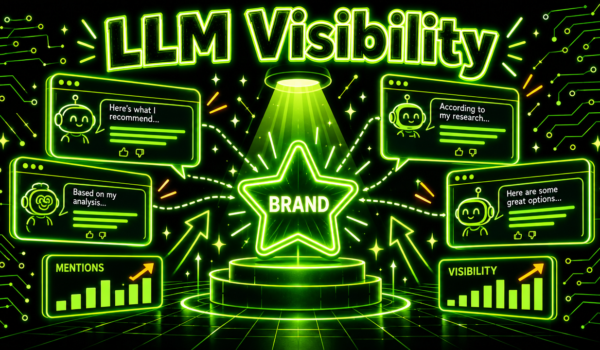
LLM visibility is how often and how favorably your brand shows up in answers from large language models such as ChatGPT, Claude, Gemini, Perplexity and Microsoft Copilot. It covers whether the model mentions you, whether it cites your website, how it describes you, and where you appear in lists of recommendations. As more people ask AI assistants for advice before they buy, LLM visibility has become a marketing metric in its own right, alongside search rankings and social reach.
This guide explains what LLM visibility means, how to measure it, what shapes it, and the practical steps that improve it.

What is LLM visibility?
Traditional search visibility measures how often your pages rank for important queries. LLM visibility measures something similar in AI answers: across the questions your customers ask, how often does an AI model bring up your brand, link to your content, or recommend your product?
It has a few parts:
- Mentions. The model names your brand in its answer.
- Citations. The model links to your website or content as a source.
- Position. Where your brand appears when the answer lists several options.
- Sentiment and accuracy. Whether the description of your brand is positive, neutral or negative, and whether the facts are right.
- Share of voice. How your mentions compare with competitors’ across the same set of questions.
Each part answers a different question for your team. Mentions show awareness, citations show whether your content is trusted as a source, position shows preference, and sentiment shows reputation.
A brand can be cited without being recommended, or recommended without being cited, so it helps to track these parts separately.
Why LLM visibility matters
AI assistants are becoming a starting point for research. People ask them to compare software, suggest restaurants, explain medical terms, plan trips and recommend products. The answer often names a short list of options. If your brand is on that list, you get considered. If not, many buyers never hear of you.
LLM visibility also affects search. Google’s AI Overviews and AI Mode put model-written answers on the results page, and studies show that fewer searches end in a click when those features appear. Our post on zero click search covers that shift. In that environment, being named in the answer matters as much as ranking below it.
How LLMs decide which brands to mention
Language models produce answers from two broad sources:
- Training data. During training, a model learns patterns from a huge amount of text. Brands that are discussed often and consistently in connection with a topic become strongly associated with it.
- Retrieval. Many AI products search the web or a curated index in real time and use the results to ground their answers. Pages that rank in the underlying index and answer the question clearly are more likely to be read and cited.
Both paths reward the same things: a brand that many trusted sources describe clearly, and content that answers specific questions directly. Our guide to AI citations explains how retrieval picks sources.

Example prompts for an LLM visibility study
A good prompt set mirrors how real people ask. The sample below is for an imaginary project management tool, grouped by stage:
| Stage | Example prompt |
|---|---|
| Problem | “How can a small team stop missing deadlines?” |
| Category | “What are the best project management tools for agencies?” |
| Comparison | “Asana vs Trello vs Monday for a 10-person team” |
| Alternatives | “What are cheaper alternatives to Asana?” |
| Brand | “Is [your brand] good for client work?” |
| Purchase | “Which project tool has the best free plan?” |
Write prompts in plain language and vary the wording, since people phrase the same need many ways. Include follow-up style prompts too, because many conversations narrow down over several turns. Your LLM visibility on the final, buying-stage prompts often matters most.
How to measure LLM visibility
Step 1: Build a prompt set
List the questions your customers ask before they buy. Include category questions (“best accounting software for freelancers”), comparison questions (“X vs Y”), problem questions (“how do I stop invoices getting paid late”) and brand questions (“is X good”). Aim for 30 to 100 prompts, grouped by topic and buyer stage.
Step 2: Choose the models to track
Pick the assistants your audience uses. For most brands that means ChatGPT, Google’s AI features, Perplexity, Claude, Gemini and Copilot. Results differ between them, because each uses different training data and retrieval sources.
Step 3: Run the prompts and record results
For each prompt and model, record whether your brand is mentioned, its position, any citations to your site, the competitors named, and the sentiment of the description. Run each prompt more than once, since answers vary between sessions.
Step 4: Calculate the core metrics
| Metric | How to calculate it | What it tells you |
|---|---|---|
| Mention rate | Prompts where you are named / total prompts | Basic presence |
| Citation rate | Prompts where your site is linked / total prompts | Whether your content is used as a source |
| Average position | Average rank when you appear in a list | How prominently you are recommended |
| Share of voice | Your mentions / all brand mentions in the set | Standing against competitors |
| Accuracy score | Share of answers that describe you correctly | Risk of misinformation |
Step 5: Repeat on a schedule
Run the same set monthly. Models and their retrieval systems change often, so trends over several months matter more than any single run.
You can do this by hand with a spreadsheet, or use one of the growing number of AI visibility tools that automate prompts, record answers and chart results. An AI visibility audit is a good way to set your first baseline.
Why AI answers vary, and what that means for tracking
Ask the same question twice and an AI assistant may give two different answers. Models generate text with some randomness, retrieval results shift as the web changes, and products are updated often. Personalization and conversation history can also change what a user sees. That variation is normal, and it is why single screenshots make poor evidence.
To get reliable numbers, run each prompt several times per model, use fresh sessions without history, and look at averages across the whole prompt set. Watch the trend over months instead of reacting to a single change. If a competitor suddenly appears in many answers, check which new sources the AI tools cite. Often a new review, article or popular thread explains the jump.
Accuracy matters as much as presence
Being mentioned is only useful if the description is right. AI tools sometimes repeat outdated pricing, list features you removed, confuse you with a company of a similar name, or describe your product as serving a market you left years ago. Prospects who read those answers may rule you out before they ever visit your site.
When you find errors, trace them to a source. Update your own pages first, then fix outdated profiles and directory listings, and contact publishers of old articles if they carry wrong facts. Make sure the correct information appears clearly on pages AI tools can crawl. Retrieval-based answers often improve within weeks once the sources change.
What improves LLM visibility
Clear, quotable content
Pages that answer a question in the first two or three sentences, use descriptive headings, and present facts in lists and tables are easier for retrieval systems to quote. Long introductions and vague copy get skipped.
Consistent brand facts
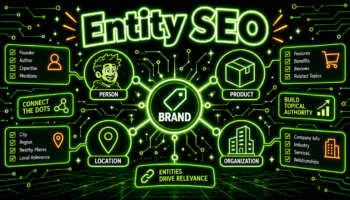
Models describe you more accurately when your name, category, products and key facts are the same across your site, profiles and directories. Structured data helps search systems connect them. Our guide to entity SEO covers this step by step.
Mentions on trusted third-party sources
Reviews, comparison articles, industry publications, podcasts and expert roundups all shape how models associate your brand with a topic. A mention in a respected source can matter even without a link.
Presence in community discussions
AI tools often cite community content when people ask for recommendations, and Reddit is one of the most cited domains in many studies. When real users mention your brand positively in the threads that rank for your category, models are more likely to mention you too.
Crawl access for AI search agents
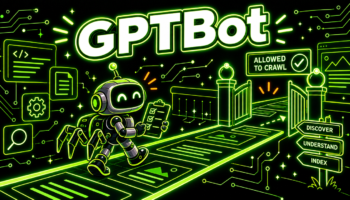
If your robots.txt or firewall blocks the agents that power AI search, your pages cannot be retrieved and cited. Check your rules for agents such as OAI-SearchBot (listed in OpenAI’s crawler documentation) and the search agents from other AI companies. Our guide to GPTBot explains the difference between training and search crawlers.
Fresh, accurate information
For time-sensitive questions, AI search tools favor current pages. Update pricing, features and statistics, and show when a page was last updated.

LLM visibility by business type
B2B software
Buyers ask AI tools to shortlist vendors and compare features. LLM visibility depends heavily on review sites, comparison articles, analyst coverage and community discussions in professional subreddits. Clear pricing and feature pages also help models answer comparison prompts correctly.
Ecommerce and consumer brands
Shoppers ask for product recommendations by use case and budget. Reviews, gift guides, editorial roundups and hobby communities carry the most weight. Product pages with clear specs and prices help retrieval-based answers.
Local businesses
For “near me” and city-specific prompts, AI tools often lean on map data, review platforms and local discussions. A complete business profile, steady reviews and mentions in local communities support LLM visibility for local queries.
Professional services
Law firms, agencies, consultants and clinics benefit from named experts who publish, speak and get quoted. Models associate firms with topics through those appearances.
Who should own LLM visibility?
In most companies, LLM visibility sits between SEO, content, PR and brand. SEO teams understand retrieval and technical access. Content teams write the pages that get cited. PR earns the third-party mentions that shape model associations. Community and social teams influence the discussions AI tools read.
Pick one owner who runs the measurement and reports results, and give them a seat in planning meetings for each of those groups. Without an owner, the work stays scattered and nobody sees the full picture.
Reporting LLM visibility to leadership
Executives want a short answer: are we showing up when buyers ask AI tools, and is it getting better? A simple monthly report covers:
- Mention rate and share of voice across your prompt set, with the trend over the last three to six months.
- The top competitors named in answers and how often.
- Accuracy issues found and fixed.
- The sources AI tools cite most for your category, and whether you appear in them.
- Actions taken last month and planned for next month.
Tie the numbers to outcomes where you can, such as branded search growth, direct traffic, or sales calls where prospects mention an AI assistant.
A 90-day LLM visibility plan
- Weeks 1 to 2: Build a prompt set, run a baseline across five or six AI tools, and list the sources they cite.
- Weeks 3 to 6: Fix accuracy problems on your site and profiles, add structured data, and check crawler access.
- Weeks 4 to 10: Rewrite your most important pages so each section opens with a direct answer. Publish pages for comparison and alternatives prompts where you are missing.
- Weeks 6 to 12: Earn mentions in the sources AI tools cite for your category, including review sites, industry publications and relevant community threads.
- Week 12: Re-run the prompt set and compare with your baseline.
LLM visibility vs SEO
| Aspect | SEO | LLM visibility |
|---|---|---|
| Where you appear | Ranked list of links | Inside a written answer |
| Main measure | Rankings, clicks, traffic | Mentions, citations, share of voice, sentiment |
| Key inputs | Relevance, links, technical health | Entity clarity, third-party mentions, quotable content, retrieval access |
| Stability | Fairly stable day to day | Answers vary between sessions and models |
| Off-site factors | Backlinks | Mentions, reviews and community discussion, with or without links |
Good SEO still helps LLM visibility, because many AI tools retrieve from search indexes. But the off-site side carries more weight: what other people say about you shapes AI answers directly.
Tools for tracking AI mentions
A growing group of tools automate prompt tracking across AI assistants. Established SEO platforms have added AI visibility features, such as Semrush’s AI Visibility Toolkit and Ahrefs’ Brand Radar, and dedicated tools such as Profound, Peec AI, Otterly.ai and Scrunch focus on AI answers specifically. They differ in which assistants they cover, how many prompts they track, how they handle sentiment and citations, and price.
When you compare tools, check:
- Which AI products they query, and whether they use the same interfaces your customers use.
- How often they run prompts and whether they repeat runs to smooth out variation.
- Whether they record citations and the full answer text, not only a yes or no for mentions.
- How easily you can add your own prompts and competitor list.
- Whether they export data for your own reporting.
Many teams start with a spreadsheet for a month to learn which prompts matter, then move to a tool once they know what they want to track.
Common LLM visibility mistakes
- Testing one prompt once and drawing conclusions. Answers vary, so use many prompts and repeat runs.
- Tracking only ChatGPT. Different assistants recommend different brands.
- Ignoring accuracy. A mention with wrong pricing or a discontinued product can cost you sales.
- Focusing only on your own website. Third-party mentions and community discussions often matter more.
- Blocking AI search crawlers by accident with broad robots.txt or firewall rules.
- Expecting fast results. Training data updates slowly, and reputation builds over months.
LLM visibility FAQ
What does LLM visibility mean?
LLM visibility is how often and how favorably your brand appears in answers from large language models like ChatGPT, Claude, Gemini and Perplexity, including mentions, citations, position and sentiment.
How do I check my LLM visibility?
Build a list of customer questions, run them across the AI tools your audience uses, and record mentions, citations, position and sentiment. Repeat monthly, by hand or with an AI visibility tool.
Is LLM visibility the same as AI visibility?
The terms are used almost interchangeably. AI visibility sometimes also covers features like Google’s AI Overviews, which are powered by language models.
How long does it take to improve LLM visibility?
Retrieval-based answers can change within weeks of new content or mentions appearing. Changes that depend on model training take longer, often months.
Does Reddit help LLM visibility?
It can. Many AI tools cite Reddit threads for recommendation questions, so positive, genuine discussions about your brand in relevant communities can raise your mentions.
What is a good LLM visibility score?
There is no universal benchmark. Compare yourself with direct competitors on the same prompt set. Being named in a majority of category prompts, near the top of lists, with accurate descriptions, is a strong position in most markets.
Can I pay to appear in LLM answers?
Some AI products have introduced or tested ads, which are labeled separately from answers. Organic mentions in the answer itself cannot be bought directly and depend on the signals described in this guide.
Want to see where your customers are already asking? Get a free Reddit Opportunity Report showing which Reddit threads already rank for your keywords.