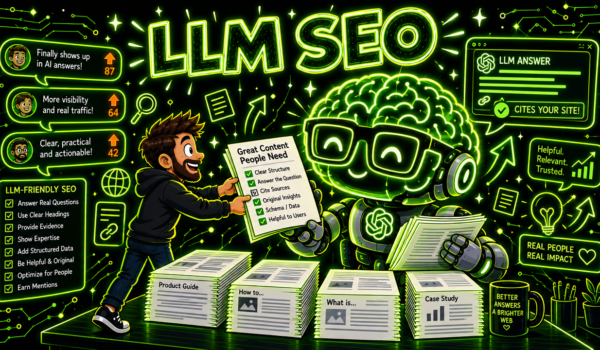
LLM SEO is the practice of making your website and brand easy for large language models such as ChatGPT, Claude and Gemini to find, understand and mention. It covers on-page work like answer-first sections, technical work like letting AI crawlers read your pages, and off-site work like being discussed accurately on Reddit, review sites and the other sources these models draw on.
This guide explains what LLM SEO is, how large language models use web content, how LLM SEO differs from traditional SEO, and eight practical ways to optimize across those three layers. It ends with how to track LLM visibility and the mistakes that most often keep good sites out of AI answers.

What is LLM SEO?
LLM SEO is search optimization aimed at large language models (LLMs), the AI systems behind tools like ChatGPT, Claude, Gemini, Microsoft Copilot and Perplexity. The goal is for these tools to describe your business accurately and recommend it when people ask relevant questions.
The same work also goes by LLM optimization (LLMO), generative engine optimization (GEO), answer engine optimization (AEO) and AI search optimization. Technical teams and in-house marketers often prefer “LLM SEO” because it names the system being optimized for. Our comparison of SEO vs GEO vs AEO explains how the labels relate.
How do large language models use web content?
Large language models use web content in two ways: through training and through live retrieval. Both matter for LLM SEO, and they call for slightly different work.
Training. Models learn from very large collections of text gathered before a cut-off date. What the web said about your business then can shape how the model describes you when it answers without searching. Crawlers such as OpenAI’s GPTBot collect training data; site owners can allow or block them.
Live retrieval. For questions about products, services, prices or anything recent, most AI tools search the web at the moment of the question, pull relevant passages and write an answer from them. This is often called retrieval-augmented generation (RAG). Search crawlers such as OpenAI’s OAI-SearchBot feed this step. OpenAI documents each of its crawlers on its crawler overview page.
Retrieval is where most businesses can make a difference quickly, because changes to your pages and your reputation can show up as soon as the tools recrawl. Training influence builds slowly as the web’s description of you improves. Our explainer on generative engine optimization walks through the retrieval process step by step.
LLM SEO vs traditional SEO
LLM SEO keeps the foundations of traditional SEO and changes the target. Traditional SEO aims for a ranked link and a click. LLM SEO aims for a mention or citation inside a written answer.
| Traditional SEO | LLM SEO | |
|---|---|---|
| Target | Search engine rankings | Mentions and citations in AI answers |
| Unit that wins | A whole page | A passage, plus what other sources say about you |
| Query style | Keywords | Full questions with context |
| Key signals | Relevance, links, technical health | Clear passages, consistent entity facts, mentions across the web, crawler access |
| Measure | Rankings, clicks, traffic | Mention rate, accuracy, cited sources, AI referrals |
Google confirms the overlap in its guidance on AI features: there are no extra requirements to appear in AI Overviews or AI Mode beyond normal SEO best practices. Strong SEO is the base layer of LLM SEO.
8 ways to optimize for LLMs
LLM SEO work falls into three layers. On-page work makes your content easy to quote. Technical work makes sure models can reach and read it. Off-site work shapes what the rest of the web says about you.

On-page LLM SEO
1. Put summaries and direct answers at the top. Start each page with a complete answer to its main question in 40 to 60 words. Retrieval systems work with passages, and a clear opening passage is the easiest one to pick. A short key-points list near the top helps too.
2. Use question headings with short answers. Phrase H2 and H3 headings the way people ask questions, and answer each in the first sentence underneath. Keep every section self-contained, since a model may quote one section without the rest.
3. State clear facts, numbers and sources. Replace vague claims with specifics: dimensions, prices, timeframes, named methods. Link credible sources and date any statistic. The academic GEO research found that adding citations, quotations and statistics improved visibility in generative answers, while keyword stuffing did not.
Technical LLM SEO
4. Let AI crawlers in. Check robots.txt for rules that block AI search crawlers. A common setup is to allow search crawlers (such as OAI-SearchBot) so you can be cited, and decide separately whether to allow training crawlers (such as GPTBot). Then check your CDN and firewall: some providers, including Cloudflare, offer AI bot blocking settings, described in their bot documentation, which can block crawlers you want to let through.
5. Serve clean, server-rendered HTML. Many crawlers do not run JavaScript the way a browser does. If your text only appears after scripts load, some AI crawlers will see an empty page. Server-side rendering or static HTML for important content avoids that. Check by viewing the raw page source: if the main text is not there, a simple crawler will not see it either.
6. Add structured data. JSON-LD structured data labels your organisation, products, prices, reviews, articles and FAQs in a format machines read reliably. Google’s structured data guide covers the main types. It is not required for AI features, but it reduces the chance of your facts being misread. Mark up only what is visible on the page.
Off-site LLM SEO
7. Keep your entity information consistent. To an LLM, your business is an entity: a name linked to a set of facts. Make those facts match everywhere: website, Google Business Profile, Bing Places, LinkedIn, Crunchbase or industry directories, app stores and marketplaces. Inconsistent names, descriptions or addresses make models less confident about who you are.
8. Earn mentions in communities, reviews and references. LLMs weigh what independent sources say. Reviews on the platforms your buyers use, comparison articles, podcasts, documentation and community threads all shape the picture. For software brands, public documentation and active GitHub or developer community presence add weight. Our guide to AI citations shows which kinds of sources AI tools cite most.
An LLM SEO example: rewriting a passage models can quote
A worked example shows how the on-page layer changes a real paragraph. Take a payroll software company with this line on its pricing page:
Before: “Flexible, affordable plans that scale with your business. Contact us to learn more about our competitive pricing.”
A model answering “how much does payroll software cost for a 10-person company?” cannot use any of that. There is no number, no plan name and no condition.
After: “Payroll for a 10-person company costs $60 a month on our Starter plan: a $40 base fee plus $2 per employee. It includes automatic tax filings in all 50 states and next-day direct deposit. Teams over 50 people move to the Growth plan, priced per employee.”
The second version answers the question in the first sentence, gives specific figures and conditions, and stands on its own if quoted. It is also what a human buyer wants to know. Most LLM SEO rewrites look like this: less adjective, more fact.
LLM SEO for different kinds of site
The three layers apply everywhere, but the weight shifts with the business.
Software and SaaS. Buyers ask models for shortlists and alternatives. Public documentation, clear pricing pages, fair comparison pages, review platform profiles and developer community activity carry the most weight. Keep docs crawlable and avoid putting key product facts behind a login.
Ecommerce. Product questions pull from product pages, specifications, reviews and comparison articles. Complete specifications in the page HTML, product structured data and consistent details across marketplaces matter most.
Local services. Local questions lean on Google Business Profile, Bing Places, review sites, local directories and local community threads. Accurate hours, service areas and steady reviews that mention specific services do the heavy lifting.
Publishers and content sites. Models cite pages that answer specific questions with sourced facts. Clear authorship, dated updates, original data and self-contained sections help most.
LLM SEO technical checklist
Use this table for a quick technical review of any site:
| Check | How to test | What good looks like |
|---|---|---|
| robots.txt | Open yoursite.com/robots.txt | AI search crawlers allowed; training crawlers set by deliberate choice |
| CDN and firewall | Check bot and AI crawler settings in your provider’s dashboard | No blanket block on the crawlers you want |
| Rendering | View page source and search for your main text | Key content present in the HTML without running scripts |
| Indexing | Google Search Console and Bing Webmaster Tools | Important pages indexed in both |
| Structured data | Google’s Rich Results Test | Organization, product or article markup valid and matching the page |
| Speed and access | Load the page logged out on a phone | Text visible quickly, no login or pop-up wall over the content |
| Entity facts | Compare your top five listings side by side | Same name, description, address and contact details everywhere |
How do Reddit and community mentions help LLM visibility?
Reddit and community mentions help LLM visibility because large language models read discussion threads both in training and when they search for recommendations. Threads where real users compare options, describe problems and share outcomes are the kind of first-hand material models use when someone asks “what’s the best tool for X?”
The share of AI citations that go to Reddit varies by tool and shifts over time. Our post Does ChatGPT use Reddit? collects the studies with their dates. Threads also rank in Google for many buying questions, which our Reddit SEO guide covers.
For LLM SEO, the aim is accurate, helpful presence. Take part as a real person in the communities your buyers use, answer questions you know well and disclose your connection whenever your business comes up. Our guide on how to mention your brand on Reddit shows how to do that without sounding like an ad.

How do you track LLM visibility?
You track LLM visibility with a fixed set of prompts run on a schedule, plus a few numbers from analytics.
- Prompt set. Write 20 to 50 questions your customers ask. Run them monthly in ChatGPT, Claude, Gemini, Perplexity and Google. Record whether you are named, how you are described and which sources are cited.
- AI referral traffic. In analytics, look for referrals from sources such as chatgpt.com, perplexity.ai, gemini.google.com and copilot.microsoft.com.
- Crawler activity. Server logs show visits from AI crawlers by user agent. A sudden drop can point to an accidental block.
- Tracking tools. AI visibility tools automate the prompt runs and chart mention share over time. They are useful at scale but measure the same things you can check by hand.
Our AI visibility audit guide includes a template for the manual version.
Common LLM SEO mistakes
These mistakes keep otherwise strong sites out of AI answers:
- Blocking AI crawlers by accident. An old robots.txt rule or a CDN setting switched on for security can stop search crawlers reaching your pages.
- Content that only exists after JavaScript runs. If crawlers see an empty shell, they cannot quote you.
- Inconsistent business facts. Different names, descriptions or addresses across listings confuse models about which entity is which.
- Vague marketing copy. Pages full of claims like “industry-leading” give models nothing specific to use.
- Ignoring the rest of the web. A perfect site with no reviews, mentions or discussions gives LLMs little reason to recommend you.
- Chasing guarantees. No one controls what a model says. Anyone promising a fixed placement is overselling, as we explain in how to rank in ChatGPT.
Should you write separate pages for LLMs?
No. Separate “AI versions” of pages, hidden text for bots or pages written only for models add work and risk without a clear benefit. Search engines treat content shown to crawlers but not to people as cloaking, and the same pages that help readers are the ones models quote.
The better approach is to improve the pages you already have. Put the answer first, add the specifics, link the sources and keep the facts consistent. Where you are missing a page that answers a common customer question, write it for the customer. One good page serves search engines, LLMs and buyers at once.
The same goes for formats. You do not need a special file, a chatbot widget or a separate AI sitemap to be cited. Proposed files such as llms.txt are optional extras that major providers have not said they rely on. Crawler access, readable HTML and strong content come first.
Where should you start with LLM SEO?
Start with the technical checks, because nothing else works if models cannot read your site. Then rewrite your five most important pages answer-first. Then spend a little time each week on off-site mentions. For a full ten-step plan written for non-technical teams, see our guide to AI search optimization.
LLM SEO: frequently asked questions
How do I optimise for LLMs?
Make your pages easy to quote with answer-first sections and question headings, let AI search crawlers reach your site, serve your content as clean HTML, keep business facts consistent across the web and earn mentions in reviews and communities.
Is there SEO for LLMs?
Yes. LLM SEO, also called LLM optimization or GEO, is the work of getting large language models to find, understand and mention your business. It builds on traditional SEO.
What is the difference between a search engine and an LLM?
A search engine finds and ranks existing pages. An LLM generates new text. AI search tools combine the two: they search the web, then use an LLM to write an answer from what they found.
Is LLM SEO the same as GEO?
Mostly. LLM SEO, GEO, AEO and AI search optimization describe the same goal. “LLM SEO” names the system being optimized for; “GEO” comes from academic research on generative engines.
Does robots.txt affect LLM visibility?
Yes. If robots.txt blocks an AI tool’s search crawler, that tool cannot read your pages when answering questions. Blocking training crawlers only affects future training data, so many sites allow search crawlers and decide on training crawlers separately.
Should I block GPTBot?
That is a business decision. Blocking GPTBot keeps your content out of OpenAI’s future training data but does not stop ChatGPT search from citing you, which uses OAI-SearchBot. If visibility in AI answers matters to you, keep the search crawler allowed whatever you decide about training.
How long does LLM SEO take to work?
Technical fixes and page rewrites can show up in AI answers within weeks of being recrawled. Off-site mentions and reputation build over months. Track a fixed prompt set monthly to see the trend.
Can agencies use LLM audits for SEO?
Yes. An LLM audit runs a set of customer questions through the main AI tools, records how a business is described and which sources are cited, and turns the gaps into on-page, technical and off-site fixes.
Want to see where your customers are already asking? Get a free Reddit Opportunity Report showing which Reddit threads already rank for your keywords.