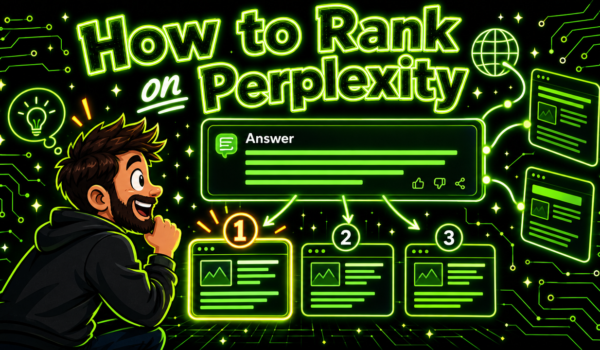
To rank on Perplexity, your page has to be reachable by Perplexity’s crawler, show up in the searches Perplexity runs for a question, and answer that question more clearly than the other sources it finds. Perplexity cites the pages it used with numbered links, so pages with direct answers, clear structure, sourced facts and a trusted reputation, including on sites like Reddit and YouTube, are the ones it picks.
Perplexity is an answer engine: you ask a question, it searches the web, reads several pages and writes a short answer with numbered sources. Those sources sit right next to the answer, which makes a Perplexity citation more visible and more clickable than a link buried in a chat reply. This guide explains how to rank on Perplexity: how it picks sources, which crawler to allow, seven ways to get cited, and how to check whether it is working.

How does Perplexity choose its sources?
Every Perplexity answer follows the same basic loop, and each tactic later in this guide ties back to one of its stages.
- Search. Perplexity turns the question into one or more searches and gathers candidate pages.
- Read. It fetches and reads the most promising pages.
- Rank. It decides which passages best support an answer, weighing relevance, clarity and how much it trusts each source.
- Write and cite. It writes the answer and attaches numbered citations to the pages it used.
Perplexity runs its own crawler and index, and it also draws on other search results. It does not publish its ranking formula. Outside researchers have studied its behaviour and reported things like reranking of results and a preference for well-known domains on some topics. Treat those findings as useful clues rather than rules, because Perplexity can change its system at any time and has not confirmed the details.
What is not in doubt is the shape of the problem. To rank on Perplexity you need to pass all four stages: be findable in the search, readable when fetched, the best passage when ranked, and a source it trusts enough to cite.
Let Perplexity’s crawlers reach your site
The first step in how to rank on Perplexity is technical: its bots have to be able to fetch your pages. Perplexity documents its bots on its crawlers page. There are two to know about:
| Crawler | What it does | If you block it |
|---|---|---|
| PerplexityBot | Crawls pages so they can be found and linked in Perplexity’s search results. Perplexity says it is not used to train foundation models. | Your pages are less likely to appear as sources in Perplexity answers |
| Perplexity-User | Visits a page when a user’s question needs it, acting on that person’s behalf | Perplexity may be unable to open your page when a user asks about it |
Perplexity’s page also explains how each bot treats robots.txt; read it before writing rules, because user-triggered fetches can be handled differently from automatic crawling. For most businesses that want to rank on Perplexity, the simple answer is to allow PerplexityBot:
User-agent: PerplexityBot
Allow: /
Then check your CDN and firewall. Some bot-management settings block AI crawlers before robots.txt is even read. Search your logs for “PerplexityBot” and confirm the requests get a normal response, not a block page.
Finally, make sure your main content is in the page HTML. If the text only appears after JavaScript runs, a crawler may fetch your page and find nothing to quote.
How to rank on Perplexity: 7 ways to get cited
With access sorted, how to rank on Perplexity comes down to winning the search, read and rank stages. These seven steps are in rough order of how often they make the difference.
1. Answer the question in the first two sentences
Perplexity is looking for the passage that answers a question. Put that answer at the top of the page and at the top of each section, then expand. We see this often in client audits: the cited page is rarely the longest, it is the one that answers first. A page that opens with a story or a sales pitch makes Perplexity work harder, and a competitor’s page that gets to the point will be picked instead.
2. Use question headings that match how people ask
People ask Perplexity full questions: “how much does a commercial roof inspection cost”, not “roof inspection pricing”. Phrase your headings the same way and answer each one in the sentence that follows. That gives Perplexity clean passages to match against the searches it runs.
3. Back claims with named, dated sources
Perplexity shows its sources to the reader, so it favours pages that look reliable. Give every number a source and a date, link to the original study or official page, and say who wrote the page and why they know. Research on generative engines, including the GEO paper from Princeton and other universities, found that adding citations, quotations and statistics made content more likely to be used in AI answers.
4. Use lists and tables for comparisons
Comparison questions are some of the most common on Perplexity: X vs Y, best tools for Z, options for a budget. A table with clear column headers lets Perplexity read the facts without guessing. Numbered steps do the same for how-to questions.
5. Keep pages current and show the update date
Perplexity answers many questions about the current state of things, so stale pages lose out. Review key pages on a schedule, update facts that change, and show a visible “last updated” date. Do not change the date without changing the content; readers notice, and it does nothing for accuracy.
6. Build traditional SEO strength
Because Perplexity starts with search results, pages that already rank well in regular search have an advantage when you are working out how to rank on Perplexity. Several studies by SEO tool companies report substantial overlap between the pages Perplexity cites and the top results in Google, though the exact figures vary by sample and date. Links from respected sites, a clean technical setup and good content all help in both places.
7. Be present where Perplexity looks: Reddit, YouTube and review sites
Perplexity often cites sources beyond business websites, including Reddit threads, YouTube videos, review platforms and industry forums. If buyers in your category discuss options in those places, those discussions can become Perplexity’s sources. Your own site is one voice; what customers and reviewers say elsewhere is what Perplexity leans on for recommendation questions.

Why Perplexity cites Reddit and YouTube
When a question asks for an opinion or a recommendation, Perplexity needs sources that show real experience. Reddit threads, where people compare products and share what worked, fit that need. So do YouTube reviews and walkthroughs. Both also rank well in regular search for many questions, which puts them in the pool of pages Perplexity reads.
Searching Google for how to rank on Perplexity even turns up a Reddit thread on the first page, and “how to rank on perplexity reddit” appears among the related searches. People go to forums for the same reason Perplexity does: to hear from someone who has done it.
For a business, that suggests a practical plan:
- Find the Reddit threads that rank for your category’s questions. Our guide to finding Reddit threads already ranking shows how.
- Read what they say about you and your competitors. That is the material Perplexity may summarise.
- Take part openly: answer questions in your area, disclose who you work for, and follow each subreddit’s rules. Our Reddit SEO guide covers how.
- If you make video, answer common buyer questions in short, clearly titled YouTube videos with accurate descriptions.
Perplexity ranking factors: what is known and what is guessed
You will find lists online that assign exact percentages to Perplexity ranking factors. Perplexity has not published any such weights, so treat precise numbers with caution. This table separates what is documented from what is inferred.
| Factor | Evidence | Source |
|---|---|---|
| Crawler access | Documented: PerplexityBot surfaces pages in results | Perplexity’s crawler documentation |
| Relevance of the passage to the question | Core to how any answer engine works | Perplexity’s own description of how it answers |
| Citations, quotes and statistics on the page | Shown to raise visibility in generative engines in academic tests | GEO paper (Aggarwal et al., KDD 2024) |
| Strength in regular search | Reported overlap with top Google results in several industry studies | Third-party studies; figures vary |
| Domain trust and reranking | Reported by outside researchers studying Perplexity’s behaviour | Independent research; not confirmed by Perplexity |
| Freshness | Inferred from how often Perplexity cites recently updated pages | Practitioner observation |
The practical lesson for anyone working out how to rank on Perplexity: focus on the factors you can control and verify (access, clarity, sourcing, regular SEO). Skip the weightings someone guessed.
How to rank on Perplexity for different kinds of questions
The same seven steps apply everywhere, but each type of question rewards a different page.
Definition and how-to questions
A clear explainer or step-by-step guide wins these. Open with the definition or the first step, number the steps, and add a short FAQ for the follow-ups.
Comparison and “best” questions
These lean on comparison pages, reviews and community threads. Publish an honest comparison of your product against the alternatives buyers consider, with a table, and make sure third-party reviews and discussions describe you accurately.
Local and service questions
Perplexity pulls from business listings, review sites and local pages. Keep your name, address, services and hours consistent everywhere, and publish pages that answer cost and timing questions for the areas you serve.
How is ranking on Perplexity different from ranking on Google?
Google shows a list and lets the reader choose. Perplexity reads the list for the reader and picks a handful of sources to cite. That changes what winning looks like. On Google, position one takes most of the clicks. On Perplexity, being one of four or five cited sources is the goal, and you can be cited from a page that sits lower in regular search if it has the clearest passage for one part of the answer.
It also changes what you measure. A Google ranking is a position you can track daily. A Perplexity citation depends on how the question is phrased, so the same page can be cited for one wording and missed for another. That is why a fixed prompt set, run the same way each month, is the most useful way to see whether your work on how to rank on Perplexity is paying off.
How to rank on Perplexity as a small business
Small sites can win on Perplexity, often more easily than on Google. Perplexity is looking for the best passage, not the biggest brand, and many questions have no strong answer yet. Three habits help most:
- Pick narrow questions. “How long does a septic inspection take in New Hampshire” is easier to own than “septic services”.
- Write from experience. Real numbers, real timelines and real mistakes you have seen give Perplexity something other pages lack.
- Get mentioned locally and in your niche. A few accurate mentions in local news, trade sites and community threads go a long way.
When we run category prompts for small businesses, the ones that get cited usually have one or two pages that answer a specific buyer question better than anyone else, plus some presence in the discussions around their category.
A page structure that tends to get cited
If you want a starting template for a page aimed at Perplexity, this structure works for most informational and comparison questions:
- A title that states the question.
- Two or three sentences that answer it on their own.
- A short section on what the answer depends on.
- Steps, options or a comparison table, with sources for any numbers.
- Follow-up questions under their own headings, each answered in the first sentence.
- Who wrote it and when it was last checked.
None of this is a trick. It is the shape of a page that respects a reader’s time, which happens to be the shape Perplexity finds easiest to cite.
How to check whether Perplexity cites you
Results show up unevenly, so measure the same way each month. Tracking is the part of how to rank on Perplexity that most businesses skip, and without it you cannot tell which changes helped.
- Write ten to twenty questions your buyers ask, covering definitions, comparisons and recommendations in your category.
- Run each one in Perplexity and record which sources are cited, whether you are among them and how you are described.
- Note the source types: Reddit, YouTube, review sites, competitors’ pages, publishers.
- Check your analytics for referral traffic from perplexity.ai.
- Repeat monthly and compare.
The sources Perplexity cites for your competitors are your to-do list. Our AI visibility audit has a template for tracking this across Perplexity, ChatGPT and Google, and AI citations explains how assistants choose what to cite.
Common mistakes when trying to rank on Perplexity
- Blocking PerplexityBot without meaning to. A blanket AI-bot block in a CDN removes you from the pool.
- Pages that need JavaScript to show text. The crawler may see an empty page.
- Thin pages built only for AI. Pages stuffed with questions and short answers but no substance rarely win against a real guide.
- Ignoring off-site sources. For recommendation questions, what others say about you matters more than what you say.
- Trusting made-up ranking factor percentages. They make a tidy slide and a poor plan.
Learning how to rank on Perplexity mostly means doing good SEO and answer-first writing, plus paying attention to the communities your buyers trust. For the wider picture across AI tools, see our guides to generative engine optimization, ChatGPT SEO and Claude SEO.

Frequently asked questions
How does Perplexity choose sources?
It searches for the question, reads the most promising pages, picks the passages that best support an answer and cites them with numbered links. Relevance, clarity, sourcing and how much it trusts a site all play a part.
What is PerplexityBot?
PerplexityBot is Perplexity’s crawler for finding and linking pages in its search results. Perplexity says it is not used to train foundation models. Allow it in robots.txt and your CDN if you want to be cited.
Does Perplexity use Google results?
Perplexity has its own crawler and index and also draws on other search results. It does not publish the full details. Industry studies report a large overlap between Perplexity’s citations and Google’s top results, so strong regular SEO helps.
How do I get my website cited by Perplexity?
Allow PerplexityBot, answer questions in your first sentences, use question headings, back claims with sources, keep pages current and build a reputation on review sites and in communities.
Is learning how to rank on Perplexity worth it for a small site?
Usually, yes. Most of the work also improves your Google rankings and your visibility in ChatGPT, and Perplexity shows its sources so prominently that even a few citations can send interested visitors.
Does Reddit help you rank on Perplexity?
Reddit threads are often among the sources Perplexity cites for recommendation questions. Being described accurately in those threads, and taking part openly, can help your brand appear in Perplexity answers.
How do I track traffic from Perplexity?
In your analytics, look for referral traffic from perplexity.ai. Pair that with a monthly prompt check so you can see citations even when people do not click.
Is there a Perplexity equivalent of Search Console?
No. Perplexity does not offer site owners a dashboard of impressions or citations. Use referral traffic from perplexity.ai in your analytics and a monthly prompt check to see how you are doing.
How long does it take to rank on Perplexity?
Access fixes and page rewrites can show up once Perplexity recrawls your pages, often within weeks. Building a reputation on other sites takes months.
Want to see where your customers are already asking? Get a free Reddit Opportunity Report showing which Reddit threads already rank for your keywords.