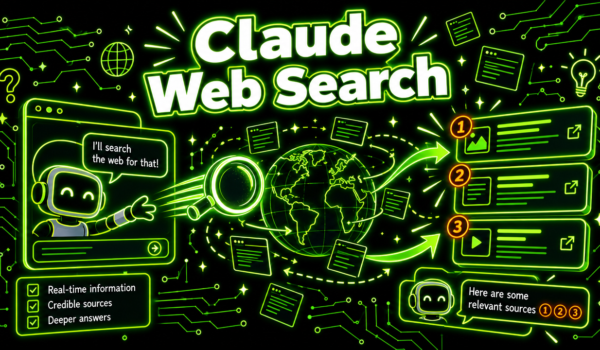
Claude web search lets Anthropic’s Claude look up current information on the internet while it answers you. When a question needs fresh facts, Claude writes search queries, reads the results, and replies with inline citations that link to its sources. Independent tests and public records point to Brave Search as the main index behind those results, which matters if you want your own site to show up in Claude’s answers.
This guide explains how Claude web search works, how to turn it on, how Claude picks and cites sources, how it compares with ChatGPT and Perplexity, and what publishers and brands can do to get cited.

What is Claude web search?
For its first years, Claude answered only from training data, which meant it could not know about events after its knowledge cutoff. Anthropic added web search to the Claude apps in March 2025, starting with paid users in the US, and expanded it to more plans and countries afterward. Developers can also give Claude a web search tool through the Claude API.
With Claude web search turned on, Claude decides for itself when a question needs current information. Ask about a recent product launch, a price, a law that may have changed, or today’s news, and Claude searches. Ask it to explain a stable concept, and it may answer without searching.
How Claude web search works
The process runs in a few steps:
- Claude reads your question and decides whether it needs fresh information.
- It writes one or more search queries, often short and specific.
- A search provider returns a list of results with titles, URLs and snippets.
- Claude reads the most relevant results, and can fetch full pages when it needs more detail.
- It may run more searches to fill gaps or check a claim.
- It writes an answer with citations attached to the claims that came from sources.
Anthropic’s own help pages describe the user-facing side: you see an indicator while Claude searches, and every answer that uses the web includes citations you can click to check.
When Claude web search kicks in
Claude does not search for every message. It tends to run Claude web search for:
- News and recent events.
- Prices, product specs and availability.
- Questions about who currently holds a role or runs a company.
- Laws, policies and rules that change.
- Software versions, libraries and documentation.
- Niche topics or names it does not recognize.
- Requests where you share a URL or ask it to look something up.
It usually skips search for stable knowledge such as definitions, history, math or writing tasks. If you want Claude to check the web anyway, say so in your message: “search the web for the latest figures” works.
Claude web search and Research mode
Claude also offers a deeper Research feature for bigger questions. Instead of a few searches, it runs many searches in sequence, reads more sources, and returns a longer report with citations. It takes longer and suits tasks such as market scans, competitor reviews and literature summaries. The basic Claude web search feature is faster and fits everyday questions.
For brands, Research mode raises the stakes. A buyer who asks Claude to compare vendors in your category may get a report built from dozens of sources. If your site, reviews and community mentions are missing from those sources, you are missing from the report.
Which search engine does Claude use?
Anthropic has not published a full technical description, but the evidence points to Brave Search for web results. In March 2025, Brave Search appeared on Anthropic’s list of subprocessors. Developer Simon Willison found a parameter named “BraveSearchParams” in Claude’s search function and matching citations between Claude and Brave, which TechCrunch reported at the time.
Later studies by SEO researchers compared Claude’s sources with Brave’s and Google’s top results across many queries. They found that most of Claude’s sources appeared in Brave’s top 10, with much lower overlap with Google’s. That gap matters, because Brave runs its own independent index and ranks pages differently from Google and Bing.
For comparison, ChatGPT search has long worked with Bing as a search partner, and Perplexity runs its own retrieval system. Each answer engine sees a different slice of the web.
How to turn on Claude web search
In the Claude app on web, desktop or mobile:
- Open a chat.
- Open the tools or settings menu near the message box.
- Turn on Web search.
- Ask your question. Claude will search when it decides current information would help.
If you do not see the option, check that your plan and region support it, and that an admin has not turned it off for your organization. The Claude help center has current instructions, since menu names change between app versions.
For developers, the Claude API offers a web search tool you add to a request. You can limit which domains Claude may use, block others, and set how many searches it may run per request. Citations are always returned with search-based answers.
How Claude web search picks and cites sources
Claude does not cite every page it reads. It tends to cite pages that:
- Rank near the top of the underlying search results for its query.
- Answer the specific question directly, often in a short passage.
- Come from sources that look authoritative for the topic, such as official sites, documentation and established publications.
- Are current enough for the question.
- Can be fetched and read without login walls or heavy scripts.
Because Claude writes its own queries, the wording of those queries matters. Claude often searches with short, specific phrases, so pages that rank in Brave for concise versions of common questions have an advantage.
Claude web search vs ChatGPT search vs Perplexity
| Feature | Claude web search | ChatGPT search | Perplexity |
|---|---|---|---|
| Main index | Evidence points to Brave Search | Bing partnership plus other sources | Own retrieval and index |
| When it searches | Claude decides, or when asked | Model decides, or when asked | Searches for most queries |
| Citations | Inline, on claims drawn from sources | Inline and source list | Numbered inline citations |
| Page fetching | Can read full pages | Can read full pages | Reads full pages |
| Developer access | Web search tool in the API | Search in the API | Sonar API |
If you optimize for one engine only, you miss the others. Our guides on how to rank on Perplexity and where ChatGPT gets its information cover the differences.
How to get your site cited by Claude web search
1. Make sure Brave can find and index your pages
Search your site in Brave Search for your key pages and topics. If important pages are missing, check that they are crawlable, linked internally and listed in your sitemap. Pages that Googlebot cannot crawl generally will not do well with Brave’s crawler either.
2. Allow Anthropic’s crawlers you want
Anthropic documents separate user agents for different jobs: one for collecting training data, one for fetching pages when a user asks Claude to, and one for search indexing. Check your robots.txt so you are not blocking the agents that power search and user requests if you want to appear in Claude’s answers. Blocking the training crawler is a separate choice from blocking search.
3. Answer questions directly
Put a clear two to three sentence answer under each question heading. Claude cites passages that answer the question, and it skips long introductions.
4. Keep pages current
Claude searches most often for time-sensitive questions. Update statistics, prices and product details, and show a last-updated date.
5. Earn mentions on sources Claude already cites
For recommendation queries, Claude often cites review sites, community discussions and well-known publications. Being mentioned positively in those sources, including Reddit threads that rank, helps you appear in answers even when your own page is not cited.
6. Avoid blocking with scripts and walls
Pages that render content only with heavy JavaScript, hide it behind logins, or show aggressive interstitials are harder for any AI crawler to read.
Our full guide to Claude SEO goes deeper into each of these steps.

How to check whether Claude cites you
- List 20 to 30 questions your customers ask, including comparisons and “best” questions.
- Ask them in Claude with web search turned on.
- Record which sources Claude cites and whether your brand is mentioned.
- Run the same questions in Brave Search and note where your pages rank.
- Repeat monthly and track changes.
Use a fresh chat for each question so earlier answers do not shape later ones, and test both short and detailed phrasings, since people ask the same thing in different ways.
Answers vary between runs, so look at patterns across many questions rather than a single response. Our post on AI citations explains how to track this across several engines.
Claude web search for businesses and teams
Teams use Claude web search in a few common ways. Sales teams research prospects and recent company news before calls. Marketers check competitor launches, pricing pages and reviews. Analysts pull current figures into reports and ask Claude to cite each one. Support teams look up the latest documentation for third-party tools.
Organization admins on business plans can usually control whether web search is available to their members. Some companies turn it off for compliance reasons, while others leave it on and train staff to check citations. If you manage a team, decide on a policy and share it, so people know when web answers are acceptable for work.
For brands, this usage matters too. Buyers and analysts at other companies may ask Claude about your product, your pricing or your reviews. Whatever Claude finds through its search is what they read.
Claude web search and Reddit
For recommendation and comparison questions, community discussions are a common source type in many answer engines, and Reddit threads often rank well in search indexes. When Claude searches for “best [product] for [use]”, it may read threads where real users compare options. That gives brands one more reason to take part openly in the communities where their customers talk, and to fix the problems people raise there.
A simple Claude web search visibility checklist
- Your key pages appear in Brave Search for your main topics.
- Your robots.txt allows the Anthropic agents you want to permit.
- Each important page opens with a direct answer to its main question.
- Facts, prices and dates are current and clearly labeled.
- Your brand is mentioned on trusted review sites and community threads.
- You check a set of customer questions in Claude every month.
Tips for getting better answers from Claude web search
If you use Claude for research, a few habits improve results:
- Be specific about time. “As of this month” or “in the last year” pushes Claude to look for fresh sources.
- Name the sources you trust. Asking Claude to prioritize official documentation or peer-reviewed studies changes which pages it reads.
- Ask for disagreement. “Find sources that disagree” surfaces a fuller picture.
- Check the citations. Open the links for anything you plan to act on.
- Ask follow-up questions in the same chat, so Claude builds on what it already found.
What Claude web search means for SEO
For years, SEO meant ranking in Google. Claude web search is one of several signs that the job now covers more indexes and more answer formats. A page that ranks well in Google but poorly in Brave may rarely appear in Claude’s answers. A brand that is discussed widely on trusted sites and communities may show up in answers even without a top-ranking page of its own.
Practical changes for marketing teams:
- Add Brave Search to your rank tracking for key queries.
- Track citations and brand mentions in Claude alongside ChatGPT, Perplexity and Google’s AI features.
- Write pages that answer specific questions in short, quotable passages.
- Invest in earned mentions on review sites, forums and Reddit threads that answer engines read.
- Review robots.txt rules for AI crawlers with both visibility and content protection in mind.
If you are new to these ideas, our explainer on generative engine optimization covers the wider practice.
Privacy and Claude web search
When Claude searches, it turns your question into short search queries for its search provider. Even so, avoid putting confidential details such as client names or unreleased product plans into a question that will trigger a search, since Claude may include parts of your wording in its queries. Check your plan’s data policies and your company’s AI usage rules if you handle sensitive information.
For publishers, the privacy question runs the other way. Anthropic says its crawlers respect robots.txt, so you control which of your pages Claude can fetch. Review those rules once a year, because new AI agents keep appearing and each one has its own user agent string.
Limits of Claude web search
- Claude can misread or over-summarize a source, so check citations for important decisions.
- Results depend on the underlying index, which may miss new or poorly linked pages.
- Pages behind paywalls or logins usually cannot be read.
- Claude may not search at all if it thinks it already knows the answer, so ask it to search when freshness matters.
- Some sites block AI crawlers, which removes them from the pool of sources.
Claude web search FAQ
Can Claude search the web?
Yes. Claude can search the web in the Claude apps when web search is turned on, and developers can add a web search tool through the API.
What search engine does Claude use?
Anthropic lists Brave Search as a subprocessor, and independent tests show strong overlap between Claude’s sources and Brave’s top results.
Is Claude web search free?
Availability depends on your plan and region. Check Claude’s help center for current plan details. Through the API, searches are billed per use.
How is Claude web search different from Claude’s training data?
Training data is fixed at a cutoff date and has no links. Web search pulls current pages at the time you ask and shows citations, so you can see exactly where each claim came from.
Why did Claude not search when I expected it to?
Claude decides when a search will help. If it thinks it already knows the answer, it may skip searching. Ask it directly to search the web, and make sure web search is turned on.
Does Claude web search show sources?
Yes. Answers that use web results include inline citations you can click to check the original pages.
How do I get my website cited by Claude?
Make sure Brave can index your pages, allow Anthropic’s search-related crawlers, write direct answers under clear headings, keep content current, and earn mentions on sources Claude already cites.
Does Claude web search use Google?
The evidence points mainly to Brave Search rather than Google. Studies comparing Claude’s sources with both engines found much higher overlap with Brave’s top results.
Can I stop Claude from using my site?
Yes. You can block Anthropic’s crawlers in robots.txt. Blocking the search and user-fetch agents will keep your pages out of Claude’s web answers.
Want to see where your customers are already asking? Get a free Reddit Opportunity Report showing which Reddit threads already rank for your keywords.