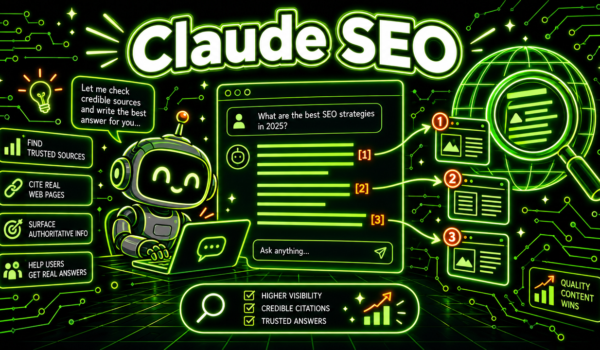
Claude SEO is the work of getting your website and brand found, trusted and cited when Claude answers a question. Claude answers from what it learned in training and, when web search is on, from pages it finds live, which it cites as sources. To show up, you let Anthropic’s crawlers reach your pages, answer questions plainly, and make sure you are described accurately on the sites and communities Claude reads.
If you search “Claude SEO” on Google, most results are about something else: using Claude, or Claude Code, as a tool to do SEO work. That is useful, and there is a short section on it near the end. This guide is about the other meaning, the one more businesses care about: how to become the source Claude names when one of your customers asks it a question.

What is Claude SEO?
Claude SEO is a slice of what people call AEO or GEO: optimizing for AI tools that write answers instead of listing links. The Claude part means you focus on how Anthropic’s assistant finds information, which crawlers it uses, and what kinds of sources it tends to cite.
The term has two meanings, and it helps to keep them apart:
- Claude SEO as visibility. Getting your business mentioned and cited in Claude’s answers. This guide covers that.
- Claude SEO as a tool. Using Claude to research keywords, draft briefs, audit pages or write schema. Covered briefly at the end.
Most of the work overlaps with what helps in ChatGPT, Perplexity and Google’s AI features. Our guide to AEO covers the shared basics. What follows is the Claude-specific layer.
How does Claude find information on the web?
Claude answers questions in two ways, and Claude SEO has to account for both.
From training data
Like other large language models, Claude learned from a large body of text collected before a training cutoff. Some of that text came from the public web. If your business was well described across many trusted sources before that cutoff, Claude may know about you without searching at all. If you are new, or rarely written about, it may not.
You cannot edit training data after the fact. What you can do is make sure the public web describes you clearly and consistently, so future training runs pick up an accurate picture.
From live web search
When web search is turned on, Claude runs searches, reads the pages it finds and writes an answer with citations that link to its sources. This is where Claude SEO pays off fastest, because a page you improve today can be found and cited the next time someone asks.
Anthropic describes web search as a feature that gives Claude current information and shows citations. The exact search index behind it, and how results are ranked, are details Anthropic controls and can change. Check Anthropic’s own documentation for the current description, since third-party claims go out of date.
What a citation means for traffic
A citation in Claude is a link a reader can click. Many readers take the answer and move on, so a citation sends less traffic than a top Google ranking. It still matters: being the named source puts your brand in front of someone at the moment they are deciding, and the people who do click tend to be further along.
Which Anthropic crawlers should you allow?
Anthropic runs more than one bot, and each does a different job. Its help article on how Anthropic crawls the web and how site owners can block it lists them. Confirm the names there before you change anything, because user agents get renamed.
| Crawler | What it does | If you block it |
|---|---|---|
| ClaudeBot | Collects public web content that may be used to train future models | Your pages are left out of future training data |
| Claude-User | Fetches a page when a Claude user asks Claude to read it or Claude needs it to answer that user | Claude cannot open your page when a user asks it to |
| Claude-SearchBot | Crawls pages to improve the quality of Claude’s search results | Your pages may be less likely to appear in Claude’s search results |
For Claude SEO, the two that matter most are Claude-User and Claude-SearchBot. Blocking either one makes it harder for Claude to read and cite you when it searches. ClaudeBot is a separate decision about training data. Some businesses are happy to be in training data because it helps the model know them. Others prefer to keep their content out. Either choice is reasonable, as long as you make it on purpose.
A robots.txt that allows search and user fetches but blocks training looks like this:
User-agent: ClaudeBot
Disallow: /

User-agent: Claude-User
Allow: /

User-agent: Claude-SearchBot
Allow: /
Robots.txt is not the only gate. Many CDNs and firewalls have settings that block AI bots, and some of them switch those settings on by default. If you use one, check its bot settings as well. A site can have a perfect robots.txt and still be invisible because a firewall rule turns the bot away.
7 ways to get cited by Claude
Once the crawlers can get in, Claude SEO is mostly about making your pages the easiest good answer to quote. These seven steps cover the work in rough order of impact.
1. Let the right crawlers in
Start with the table above. Open your robots.txt at yoursite.com/robots.txt and look for any rule that blocks Claude-User or Claude-SearchBot, or a wildcard rule that blocks everything except a named list. Then check your CDN’s bot settings. This takes ten minutes and fixes the most common reason a business never shows up.
2. Answer the question in the first lines
When Claude reads a page during a search, it looks for the passage that answers the question. Pages that open with three paragraphs of scene-setting make that harder. Put the direct answer in the first two or three sentences under each heading, then expand. Our guide to AI search optimization shows how to rewrite pages this way.
3. Publish clear, factual pages
Claude tends to cite pages that state facts plainly: specifications, comparisons, step-by-step guides, definitions, policies, prices where you publish them. Vague pages full of claims like “industry-leading quality” give it nothing to quote. If a customer would ask the question, give the answer a page, or a clearly labelled section, with the facts in sentences a reader could lift on their own.
4. Keep your business facts consistent
Claude builds its picture of your business from many places: your site, your profiles, directories, review sites and articles. If your founding year, location, product names or service area differ from one place to the next, the model has to guess, and it may guess wrong. Pick one version of each fact and use it everywhere. This is entity work, and it helps in every AI tool.
5. Earn mentions on review sites and in communities
When someone asks Claude for a recommendation, the answer often leans on what other people say: reviews, comparison articles, forum threads. Your own site says you are good. Other sites saying so carries more weight. Ask happy customers for reviews on the platforms your industry uses, and take part in the communities where your buyers ask questions. More on Reddit below.
6. Publish original data people quote
Pages with original numbers, such as a survey of your customers, benchmark results or pricing data from your market, get cited by other writers, and those citations spread your name to more sources Claude reads. One well-sourced data page can do more for Claude SEO than ten generic blog posts.
7. Check your answers with a fixed prompt set
Write down ten to twenty questions your customers ask before they buy. Run them in Claude with web search on, once a month, and record whether you are named, how you are described and which pages are cited. That record is the only reliable way to see whether your Claude SEO work is doing anything.

Reddit and community threads in Claude answers
Recommendation questions, such as “what is the best CRM for a five-person agency” or “which accountant software do freelancers like”, are where community discussions show up most. When Claude searches for those, forum threads where real users compare options are often among the pages it can read. Reddit threads also rank well in Google for this kind of question, so they show up in many search results AI tools draw on.
That gives you two jobs. First, find out what is already being said. Search Reddit for your brand, your competitors and your category, and read the threads that rank. Our guide to finding Reddit threads that already rank shows how. Second, take part openly: answer questions in your area, disclose who you are when you mention your own business, and follow each subreddit’s rules. Our post on how to mention your brand on Reddit covers how to do that without getting removed.
When we run category prompts in AI tools for clients, the brands that get named usually have some presence in these discussions: a few threads where customers mention them by name, ideally with specifics. Brands with no community footprint tend to be missing from recommendation answers even when their own sites are strong.
Claude SEO vs ChatGPT SEO: what is different?
Most of the work is the same. The differences sit in the crawlers and in how each assistant handles search.
| Area | Claude | ChatGPT |
|---|---|---|
| Training crawler | ClaudeBot | GPTBot |
| Search crawler | Claude-SearchBot | OAI-SearchBot |
| User-triggered fetch | Claude-User | ChatGPT-User |
| Citations | Shown as links when web search is used | Shown as links when search is used |
| Where to check the rules | Anthropic’s help centre | OpenAI’s crawler documentation |
The practical takeaway: if you already did the technical work for ChatGPT, repeat it for Anthropic’s user agents. Our ChatGPT SEO checklist covers the OpenAI technical side, and how to rank in ChatGPT covers strategy.
What makes a page easy for Claude to cite?
Pull the steps above together and a citable page tends to have the same traits. Use this as a quick check on any page you want Claude to quote:
- The page title and first heading say exactly what question it answers.
- The first two or three sentences answer that question on their own.
- Headings are phrased the way people ask: “How long does X take?” rather than “Timelines”.
- Facts carry numbers, names and dates, with links to the source.
- Comparisons sit in tables with clear column headers.
- The author and the business behind the page are named, with a reason to trust them.
- The main content loads in the page HTML, not only after scripts run.
None of these is specific to Claude. That is the point: Claude SEO done well makes a page better for every reader, human or machine.
Does Claude SEO matter for a small business?
It depends on who your buyers are. Claude is popular with professionals, developers, writers and people doing research at work, so a B2B company, a software tool or a professional service has more reason to care than a neighbourhood café. The work is also cheap to start. Checking robots.txt, rewriting the opening of your key pages and fixing inconsistent business details takes days, not months, and every one of those fixes helps in Google, ChatGPT and Perplexity too.
A sensible way to decide: run five of your customers’ buying questions in Claude this week. If competitors are named and you are not, Claude SEO deserves a place on your list. If nobody in your category is named, the answers are coming from general sources, and you have a chance to become the first business Claude can cite.
Common Claude SEO mistakes
The same handful of problems explain most cases where a business is missing from Claude’s answers:
- Blocking every AI bot by default. A blanket rule meant to stop training also stops Claude from reading your pages when a user asks.
- Pages that need JavaScript to show their text. If the main content only appears after scripts run, a crawler may see an empty page.
- Inconsistent business details. Different names, addresses or product lists across the web make the model less sure who you are.
- Chasing tricks. Hidden text aimed at AI, keyword-stuffed pages or fake reviews can get a site discounted and damage trust with real readers.
- Not checking. Without a monthly prompt check you will not know whether anything changed.
Using Claude as an SEO tool
For readers who came for the other meaning of Claude SEO: Claude is a capable assistant for SEO tasks, and Claude Code can run longer jobs such as auditing a set of pages or reworking templates. Common uses:
- Grouping keyword lists into topics and search intents.
- Drafting content briefs from a list of competing pages you supply.
- Writing or checking schema markup.
- Reviewing a page against a checklist and listing fixes.
Treat the output as a draft. Check every fact, and do not publish AI-written text without editing it, because readers and search engines both notice generic copy.
How to check whether Claude mentions your brand
Claude SEO results come slowly and unevenly, so measure them the same way each month:
- Write your prompt list: category questions (“best X for Y”), comparison questions (“X vs Y”) and direct questions about your business.
- Run each prompt in Claude with web search on, in a fresh conversation.
- Record whether you are named, whether the description is accurate, and which URLs are cited.
- Note which other brands appear and which sources they are cited from.
- Repeat monthly and compare.
The sources cited for your competitors are a to-do list. If a comparison article or a Reddit thread keeps showing up, that is where you need to be described accurately. Our AI visibility audit guide has a template for the whole process, and AI citations explains how assistants pick their sources.

Frequently asked questions
Does Claude search the web?
Yes, when web search is available and turned on. Claude then runs searches, reads pages and cites them in its answer. Without web search, it answers from its training data alone.
How do I get my website cited by Claude?
Allow Claude-User and Claude-SearchBot in robots.txt and in your CDN, answer questions directly near the top of your pages, keep your business facts consistent, and earn mentions on review sites and in communities. Then check a fixed set of prompts each month.
What is ClaudeBot?
ClaudeBot is Anthropic’s crawler for collecting public web content that may be used to train future models. It is separate from the crawlers Claude uses for search and for fetching pages at a user’s request.
Should I block ClaudeBot?
That depends on whether you want your content in future training data. Blocking ClaudeBot does not stop Claude-User or Claude-SearchBot, so you can keep training out and still be found in search. Make the choice on purpose.
Is Claude SEO different from ChatGPT SEO?
Mostly not. Both reward clear, factual pages and a good reputation on other sites. The main differences are the crawler names and where each company documents its rules.
Can I use Claude for SEO?
Yes. Claude can help with keyword grouping, briefs, schema and page reviews. Check its output before publishing, and keep a person responsible for the final edit.
How long does Claude SEO take to work?
Fixes to crawler access and page structure can show up in Claude’s search answers within weeks, once pages are recrawled. Changes to how you are described across the web take months. Training data only updates with new model releases.
Want to see where your customers are already asking? Get a free Reddit Opportunity Report showing which Reddit threads already rank for your keywords.