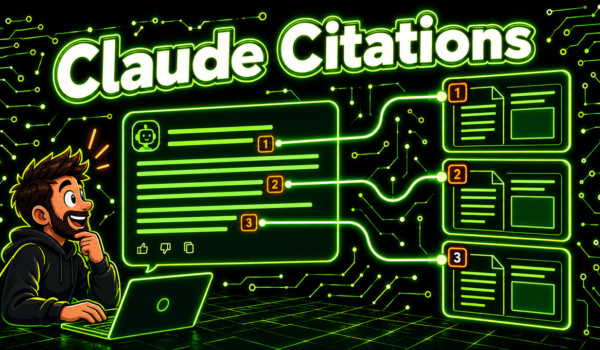
Claude citations are the source links Claude attaches to its answers when it searches the web. When a question needs current or specific information, Claude can run a web search, read the results, write an answer, and mark which statements came from which pages. Those Claude citations show readers where the information came from, and they send clicks to the cited sites. For brands, earning Claude citations means being one of the pages Claude finds, trusts and quotes when your buyers ask questions.
This guide explains how Claude citations work, what influences which pages Claude cites, and what you can do to improve your chances.

How Claude citations work
Claude answers many questions from what it learned during training, without searching and without citations. When a question needs fresh, specific or verifiable information, Claude can use its web search tool. The process looks roughly like this:
- Claude decides that a search would help answer the question.
- It writes one or more search queries, often rephrasing the user’s question.
- It receives a set of results from its search provider and can fetch individual pages.
- It writes an answer based on what it read.
- It attaches Claude citations to the statements drawn from specific sources, so readers can open them.
Our guide to Claude web search covers the feature itself in more detail.
Where Claude finds the pages it cites
Claude does not run a full web index of its own in the way Google does. Anthropic lists Brave Search as a provider for its web search, and independent tests have found that the sources Claude cites closely match Brave’s top results for the same queries. That makes Brave’s index an important factor for Claude citations. If a page is not in that index, or ranks poorly there, Claude is less likely to find it.
Anthropic also runs its own crawlers. Claude-SearchBot indexes content to improve search results, and Claude-User fetches pages when a user’s question needs them. A separate crawler, ClaudeBot, collects content that may be used for training. Anthropic explains these bots and how to control them in its help center article on its crawlers.
When Claude searches and when it does not
Not every prompt triggers a search. Questions about stable concepts, such as definitions or how something generally works, can often be answered from training alone, so they produce no Claude citations. Questions about current information, specific products, prices, comparisons, recent events or niche topics are more likely to trigger a search. For brands, the prompts that matter most, like “which tool should I use for this” or “is this product worth it”, are usually the kind that lead to a search and to citations.
What makes a page more likely to earn Claude citations
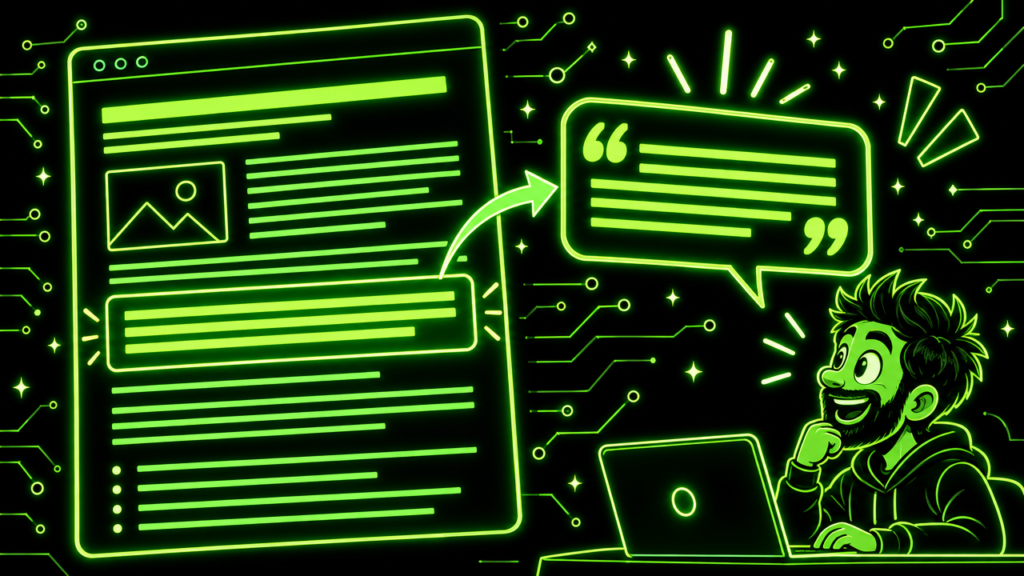
It can be found
The page must be crawlable, indexed by the search provider Claude uses, and allowed for Anthropic’s search and user crawlers in robots.txt. Pages blocked by robots.txt, hidden behind logins, or built so that content only appears after heavy scripts run are harder to find and read.
It ranks well for the query Claude writes
Because Claude rewrites questions into search queries, pages that rank for natural, descriptive phrasings of a topic have an advantage. Strong traditional SEO, including clear titles, relevant content and quality links, helps a page appear in the results Claude reads.
It answers the question directly
Pages that state the answer clearly near the top, then support it with specifics, are easy to quote. Long introductions and vague copy make it harder for Claude to find the sentence it needs.
It contains specific, checkable details
Numbers, steps, comparisons, dates and named examples give Claude concrete material to cite. Generic statements rarely need a citation, so they are less likely to earn one.
It is current
For topics that change, recent and clearly dated pages have an edge. Update key pages when facts change, and show the update date.
Third-party sources and Claude citations
Many Claude citations point to sources other than brand websites: review platforms, comparison articles, news coverage, documentation and community discussions such as Reddit threads. For recommendation questions, these independent sources often carry more weight than a brand’s own claims. If you want Claude to mention your product, you usually need to appear in the sources Claude cites, not only on your own site. Our guide to AI citations explains this pattern across assistants.
Claude citations vs ChatGPT citations
| Factor | Claude | ChatGPT |
|---|---|---|
| Search source | Brave Search listed as a provider, plus Anthropic’s own crawlers | OpenAI’s search systems, with its own crawler |
| Crawlers to allow | Claude-SearchBot and Claude-User | OAI-SearchBot and ChatGPT-User |
| Citation style | Inline citations linked to sources | Inline citations and a source list |
| Overlap | Studies have found limited overlap between the sources each assistant cites for the same prompts, so tracking both matters | |
Our guide to ChatGPT citations covers the OpenAI side.
How to earn more Claude citations
- Check robots.txt. Allow Claude-SearchBot and Claude-User. Decide separately whether to allow ClaudeBot, which relates to training. Our guide on how to block AI crawlers explains the tradeoffs.
- Check that your key pages appear in Brave Search for the queries your buyers would ask. If they do not, focus on crawlability and the same fundamentals that help any search engine find and rank you.
- Write pages that answer specific questions in the first paragraph, then go deeper with steps, data and examples.
- Keep facts current and show update dates on important pages.
- Earn mentions in the third-party sources Claude cites for your category, such as review sites, roundups and community threads.
- Track results by asking Claude your buyers’ questions each month and recording which sources it cites.
Citable vs uncitable passages
A quick comparison shows why some pages earn Claude citations and others do not.
Uncitable: “Our innovative platform helps teams work smarter and achieve more with powerful features designed for modern workflows.” There is nothing specific here for Claude to quote or for a reader to verify.
Citable: “The free plan supports up to three users and 1,000 tasks. Paid plans add time tracking, client portals and integrations with common accounting tools, and are billed per user per month.” This passage answers concrete questions about limits, features and billing, so it can support a specific statement in an answer.
Go through your most important pages and rewrite vague passages into specific ones. That single change does more for Claude citations than most technical tweaks.
A page template that earns Claude citations
- A title that matches how people ask the question.
- A first paragraph that answers the question in two or three sentences.
- Headings phrased as follow-up questions, each answered directly below.
- Specific details: numbers, steps, comparisons, examples and dates.
- A short section on limitations or who the option does not suit.
- Sources for any statistics or claims, linked inline.
- A visible last updated date.
This structure suits Claude citations because each section can stand on its own as evidence for a specific part of an answer.
Claude citations by industry
Software and SaaS
Claude is popular with professionals and technical users, so software questions are common. Documentation, pricing pages, comparison pages and integration guides are frequent sources. Make sure docs are public and crawlable, and keep pricing and feature lists accurate. Community threads where developers discuss tools also show up often among Claude citations.
Professional services
Questions about legal, financial or consulting topics often lead Claude to authoritative explainers and firm resources. Clear articles written by named experts, with specifics and current rules, are more likely to be cited than general marketing pages.
Ecommerce and consumer products
For product questions, Claude tends to cite reviews, comparison articles and community discussions. Detailed product pages help, but third-party coverage usually decides which products get named.
Local businesses
Local questions depend on listings and reviews that appear in search results. Consistent business information across directories and an informative website with service and location pages give Claude the details it needs.
Why some pages never get Claude citations
- The page is not in the search index Claude uses, or ranks too low to be retrieved.
- Robots.txt blocks Claude-SearchBot or Claude-User.
- Key content is hidden behind tabs, scripts or logins.
- The page talks around the topic without answering a specific question.
- The information is outdated, so newer sources win.
- Competitors are discussed in third-party sources and your brand is not.
Fix the first three items before anything else, since they block Claude citations entirely. The rest improve your odds over time.
Claude citations and AI visibility more broadly
Earning Claude citations is one part of a wider effort to appear in AI answers. The same habits help with ChatGPT, Perplexity, Gemini and Google’s AI features: crawlable pages, direct answers, specific details and a strong reputation in third-party sources. Optimizing for one assistant rarely hurts the others, but tracking each separately matters because they cite different sources. Our guide to LLM visibility explains how to manage this across assistants.
How to track Claude citations

Build a list of 20 to 50 prompts your buyers ask, with web search enabled. Run them in Claude each month, and record whether your brand is mentioned, which pages are cited, and which competitors appear. Visits from claude.ai in your analytics show part of the downstream traffic. Our guide on how to track brand mentions in AI search gives a full template.
How people use Claude for research
Understanding who uses Claude and how helps you decide which content matters. Many people use Claude for work: researching vendors, comparing tools, drafting documents, summarizing reports and checking facts. Those tasks often involve long, specific questions with follow-ups, such as “compare these three analytics tools for a team of twenty that needs SSO and a self-hosted option”. Answers to questions like that draw on pages with precise, comparable details.
Claude users also tend to ask Claude to read a specific page or document they share. In that case Claude fetches the page directly through its user agent. If your pricing page, documentation or comparison page is the one a buyer pastes into a conversation, it needs to be readable without scripts or logins, and it needs to state facts clearly enough that Claude summarizes them correctly.
Accuracy: what happens after your page is cited
Being cited is not the end of the story. Claude summarizes what it reads, and a summary can lose nuance. Pages with ambiguous wording, outdated details or contradictory statements are more likely to be summarized incorrectly. Keep facts in one clear place on each page, avoid burying conditions in footnotes, and use consistent numbers across your site. When you test prompts, check not only whether your page is cited but whether the statement attached to the citation is accurate.
If you find an error, trace it to the source. Sometimes the cited page is a third-party article with outdated information. Contact the publisher with a correction, update your own pages, and recheck a few weeks later.
A monthly routine
- Week one: run your prompt list in Claude with web search on, and record mentions and sources.
- Week two: fix any technical blockers you found, and update pages with outdated facts.
- Week three: improve one or two pages that should be cited but are not, using the template above.
- Week four: work on third-party sources, such as review profiles, roundups and community threads that appear in answers.
A small, steady routine like this tends to beat occasional big pushes, because sources and answers change gradually.
Citations in the Claude API
Developers who build on Claude can also use a citations feature in the API, which lets Claude point to the exact passages in documents a developer provides. That is different from web search citations. It matters if your company builds AI features on your own content, since it helps users verify answers against your documentation.
Expect change
AI assistants change quickly. Search providers, crawler names, citation formats and the share of prompts that trigger a search can all shift with new releases. Build your approach on durable foundations, such as crawlable pages, specific answers and a good reputation in trusted sources, rather than on tricks tied to how one version behaves.
Review this guide’s crawler and search details against current documentation every few months, and keep your monthly prompt testing going. Testing tells you what is happening now, which matters more than any rule of thumb.
If you only have time for one thing this month, pick the page that should answer your most valuable buyer question, and make it the clearest, most specific and most current answer on the web. Then check whether Claude cites it.
Claude citations FAQ
Does Claude cite its sources?
Yes, when it searches the web. Claude attaches citations to statements drawn from the pages it read. Answers from training alone do not include web citations.
What search engine does Claude use?
Anthropic lists Brave Search as a provider for Claude’s web search, and tests have found Claude’s citations closely match Brave’s top results.
How do I get my site cited by Claude?
Allow Anthropic’s search and user crawlers, make sure your pages rank in Brave for relevant queries, answer questions directly with specific details, and earn mentions in sources Claude cites.
Will blocking ClaudeBot stop Claude citations?
ClaudeBot relates to training. Search and user fetching use Claude-SearchBot and Claude-User, which are controlled separately.
Why does Claude cite different sources than ChatGPT?
They use different search systems and ranking, so the same question can produce different sources. Track both.
Can I see traffic from Claude citations?
Yes. Visits from links in Claude typically arrive with claude.ai as the referrer in your analytics.
Do I need to rank first in Brave to be cited?
Not necessarily first, but pages near the top of the results Claude retrieves have the best chance. Pages that rank lower are less likely to be read at all.
Does Claude cite Reddit threads?
Yes. For recommendation and experience questions, community discussions including Reddit threads are common sources, since they contain first-hand opinions.
Can I ask Anthropic to cite my site?
No. There is no submission process. Pages earn citations by being findable, relevant and useful for the questions people ask.
Does structured data help with Claude?
It may help search engines understand your pages, but Claude reads page content. Clear visible text matters most, with structured data as a supporting signal.
How quickly do changes show up?
It depends on how fast search indexes recrawl your pages. Updates to frequently crawled pages can appear within days or weeks, while new pages may take longer to be discovered.
Want to see where your customers are already asking? Get a free Reddit Opportunity Report showing which Reddit threads already rank for your keywords.