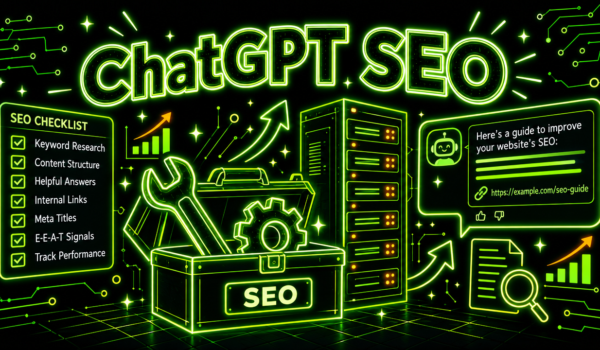
ChatGPT SEO is the technical and content work that lets ChatGPT find, read and cite your website. In practice it means allowing OpenAI’s search crawler, OAI-SearchBot, serving pages whose main content is in the HTML, being indexed in the search engines ChatGPT search draws on, and writing pages that answer questions plainly enough to quote. Get those right and your pages can appear as sources when ChatGPT searches the web.
This is the technical companion to our guide on how to rank in ChatGPT, which covers strategy: what content to create and how to build a reputation ChatGPT picks up. This guide covers the plumbing. Each of the nine fixes below comes with a quick way to check it, so you can audit your own site for ChatGPT SEO in an afternoon.

What is ChatGPT SEO?
ChatGPT SEO, sometimes called SEO for ChatGPT, is making your site easy for ChatGPT to discover, read and cite. It sits inside the wider practice of answer engine optimization, which our guide to what AEO is explains.
The phrase is also used for something else: using ChatGPT as a tool to do SEO work. That gets a short section near the end. The rest of this article treats ChatGPT SEO as visibility in ChatGPT itself, because that is the part most technical guides skip.
Think of it as three layers. Access decides whether OpenAI’s bots can reach your pages. Readability decides whether they can understand what they reach. Quotability decides whether your page is the best passage to use in an answer. Most sites that are missing from ChatGPT fail on the first two layers without knowing it.
How does ChatGPT find web pages?
ChatGPT answers from two sources. One is what the model learned in training. The other is live web search, which ChatGPT uses for current questions and when a user asks it to search. When it searches, it shows the pages it used as clickable sources.
OpenAI runs three separate agents, documented on its overview of OpenAI crawlers:
- GPTBot crawls public pages that may be used to train future models.
- OAI-SearchBot crawls pages so they can appear in ChatGPT’s search results.
- ChatGPT-User visits a page when a user’s request needs it, for example when someone pastes a link or ChatGPT opens a result to read it.
Each one reads robots.txt under its own name, so you can treat them differently. For ChatGPT SEO the one that matters most is OAI-SearchBot. OpenAI’s documentation also notes that ChatGPT-User acts on behalf of a person, and it describes how robots.txt applies to it; read that section before you write rules for it.
Where do the search results come from? OpenAI has said ChatGPT search uses third-party search providers alongside its own crawling, and Microsoft’s Bing has been widely reported as one of them. Neither company publishes the full details, and they can change. The safe approach is to make sure your site is crawlable by OAI-SearchBot and well indexed in both Google and Bing.
9 technical fixes for ChatGPT SEO
Work through these in order. The first four decide whether ChatGPT can find you at all.
1. Allow OAI-SearchBot in robots.txt
Open yoursite.com/robots.txt. Look for a rule that names OAI-SearchBot, and for a wildcard rule such as “User-agent: *” with “Disallow: /” that would block it by default. If you want to appear in ChatGPT search, OAI-SearchBot needs to be allowed on the pages you care about.
How to check it: read the file, then test a few important URLs against it with a robots.txt testing tool, choosing OAI-SearchBot as the user agent.
2. Check your CDN or firewall is not blocking AI bots
Robots.txt is a request. A CDN or web application firewall can block a bot before it ever reads robots.txt. Several CDN providers offer one-click settings to block AI crawlers, and some have turned such settings on by default for new sites. A rule meant to stop scrapers can stop OAI-SearchBot too.
How to check it: open your CDN’s bot or security settings and look for AI crawler rules. Then search your server or CDN logs for “OAI-SearchBot” and see whether requests get a 200 response or a 403.
3. Serve main content in server-rendered HTML
Many AI crawlers do not run JavaScript the way a browser does. If your page loads an empty shell and fills in the text with scripts, a crawler may see nothing worth citing. Sites built as single-page apps are the usual culprits.
How to check it: view the page source (not the inspector) or fetch the page with curl. If the main headings and paragraphs are in that raw HTML, you are fine. If you see only a script tag and an empty div, ask your developer about server-side rendering or prerendering.
4. Get indexed in Bing as well as Google
Because ChatGPT search draws on third-party providers, being well indexed in Bing is cheap insurance for ChatGPT SEO. Many sites set up Google Search Console years ago and never touched Bing.
How to check it: verify your site in Bing Webmaster Tools, submit your sitemap, and use its URL inspection to confirm key pages are indexed. Bing also supports IndexNow, a way to tell it about new and updated URLs straight away; many SEO plugins can send those pings for you.
5. Keep pages fast and free of interstitials
Slow pages time out for crawlers as well as people. Full-screen pop-ups, cookie walls that hide the content, and login prompts can stop a bot from reading the page at all.
How to check it: run your key pages through a page speed test, then load them in a private window and note what appears before the first paragraph. If a visitor has to close something to read, a crawler may never get past it.
6. Use descriptive titles and question headings
ChatGPT looks for the passage that answers the question it was asked. Clear titles and headings phrased as questions help it find that passage. “How long does shipping to Canada take?” works better than “Logistics”.
How to check it: list the headings on your ten most important pages. If a stranger could not tell from the headings alone which questions the page answers, rewrite them.
7. Add structured data that matches the page
Schema markup such as Organization, Product, Article and FAQPage gives machines a clean statement of the facts on a page. It is not a guarantee of anything, but it removes guesswork. What matters is that every value matches what a visitor can see.
How to check it: run pages through a schema validator and compare each value with the visible text. Fix anything that disagrees.
8. Make key facts easy to quote
ChatGPT cites pages it can lift a clean answer from. Put specifications, prices where you publish them, delivery times, policies and comparisons in plain sentences and tables, not inside images or PDFs. Our strategy guide covers how to choose which pages to write; this fix is about formatting the facts on them.
How to check it: ask ChatGPT a factual question about your business with search on. If it gets the answer wrong or cites a third-party site, find where that fact lives on your own site and make it clearer.
9. Track ChatGPT referrals in analytics
Visits from ChatGPT usually show up as referral traffic from chatgpt.com, and ChatGPT often adds utm_source=chatgpt.com to the links it shows. Confirm what your own analytics records before you build reports on it.
How to check it: in GA4, open the traffic acquisition report and filter session source for “chatgpt”. Save that view and watch it monthly. A rise after technical fixes is the clearest sign your ChatGPT SEO work is reaching people.

ChatGPT SEO checklist
Use this table to record your audit. One row per fix, one column for what you found.
| Fix | Why it matters | How to check it |
|---|---|---|
| Allow OAI-SearchBot | Blocked bots cannot surface your pages in ChatGPT search | Read robots.txt; test key URLs |
| CDN and firewall rules | Can block bots before robots.txt is read | Bot settings; logs for 403 responses |
| Server-rendered HTML | Crawlers may not run JavaScript | View source or curl the page |
| Bing indexing | ChatGPT search uses third-party providers | Bing Webmaster Tools, sitemap, IndexNow |
| Speed and interstitials | Timeouts and pop-ups hide content | Speed test; private window check |
| Question headings | Helps find the answering passage | Read headings in isolation |
| Structured data | States facts in a machine-readable form | Schema validator vs visible text |
| Quotable facts | Clean passages get cited | Ask ChatGPT a fact about you |
| Referral tracking | Shows whether the work reaches people | GA4 source filter for chatgpt |
GPTBot vs OAI-SearchBot: which should you block?
This is the question we get most often about ChatGPT SEO, and it trips people up because blocking one does not block the other.
| Agent | Used for | Block it if | Effect on ChatGPT search |
|---|---|---|---|
| GPTBot | Training future models | You do not want your content in training data | None; search uses a different agent |
| OAI-SearchBot | Showing pages in ChatGPT search | You do not want to appear in ChatGPT search | Your pages stop appearing as sources |
| ChatGPT-User | Fetching pages for a user’s request | Rarely a good idea for public pages | ChatGPT cannot open your page when a user asks |
A common setup for businesses that want visibility but prefer to stay out of training data:
User-agent: GPTBot
Disallow: /

User-agent: OAI-SearchBot
Allow: /
Whether to block GPTBot is a business decision. Being in training data can help the model know your brand, which matters for answers given without search. Some publishers prefer not to be used for training. Either way, keep OAI-SearchBot allowed if ChatGPT SEO is the goal.
ChatGPT SEO on WordPress
WordPress powers a large share of business sites, and a few of its defaults matter for ChatGPT SEO.
- Robots.txt is often virtual. SEO plugins such as Rank Math and Yoast generate robots.txt on the fly. Edit it in the plugin’s settings, not by uploading a file, or your changes may be ignored.
- Security plugins can block bots. Firewall and anti-spam plugins sometimes rate-limit or block unfamiliar user agents. Check their logs for OAI-SearchBot.
- Caching layers can serve stale pages. If you update a page and ChatGPT still quotes the old version, clear the page cache and the CDN cache, then request reindexing in Bing.
- Page builders can hide text. Some builders load tabs, accordions and sliders with scripts. Put the facts you want quoted in plain content blocks.
Most WordPress sites already render their text in HTML, which puts them ahead on the readability layer of ChatGPT SEO. The common gaps are access settings and Bing indexing.
How is ChatGPT SEO different from Google SEO?
Most of the groundwork is shared: crawlable pages, clear content, a trusted site. Three differences are worth knowing. ChatGPT SEO depends on OpenAI’s own crawler being allowed, which Google SEO never touched. It leans on the third-party search providers ChatGPT draws on, so Bing matters more than many SEOs are used to. And the result is a citation inside a written answer, so the passage that answers the question matters more than the page’s overall ranking. If you already do Google SEO well, ChatGPT SEO is mostly a matter of checking access and tightening your answers.
The off-site part: mentions ChatGPT reads
Technical fixes make you findable. They do not make you recommended. When someone asks ChatGPT for the best option in a category, the answer leans on what other sites say: reviews, comparison articles and community discussions, Reddit among them.
If threads about your category rank in Google and Bing, they are also among the pages ChatGPT search can read. That makes it worth knowing what those threads say about you and taking part in them openly, under each subreddit’s rules. We cover the evidence in Does ChatGPT use Reddit? and the practical side in how to mention your brand on Reddit.
Common ChatGPT SEO mistakes
- Blocking every OpenAI agent with one rule. A site that meant to opt out of training also opts out of search.
- Trusting robots.txt alone. The CDN setting nobody remembers turning on is often the real block.
- Hiding facts in images and PDFs. A price list in a JPEG cannot be quoted.
- Ignoring Bing. A site with a strong Google footprint can be thin in Bing’s index.
- Publishing unedited AI text. Pages that read like everyone else’s give ChatGPT no reason to pick yours.
Using ChatGPT for SEO tasks
For readers who came for the other meaning of ChatGPT SEO: ChatGPT is a handy assistant for technical SEO chores. It can draft schema markup, write regular expressions for redirects or filters, turn a list of old and new URLs into redirect rules, group keywords by intent and suggest title tag options. Check every output before it touches your site, and do not publish AI-written copy without a real edit, because it tends to sound like every other page on the topic.
For the full picture across assistants, our LLM SEO guide covers the same three layers for ChatGPT, Claude, Gemini and Perplexity together, and our AI visibility audit shows how to measure the result with a fixed set of prompts.

Frequently asked questions
How do I optimize my website for ChatGPT?
Allow OAI-SearchBot in robots.txt and your CDN, make sure your main content is in the page HTML, get indexed in Bing as well as Google, and write pages that answer questions in their first lines. Then build mentions on the sites ChatGPT reads, and track referrals from chatgpt.com.
Does ChatGPT use Bing or Google?
OpenAI says ChatGPT search uses third-party search providers along with its own crawling, and Bing has been widely reported as one of them. Neither company publishes the full details, so aim to be well indexed in both.
What is OAI-SearchBot?
OAI-SearchBot is OpenAI’s crawler for ChatGPT search. It collects pages so they can be shown as sources in ChatGPT’s answers. It is separate from GPTBot, which collects training data.
Should I block GPTBot?
Only if you do not want your content used to train OpenAI’s models. Blocking GPTBot does not affect ChatGPT search, which uses OAI-SearchBot, so you can block training and still be cited.
How do I see traffic from ChatGPT in Google Analytics?
In GA4, look at traffic acquisition and filter session source for “chatgpt”. Visits usually arrive as referrals from chatgpt.com, often tagged with utm_source=chatgpt.com.
Can I use ChatGPT to do SEO?
Yes, for drafts and chores such as schema, regex, redirects and keyword grouping. Treat everything it produces as a first draft and check it before publishing.
Does llms.txt help with ChatGPT SEO?
OpenAI has not said that its crawlers use llms.txt, and the file does not control access the way robots.txt does. It is a low-cost extra for documentation-heavy sites. The fixes above matter far more. Our guide to what llms.txt is explains when the file is worth adding.
Do I need a separate page for ChatGPT?
No. ChatGPT reads the same pages people do. Improve the pages you already have so they answer questions directly. Copies written for AI only add duplicate pages.
How long does ChatGPT SEO take to show results?
Unblocking a crawler or fixing rendering can show results once your pages are recrawled, often within weeks. Building the reputation that gets you recommended takes months.
Want to see where your customers are already asking? Get a free Reddit Opportunity Report showing which Reddit threads already rank for your keywords.