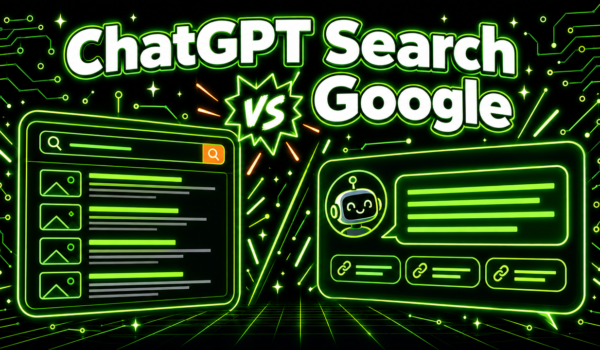
ChatGPT search and Google both answer questions with information from the web, but they work in different ways and send very different amounts of traffic to websites. Google returns a ranked page of links, ads and AI Overviews, and it still sends most of the referral clicks on the internet. ChatGPT search writes a conversational answer, cites a handful of sources inline and lets the user ask follow-up questions in the same thread. For a business, that means two different jobs: ranking pages in Google, and being one of the few sources ChatGPT search reads, trusts and names.
This guide compares ChatGPT search vs Google side by side, explains how each one picks sources, and shows how to plan for both without doubling your workload.

What is ChatGPT search?
ChatGPT search is the web search feature built into ChatGPT. When a question needs fresh or specific information, ChatGPT runs searches, reads a set of pages and writes an answer with citations that link back to the sources. Users can also turn search on by hand. OpenAI introduced ChatGPT search as a way to get timely answers with links to relevant web sources, and it uses third-party search providers alongside content from its own crawler and publishing partners.
The key difference from a classic search engine is the output. ChatGPT search gives one written answer, usually with a short list of sources, product cards or maps for some queries. There is no page two. If your page is not among the sources ChatGPT search reads for that question, you are invisible for that answer.
What is Google Search today?
Google is still a ranked list of results at heart, but the top of the page has changed. Many queries now show an AI Overview above the links, and Google offers AI Mode as a separate conversational experience. Ads, local packs, shopping results, videos and forum threads all compete for the same screen. Our guide on how to appear in Google AI Overviews covers that layer in detail.
Google crawls and indexes a huge share of the public web, and it ranks pages using hundreds of signals, including relevance, links, page experience and helpfulness. Searchers still click blue links in large numbers, which is why Google remains the biggest source of referral traffic for most sites.
ChatGPT search vs Google at a glance
The table below sums up the practical differences that matter to marketers.
| Factor | ChatGPT search | |
|---|---|---|
| Output | One written answer with inline citations | Ranked links, plus AI Overviews on many queries |
| Number of sources shown | Usually a handful per answer | Ten or more organic results per page, plus extras |
| Follow-up questions | Built in, the thread keeps context | Mostly a new search, or AI Mode |
| Index | Third-party search providers plus OpenAI’s own crawler | Google’s own index |
| Referral traffic | Small but growing, often high intent | By far the largest source for most sites |
| Ads | Limited compared with Google | Ads on many commercial queries |
| Best for | Research, comparisons, advice, planning | Navigation, local intent, quick facts, shopping |
How ChatGPT search picks its sources
It works more like a research assistant than a ranking engine. It turns the user’s question into one or more search queries, pulls results from its search providers, reads a selection of pages and then writes a summary. Several factors influence which pages make the cut.
Retrieval from search providers
ChatGPT does not keep a full index of the web the way Google does, so it relies on search partners to find candidate pages. Our post on whether ChatGPT uses Google explains the provider question in more depth. The practical takeaway: pages that rank well in traditional search engines have a better chance of being retrieved by ChatGPT search in the first place.
Crawl access
OpenAI runs a crawler called OAI-SearchBot that helps surface sites in ChatGPT search results. If your robots.txt blocks it, your pages are less likely to appear as cited sources. Blocking GPTBot, the training crawler, is a separate choice. Our guide to GPTBot covers the difference.
Answer fit
Once it has candidate pages, it favors content that answers the question clearly. Pages that open with a direct answer, use plain headings and include specific facts are easier to quote. A long intro that delays the answer makes your page harder to use.
Third-party opinions
For “best” and “which should I choose” questions, it often cites review sites, comparison articles and forum threads, including Reddit. What other people say about your brand can shape the answer as much as your own site does.
How Google picks its results
Google ranks pages from its own index. It looks at how well a page matches the query, how trustworthy the site is, how many relevant sites link to it, and whether people find it useful. AI Overviews draw on that same index and often cite pages that already rank on page one, although they also pull from pages further down.
Google also personalizes results by location and shows different features depending on intent. A search for “plumber near me” brings up a map pack. A search for “best running shoes” brings up shopping units, videos and forum threads. Each feature is its own small ranking contest.

Traffic: what ChatGPT search sends compared with Google
Google still sends far more visitors to websites than ChatGPT does. An Ahrefs study of referral traffic found that Google sent roughly 190 times more visits to websites than ChatGPT. For most businesses, Google organic traffic will dwarf ChatGPT search traffic for a long time.
Volume is only part of the story. Visitors who arrive from ChatGPT search have often already read a summary, compared options and decided your page is worth a closer look. Many sites report that this traffic converts well even when it is small. Our guide to AI referral traffic explains how to measure it in analytics.
There is also a visibility effect you will not see in referral numbers. When ChatGPT names your brand in an answer, many users remember the name and search for it later, or type your URL directly. That shows up as branded search or direct traffic, not as a ChatGPT referral.
Where ChatGPT search beats Google
ChatGPT tends to win when the user wants help thinking, not just a list of links.
- Complex comparisons. “Compare three CRM tools for a ten-person agency on price and integrations” gets a structured answer instead of ten tabs.
- Follow-up questions. Users can narrow the answer without starting over.
- Planning. Trip plans, project plans and shopping lists are easier in a conversation.
- Summaries of many sources. ChatGPT reads several pages and condenses them.
Where Google beats ChatGPT search
Google still wins most quick, navigational and local searches.
- Navigation. People who want a specific site type its name into Google and click.
- Local intent. Maps, hours, reviews and directions are deeply built into Google.
- Freshness at scale. Google indexes new pages quickly across the whole web.
- Browsing many options. Some users want to scan ten results and pick for themselves.
How user behavior differs
Queries in ChatGPT search are usually longer and more conversational. Instead of “crm small agency”, a user might write “what’s the easiest CRM for a small marketing agency that uses Gmail and needs client portals?” That longer question carries context Google would have to guess.
Sessions also look different. A Google session often ends with a click. A ChatGPT session may involve five follow-up questions, with citations appearing and disappearing along the way. Your brand can be mentioned in one turn and replaced in the next.
Does ranking in Google help you appear in ChatGPT search?
Yes, in most cases. Because ChatGPT search pulls candidate pages from search providers, pages that already rank well in traditional search engines have a head start. Strong organic rankings make it more likely that your page gets read in the first place.
Ranking is not the whole picture. It also leans on third-party sources such as reviews, listicles and Reddit threads, and it picks content that answers the exact question. A page can rank in Google and still be skipped if it buries the answer.
How to optimize for ChatGPT search and Google together
The good news is that most of the work overlaps. Use the steps below as a shared plan.
1. Keep your technical SEO healthy
Fast, crawlable pages with clean HTML help both systems. Make sure Googlebot and OAI-SearchBot can reach your important pages, and keep a working XML sitemap.
2. Answer the question first
Open each page with a clear two to four sentence answer to the main question, then expand. This format helps Google’s featured snippets and AI Overviews, and it gives ChatGPT search a clean passage to cite.
3. Write for the long, specific question
Cover the detailed versions of your topic: use cases, price ranges, team sizes and integrations. These are the questions people type into ChatGPT search, and they also match long-tail Google queries.
4. Earn mentions on third-party sites
Reviews, comparison articles, podcasts and community threads all feed AI answers. Our guide on how to get ChatGPT to recommend your business covers this step by step.
5. Show up where people discuss your category
Reddit threads rank well in Google and are cited often in AI answers. Helpful, disclosed participation in relevant subreddits can help in both places. Our post on Reddit and AI search explains why.
6. Use structured data
Schema markup for products, FAQs, reviews and organizations helps Google understand your pages and display rich results. It also makes key facts easier for any system to extract.
7. Track both channels
Monitor Google rankings with your usual tools. For ChatGPT search, run a fixed list of buyer questions each month and record whether your brand is named and which pages are cited.

How to measure ChatGPT search visibility
ChatGPT search does not offer a webmaster console like Google Search Console, so measurement takes a few manual steps.
- List 20 to 50 questions a buyer would ask before choosing a product like yours.
- Run each question in ChatGPT search with search turned on, in a fresh chat.
- Record whether your brand appears, where it appears, how it is described and which URLs are cited.
- Repeat monthly and compare. Look for trends, not single answers, because responses vary.
- Check analytics for referrals from chatgpt.com and watch for branded search growth in Google Search Console.
Our article on AI share of voice shows how to turn those checks into a single metric you can report.
ChatGPT search vs Google for different business types
Local businesses
Google still dominates local discovery through Maps and the local pack. Keep your Google Business Profile complete and keep reviews coming. ChatGPT also answers local questions, often citing review sites and directories, so consistent listings help there too.
B2B and SaaS
Buyers use ChatGPT search for research-heavy questions like vendor comparisons and integration checks. Clear pricing pages, comparison pages and honest third-party reviews matter a lot. Google still drives most demo traffic, so keep investing in organic search.
Ecommerce
Google Shopping and product listings remain a major source of sales. ChatGPT can show product recommendations for some queries, and it often draws on reviews and roundup articles. Detailed product data and strong review coverage help in both.
Publishers and content sites
Content sites feel the pressure most, since AI answers can satisfy a question without a click. Focus on original reporting, data and expert opinion that AI tools need to cite by name.
Common mistakes when comparing ChatGPT search and Google
- Abandoning SEO for AI. Google traffic is still the larger channel for nearly everyone.
- Ignoring ChatGPT search because referral numbers look small. Brand mentions in answers have value beyond clicks.
- Blocking every AI crawler without checking which ones affect search visibility.
- Judging ChatGPT search visibility from a single prompt. Answers change between runs.
- Writing only for your own site and ignoring the third-party sources AI answers cite.
A simple 90-day plan for both channels
Most teams do not need a separate AI budget to get started. A short, focused plan covers the basics and shows you where to invest next.
Days 1 to 30: audit and access
Check robots.txt, your sitemap and your page speed. Confirm that search crawlers from Google and OpenAI can reach your key pages. Write down the 30 questions your buyers ask most often, using sales calls, support tickets and Reddit threads as sources. Run those questions in Google and in ChatGPT and record what you see. That record becomes your baseline.
Days 31 to 60: fix your best pages
Pick the ten pages that matter most for revenue. Rewrite each opening so the main answer comes first. Add clear headings, a short FAQ and specific numbers where you have them. Update stale facts and add schema where it fits. These changes tend to lift Google rankings and make the pages easier for AI tools to quote.
Days 61 to 90: build outside proof
Ask happy customers for reviews on the sites your buyers read. Pitch your product to two or three comparison articles that already rank for your category. Join relevant Reddit discussions from a disclosed account and answer questions in detail. At the end of the 90 days, rerun your question list and compare the results with your baseline.
Signals to watch as search keeps changing
Search habits shift slowly, then all at once for certain topics. Watch a few signals so you can adjust early. Track the share of your Google impressions that come from queries with AI Overviews, since those queries often see lower click-through rates. Track referrals from AI assistants each month. Watch branded search volume, which often rises when AI answers start naming you. Keep an eye on which third-party sites show up as citations in your category, because those are the places where a mention carries the most weight.
Will ChatGPT search replace Google?
Not soon. Google handles a massive volume of searches every day, and its habits are deeply built into browsers, phones and daily life. ChatGPT is growing as a place where people research and decide, and Google itself keeps adding AI answers to its results. The more useful question is how much of your audience’s research now happens inside AI answers, and whether your brand shows up there.
For most businesses, the right plan is to keep Google as the main traffic channel while building visibility in ChatGPT search and other AI assistants. The two efforts support each other.
Frequently asked questions
Is ChatGPT search free?
ChatGPT search is available to ChatGPT users, including on the free plan, though limits and features can vary by plan and region. Check OpenAI’s current plan details for specifics.
Does ChatGPT search use Google results?
OpenAI has said ChatGPT search uses third-party search providers along with its own crawler and content partners. Read our post on whether ChatGPT uses Google for the details.
Is ChatGPT search more accurate than Google?
Neither is perfect. ChatGPT can summarize sources incorrectly, and Google can rank weak pages. Check citations for anything important.
Can I see ChatGPT search traffic in Google Analytics?
Yes. Look for referrals from chatgpt.com. Some visits arrive without a referrer, so the true number may be higher.
Should I optimize for ChatGPT search or Google first?
Start with Google, since it sends more traffic and good rankings help ChatGPT search retrieve your pages. Then add answer-first formatting, third-party mentions and monthly ChatGPT search checks.
How long does it take to appear in ChatGPT search?
It depends on crawl access, rankings and mentions. Some brands see changes within weeks after fixing access or earning new reviews. Others need several months of steady work.
Does ChatGPT search show ads?
Ad formats in AI assistants are still evolving. Google shows ads on many commercial queries, while ChatGPT search has far fewer ad placements today.
Want to see where your customers are already asking? Get a free Reddit Opportunity Report showing which Reddit threads already rank for your keywords.