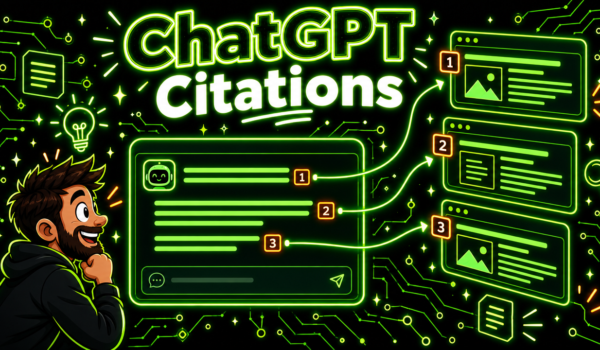
ChatGPT citations are the links ChatGPT shows when it searches the web to answer a question. They appear as small inline source tags next to a sentence and in a Sources panel at the end of the answer. ChatGPT only adds citations when it runs a web search. Answers written from its training data alone usually have no citations, and if you ask for sources in that mode it can invent ones that do not exist. To get your own pages cited, they need to be crawlable by OpenAI’s search crawler, indexed, and written so a clear answer to the question sits near the top of the page.
This guide covers how ChatGPT citations work, why they are sometimes wrong, how to check them, and nine ways to make your pages more likely to be cited. It also covers what to do if you came here looking for how to cite ChatGPT in an essay.
How ChatGPT citations work
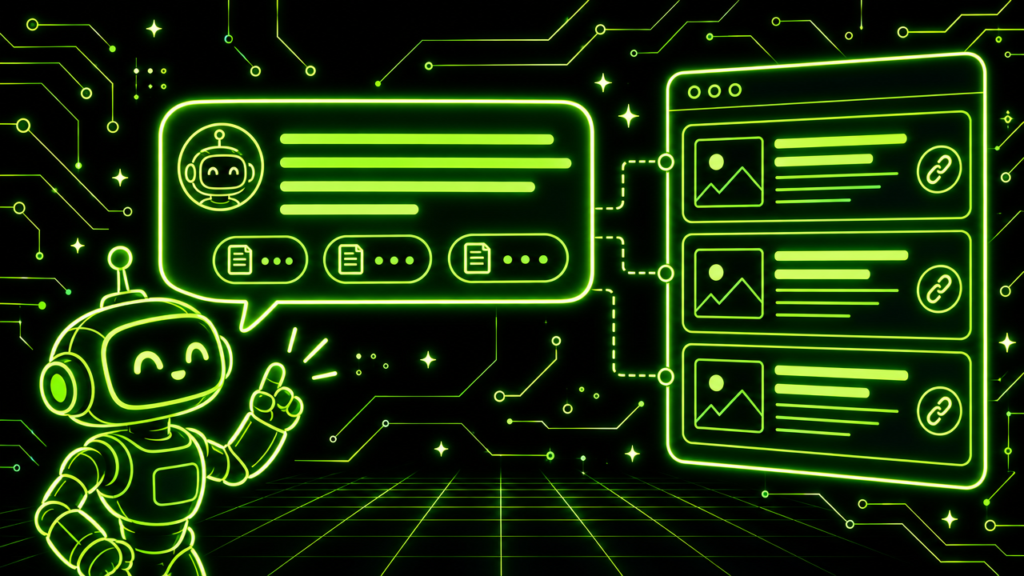
ChatGPT answers questions in two ways. Sometimes it answers from what the model learned during training. Other times it searches the web first, reads a set of pages, and writes an answer from them. OpenAI’s ChatGPT search help page explains that search answers include inline citations and a Sources button, so you can see which pages the answer drew on.
ChatGPT decides whether to search based on the question. Questions about recent events, prices, local businesses, product comparisons and anything that needs current facts usually trigger a search. You can also ask it to search, or turn search on manually. When it searches, the process looks roughly like this:
- ChatGPT rewrites your question into one or more search queries.
- It retrieves candidate pages from its search providers and its own crawled index.
- It reads the most relevant pages and pulls out the passages that answer the question.
- It writes an answer and attaches ChatGPT citations to the sentences those passages support.
OpenAI has published how its crawlers work but not how it picks one page over another. From testing and from industry analysis, the pattern is consistent: pages that rank well in traditional search, answer the question directly, and agree with other sources are cited far more often than pages that do not.
Where ChatGPT citations come from
ChatGPT citations point to many kinds of sources. For most commercial and how-to questions, the citations tend to come from a few groups:
- Brand and product pages that answer specific questions about features, pricing and policies.
- Publishers and review sites with comparisons, lists and guides.
- Reference sites such as Wikipedia and official documentation.
- Forums and communities, especially Reddit threads, for opinion and experience questions. Our guide to whether ChatGPT uses Reddit covers this in detail.
- Video pages, especially for tutorials.
The mix depends on the question. “What is the return policy for [brand]” usually cites the brand’s own site. “Best CRM for a small agency” usually cites review sites, comparison articles and Reddit threads. Our guide to AI citations explains how this differs across ChatGPT, Perplexity, Gemini and Google’s AI features.
Why ChatGPT citations are sometimes wrong
ChatGPT citations are useful, but they are not proof. Common problems include:
- Made-up sources. Without a web search, ChatGPT can produce citations that look real but point to articles, papers or pages that do not exist. This is the main risk when people ask it for references in research or school work.
- The right page, the wrong claim. A real citation can sit next to a sentence the page does not say. The model may blend several sources or overstate what one source claims.
- Copies instead of originals. Studies of news citations, including one by Columbia’s Tow Center, found that ChatGPT sometimes links to syndicated or copied versions of a story instead of the original publisher.
- Old pages. An outdated page that still ranks can be cited for a fact that has changed.
- Broken links. Pages move or disappear, so a link that worked when the answer was written can fail later.
How to check ChatGPT citations
A quick check catches most problems with ChatGPT citations:
- Confirm a search happened. Look for inline source tags or the Sources button. If there are none, treat any “source” in the text as unverified.
- Open the link. Make sure the page loads and is the page it claims to be.
- Find the sentence. Search the page for the specific claim. If you cannot find it, do not rely on it.
- Check the date. For prices, rules and statistics, make sure the page is current.
- Prefer the original. If the link goes to a summary or a copy, find the primary source.
For important decisions, ask ChatGPT to quote the exact passage it relied on, then verify that passage on the page itself.
Why ChatGPT citations matter for businesses
When ChatGPT answers a buying question, the pages it cites shape what the buyer believes and which brands they consider. A citation also gives the buyer a link to click. Analytics tools show visits from chatgpt.com as referral traffic, and many businesses now see it growing month over month, though it is still small next to Google for most.
ChatGPT citations also matter when nobody clicks. If ChatGPT’s answer cites a review site that recommends your competitor, the buyer may never visit your site at all. That is why it pays to know which pages ChatGPT cites for your category, not only whether your own site is cited.
9 easy ways to get your pages cited in ChatGPT
1. Make sure OpenAI’s search crawler can reach you
OpenAI uses a crawler called OAI-SearchBot to find pages for ChatGPT search. Its crawler documentation says sites that block OAI-SearchBot will not be shown in ChatGPT search answers, though they can still appear as plain navigational links. Check your robots.txt and any firewall or CDN rules. OpenAI’s training crawler, GPTBot, is separate, so you can block training and still allow search.
2. Get indexed in Bing
ChatGPT search draws on several providers, and Bing has been a major one since early on. Verify your site in Bing Webmaster Tools, submit your sitemap, and fix crawl errors. Bing’s AI Performance report also shows how often your pages are cited in Microsoft Copilot, which is a useful proxy. Our guide to answer engine optimization tools covers that report.
3. Answer the question in the first paragraph
ChatGPT pulls passages that answer the question. Put a clear, two to four sentence answer at the top of each page, then expand below. A page that buries the answer under a long introduction is harder to quote.
4. Write one page per question that matters
Pages that try to cover everything get cited less than pages focused on one question. If buyers ask “how much does X cost”, “X vs Y” and “is X worth it”, give each its own page or a clearly labelled section with its own heading.
5. Use specific facts, numbers and dates
Specific claims are easier to cite than vague ones. “Plans start at $29 a month and include five users” is more quotable than “affordable plans for teams”. Keep facts current and show when the page was last updated.
6. Structure pages for scanning
Descriptive headings, short paragraphs, lists, comparison tables and FAQs help both readers and AI tools find the right passage. Our guide to ChatGPT SEO covers page structure in more depth.
7. Be consistent across the web
ChatGPT is more likely to repeat a claim that several sources agree on. Make sure your pricing, features, locations and policies match across your site, your listings, review profiles and the places people discuss you.
8. Show up in the sources ChatGPT already cites
Ask ChatGPT your buyers’ questions and note which review sites, publishers and Reddit threads it cites. Those pages are where your category’s answers come from. Earning a fair mention there, through reviews, PR or helpful and disclosed comments in Reddit threads, can matter as much as your own pages. Our guide to Reddit SEO explains why Reddit threads keep showing up.
9. Keep pages fast, simple and accessible
Pages that load slowly, hide content behind scripts, or put key text inside images are harder for crawlers to read. Plain HTML text, clean markup and valid structured data make your content easier to fetch and quote. An llms.txt file can also point AI tools to your most important pages.
ChatGPT citations by question type
The kind of page ChatGPT cites changes with the question. Knowing the pattern tells you where to focus.
| Question type | Example | Pages usually cited |
|---|---|---|
| Definition | “What is net revenue retention?” | Reference sites, glossaries, educational guides |
| How-to | “How do I reset a smart thermostat?” | Official support pages, tutorials, videos |
| Comparison | “Asana vs Trello for a small team” | Comparison articles, review sites, Reddit threads |
| Best-of | “Best accounting software for freelancers” | List articles, review sites, community threads |
| Brand facts | “Does [brand] offer a free trial?” | The brand’s own pricing and help pages |
| Local | “Best dentist near Back Bay Boston” | Map listings, review sites, local directories |
For brand-fact questions, your own pages should win the ChatGPT citations. If they do not, the page is missing, unclear, blocked or out of date. For best-of and comparison questions, third-party sources usually dominate, so your presence on those sources matters more than your own blog.
A citation-ready page template
Pages that earn ChatGPT citations tend to share a simple structure. Use this as a starting point for any page you want quoted:
- A question-style heading that matches how buyers phrase the question.
- A direct answer of two to four sentences right below it, with the key fact or number.
- Supporting detail in short sections with descriptive headings.
- A comparison table or list where the answer involves options or steps.
- Evidence: sources, data, screenshots or first-hand experience that back up the claims.
- An FAQ covering follow-up questions in one or two sentences each.
- A visible last-updated date and an author or company name.
This structure is not a trick. It makes the page easier for people to scan, and the same qualities make it easier for ChatGPT to find a passage worth citing.
How to see which pages ChatGPT cites for your category
A simple monthly audit is enough to start:
- List 20 to 50 questions your buyers ask before they buy.
- Ask each one in ChatGPT with search on, in a fresh chat.
- Record which brands are named and which URLs appear as ChatGPT citations.
- Group the cited URLs by type: your site, competitors, review sites, publishers, Reddit and others.
- Pick the sources that appear most often and plan how to improve your presence in each.
Repeat the same questions every month to see what changes. If you need to track more prompts, AI visibility tools can automate the process. Our AI visibility audit guide has a full checklist.
ChatGPT citations vs Perplexity and Google citations
| Tool | When it cites | How citations appear |
|---|---|---|
| ChatGPT | When it runs a web search | Inline source tags and a Sources panel |
| Perplexity | On almost every answer | Numbered citations next to each claim |
| Google AI Overviews | When an AI Overview appears | Link cards beside or below the summary |
| Microsoft Copilot | When it grounds an answer in Bing results | Inline references and source links |
The same page can earn ChatGPT citations and citations in the other three tools, but each weighs sources differently. Perplexity cites more sources per answer, which makes it easier to get a mention. Our guide on how to rank on Perplexity covers its quirks, and our guide on how to rank in ChatGPT covers ChatGPT’s.
Common mistakes that cost ChatGPT citations
- Blocking OAI-SearchBot by accident, often through a broad bot rule or a security setting.
- Thin pages with a few sentences and a sign-up button, which give ChatGPT nothing to quote.
- Outdated facts that contradict newer sources, which makes the page less likely to be trusted.
- Key information only in PDFs or images, which are harder to read and quote.
- Ignoring third-party sources, so competitors own the review sites and threads ChatGPT relies on.
How to cite ChatGPT in an essay or paper
Some people searching for ChatGPT citations want to know how to reference ChatGPT itself in academic work. APA, MLA and Chicago each publish guidance on citing generative AI tools, and those formats have changed as the tools have evolved, so check the current version of your style guide or ask your instructor. As a general rule, name the tool and its maker, describe the prompt you used, and give the date. Many schools also require you to disclose AI use even when you do not quote it.
Whatever style you use, do not cite a source ChatGPT gave you unless you have opened it and confirmed it says what you claim. ChatGPT citations from a web search can be checked. References it produces from memory often cannot.
Frequently asked questions
Does ChatGPT always cite its sources?
No. ChatGPT citations appear when it searches the web. Answers from training data alone usually have no citations.
Why does ChatGPT make up citations?
Without a search, the model writes text that looks like a citation based on patterns it learned. It does not look the source up, so the reference may not exist. Turn on search or ask it to search, then check every link.
How do I get ChatGPT to show sources?
Ask it to search the web or turn on search, then open the Sources panel or hover over the inline source tags.
Should I add a sources section to my own pages?
It helps. Linking to the studies, documentation and data behind your claims shows readers and AI tools where your facts come from, and pages that cite good sources tend to be trusted and cited more themselves.
Can I pay to be cited by ChatGPT?
No. ChatGPT citations in search answers cannot be bought. They depend on your pages being crawlable, relevant and trusted.
How long does it take to start getting ChatGPT citations?
If your site is already indexed and allowed, changes to a page can show up within days or weeks. New sites and new topics usually take longer, because they need to be crawled, indexed and trusted first.
Does blocking GPTBot stop ChatGPT citations?
GPTBot is OpenAI’s training crawler. OAI-SearchBot is the search crawler. Blocking GPTBot alone does not remove you from ChatGPT search, according to OpenAI’s crawler documentation.
Can ChatGPT citations hurt my brand?
They can if the cited pages are wrong or negative. If ChatGPT keeps citing an old complaint thread or an outdated review, respond where it is appropriate, publish clear and current facts on your own site, and work on fresher, more accurate coverage elsewhere.
Do ChatGPT citations change over time?
Yes. The same question can return different ChatGPT citations on different days, as new pages are indexed and the model’s search results shift. Track a fixed set of questions monthly to see the trend.
Do Reddit threads count as ChatGPT citations for my brand?
They can. If a cited Reddit thread recommends your product, ChatGPT may name you in its answer even though your site is not the cited page. That is why helpful, honest participation in relevant threads matters.
Want to see where your customers are already asking? Get a free Reddit Opportunity Report showing which Reddit threads already rank for your keywords.