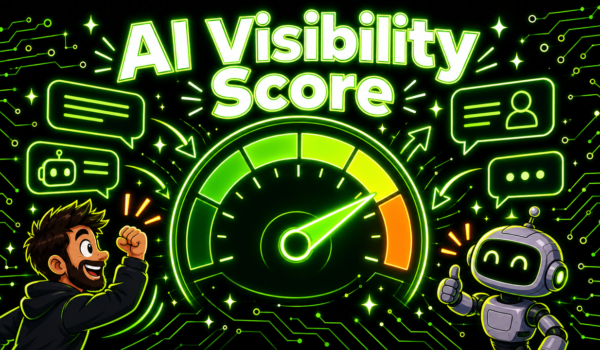
An AI visibility score is a single number that shows how often, and how well, AI assistants mention your brand when people ask questions in your category. You build it by running a fixed set of buyer questions through tools like ChatGPT, Google AI Overviews and AI Mode, Perplexity, Gemini and Claude, then scoring each answer on whether your brand appears, where it appears, how it is described and whether your site is cited. Tracked monthly, an AI visibility score tells you if your brand is gaining or losing ground in AI answers, in the same way keyword rankings track progress in Google.
This guide explains what goes into an AI visibility score, gives you a simple formula you can run in a spreadsheet, and shows how to raise the number over time.

Why you need an AI visibility score
AI assistants now answer many of the questions buyers used to type into Google, and they often name specific brands. When a buyer asks “what’s the best payroll tool for a ten-person company?”, the answer may list three products. If yours is not one of them, you lose that buyer before they ever reach a search results page.
Most analytics tools cannot see this. A mention in ChatGPT does not always produce a click, and AI answers change from run to run. An AI visibility score turns that messy picture into a number you can track, report and improve. It also gives your team a shared target, which makes it easier to justify work on content, reviews and community presence.
What an AI visibility score measures
Different tools define the metric in slightly different ways, but a useful AI visibility score covers four things.
Mention rate
How often your brand appears in answers to your tracked questions. If you run 50 questions and your brand appears in 15 answers, your mention rate is 30%. This is the backbone of any AI visibility score.
Position
Where your brand appears within the answer. Being named first in a list of recommendations is worth more than being mentioned in passing at the end.
Sentiment and accuracy
How the answer describes you. A positive, accurate description helps. A wrong price, an outdated feature list or a negative framing hurts, even if you are mentioned.
Citation rate
How often the answer links to your own site as a source. Citations send traffic and show that the AI tool trusts your pages.
A simple AI visibility score formula
You do not need a paid tool to start. The formula below works in any spreadsheet and produces an AI visibility score from 0 to 100.
| Component | How to score each answer | Weight |
|---|---|---|
| Mentioned | 1 if your brand appears, 0 if not | 40% |
| Position | 1 if first, 0.6 if second or third, 0.3 if lower, 0 if absent | 25% |
| Sentiment and accuracy | 1 positive and accurate, 0.5 neutral, 0 negative or wrong | 20% |
| Cited | 1 if your site is linked as a source, 0 if not | 15% |
For each answer, multiply each component by its weight and add them up. Then average across all answers and multiply by 100. The result is your AI visibility score for that month.
Here is a quick example. Suppose an answer names your brand second, describes it accurately and positively, but does not cite your site. That answer scores 0.40 + (0.6 × 0.25) + (1 × 0.20) + 0 = 0.75. An answer that does not mention you at all scores 0. Average those across your full question set to get the overall AI visibility score.
Adjust the weights to fit your goals. If referral traffic matters most, raise the citation weight. If you care most about being recommended, raise position.
How to build your question set
Your AI visibility score is only as good as the questions behind it. A strong question set mirrors what real buyers ask at each stage.
Category questions
Broad questions like “best project management tools for agencies” show whether you are part of the default shortlist.
Problem questions
Questions that describe a pain without naming a product, such as “how do I stop missing client deadlines?”, show whether AI tools connect your brand to the problem you solve.
Comparison questions
Questions like “Tool A vs Tool B” or “alternatives to Tool A” show how you are positioned against competitors.
Brand questions
Questions like “is [your brand] good?” or “how much does [your brand] cost?” check whether AI tools describe you accurately.
Aim for 30 to 100 questions, drawn from sales calls, support tickets, keyword research and community threads. Keep the set fixed from month to month so your AI visibility score stays comparable.

Example question sets by business type
The right questions depend on how your buyers search. These examples show what a starting set might look like.
A B2B software company
A payroll software vendor might track “best payroll software for small businesses”, “payroll software that integrates with QuickBooks”, “how to run payroll for contractors and employees together”, “Gusto alternatives” and “is [brand] payroll easy to set up?”. Comparison and alternative questions often carry the highest buying intent, so give them extra weight in the question set.
A local service business
A dental practice might track “best family dentist in [city]”, “dentist open Saturdays near [neighborhood]”, “how much does teeth whitening cost in [city]” and “is [practice name] good for kids?”. Local answers lean on review sites and map listings, so expect citations to come from those sources more than from your own site.
An ecommerce brand
A running shoe brand might track “best running shoes for flat feet”, “most comfortable shoes for marathon training”, “[brand] vs [competitor] for trail running” and “are [brand] shoes true to size?”. Product roundups and community threads tend to dominate these answers.
A professional services firm
An accounting firm might track “how to choose an accountant for a startup”, “accountant for ecommerce sellers”, “what does a fractional CFO do” and “[firm name] reviews”. Problem questions matter most here, because buyers often start with the problem rather than a list of firms.
Which AI tools to include
Include the assistants your buyers use. For most businesses, that means ChatGPT with search on, Google AI Overviews and AI Mode, Perplexity, Gemini and Claude. B2B buyers may lean on ChatGPT and Claude. Consumers often see Google AI Overviews first. Google explains how its own AI features pull from its index in its guide to AI features and your website.
You can calculate one AI visibility score per tool and a blended score across all of them. Per-tool scores are useful because results often differ a lot. A brand can score well in Perplexity and poorly in ChatGPT if the two tools cite different sources.
How often to measure your AI visibility score
Monthly works for most brands. AI answers vary from run to run, so measuring too often adds noise. During a launch, rebrand or big content push, a weekly check on a smaller set of questions can help you spot changes early.
To reduce randomness, run each question two or three times per tool and average the results. Use fresh sessions, turn off personalization where you can and keep location settings consistent.
Manual tracking vs AI visibility tools
You can track an AI visibility score by hand or with software. Each approach has trade-offs.
| Approach | Pros | Cons |
|---|---|---|
| Manual spreadsheet | Free, flexible, teaches you how answers work | Slow, hard to scale past 50 questions |
| AI visibility software | Fast, runs many prompts, tracks trends | Costs money, methods differ by vendor |
| Hybrid | Software for volume, manual review for accuracy | Needs a little time each month |
Our roundup of answer engine optimization tools compares options if you want to automate. Whatever you pick, keep the method consistent so your AI visibility score trend stays meaningful.
AI visibility score vs AI share of voice
The two metrics are close cousins. AI share of voice compares your mentions with competitors’ mentions across the same questions. An AI visibility score focuses on your own performance, including position, sentiment and citations. Many teams track both: the AI visibility score to measure progress, and share of voice to see the competitive picture. Our guide to AI share of voice explains how to calculate it.
What is a good AI visibility score?
There is no universal benchmark, because the number depends on your questions, your category and your weights. A new brand in a crowded category might start under 10. A category leader might score above 60. The trend matters more than the absolute number.
A practical way to set targets is to score your top three competitors with the same method. If the leader scores 55 and you score 20, you have a clear gap to close. Recheck competitors every quarter.
How to improve your AI visibility score
Each component of the AI visibility score points to specific work.
Raise your mention rate
AI tools mention brands they see discussed across many sources. Earn reviews on the sites your buyers read, get included in comparison articles and take part in relevant community discussions. Reddit threads are cited often in AI answers, so helpful, disclosed participation there can lift mentions. Our guide on Reddit and AI search covers the approach.
Improve your position
Position improves when sources agree that you are a strong choice for a specific use case. Be precise about who you serve. “Best for agencies under 20 people” is easier for an AI tool to repeat than “best for everyone”.
Fix sentiment and accuracy
Find where wrong information comes from. Outdated pricing pages, old reviews and stale directory listings are common causes. Update your own pages first, then correct third-party listings you control. Respond calmly to public complaints and fix real problems.
Earn more citations
Make your pages easy to cite. Open each page with a clear answer, use plain headings, publish specific facts and keep them current. Check that search crawlers can reach your content. Our AI visibility audit guide walks through the technical checks.

Reporting your AI visibility score
Keep reports simple. A monthly line chart of the overall AI visibility score, plus a table of per-tool scores, covers most needs. Add a short list of notable changes: new questions where you started appearing, answers that described you wrongly and the third-party sources cited most often.
Connect the score to business outcomes where you can. Compare it with branded search volume in Google Search Console, referral traffic from AI tools and demo or sales requests that mention AI assistants. Our guide to AI referral traffic shows how to set up those reports.
How to read changes in your score
A rising or falling number is a prompt to look deeper, not a conclusion. Break the change down before acting on it.
First, check which component moved. A jump in mention rate with flat citations usually means third-party sources started talking about you. A jump in citations with flat mentions often means a page of yours started ranking for a narrow query. A drop in sentiment points to a new negative review, thread or article.
Next, check which questions changed. Gains or losses usually cluster in one group, such as comparison questions or local questions. That tells you where to focus.
Finally, check the cited sources. If a new review site or forum thread appears across several answers, it is shaping how AI tools describe your category. Decide whether you need a presence there.
Questions to ask before buying an AI visibility tool
- Which AI assistants does it test, and does it use search-enabled versions?
- How many times does it run each prompt, and does it average the results?
- Can you bring your own question set, or only use its suggested prompts?
- Does it record which sources were cited, not just whether you were mentioned?
- Does it score sentiment and accuracy, or only presence?
- Can you export raw answers so you can audit the scoring?
A 30-day plan to set up your first AI visibility score
Week 1: build the question set
Collect 50 buyer questions from sales, support and search data. Group them by stage: category, problem, comparison and brand.
Week 2: run the baseline
Run every question in each tool, twice. Record mentions, position, sentiment, accuracy and citations in a spreadsheet.
Week 3: calculate and benchmark
Calculate your AI visibility score and repeat the process for two or three competitors on the same questions.
Week 4: pick three fixes
Choose the three changes most likely to move the score, such as fixing a wrong pricing description, pitching a comparison article and refreshing your top product page. Measure again next month.
Who should own the AI visibility score
The metric touches several teams, so give one person clear ownership. In most companies that is the SEO or content lead, because the work overlaps heavily with search. The owner runs the monthly check, keeps the question set stable and shares the report.
Other teams feed into it. Product marketing owns positioning and comparison pages. Customer success can drive reviews. PR and partnerships can land mentions in industry articles. Community or social teams can join relevant forum discussions. When the AI visibility score drops in one area, the owner knows which team to bring in.
Small businesses can keep it simple. One person, one spreadsheet and one hour a month is enough to run the baseline, spot problems and track progress.
Common mistakes with an AI visibility score
- Changing the question set every month, which makes the trend useless.
- Judging from a single run of each question instead of averaging several.
- Counting mentions but ignoring wrong or negative descriptions.
- Only tracking one AI tool when buyers use several.
- Treating the score as a vanity number instead of linking it to fixes.
Frequently asked questions
What is an AI visibility score?
An AI visibility score is a metric that summarizes how often and how favorably AI assistants mention and cite your brand across a fixed set of buyer questions.
How is an AI visibility score calculated?
Score each AI answer on mention, position, sentiment and citation, apply weights, average across all answers and multiply by 100.
Do I need a paid tool to measure an AI visibility score?
No. A spreadsheet works for up to about 50 questions. Paid tools help when you want more questions, more frequent checks or automatic trend charts.
How long does it take to improve an AI visibility score?
Fixing crawl access or wrong facts can show results within weeks. Earning reviews and third-party mentions usually takes a few months to move the score.
Is an AI visibility score the same across all tools?
No. Each AI tool uses different sources, so scores often differ by tool. Track each one separately and as a blended total.
Why does my AI visibility score change when I did nothing?
AI answers vary from run to run, competitors publish new content and search results shift. Averaging several runs and watching the trend over months reduces that noise.
Want to see where your customers are already asking? Get a free Reddit Opportunity Report showing which Reddit threads already rank for your keywords.