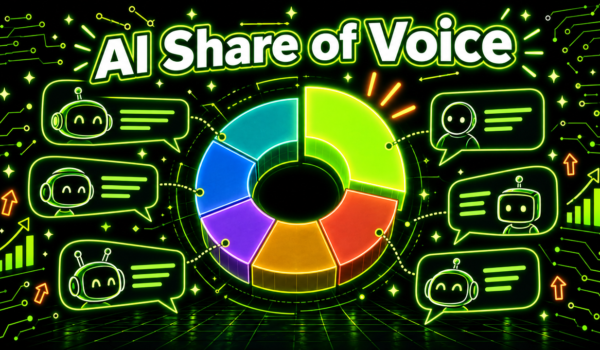
AI share of voice is the percentage of brand mentions in AI-generated answers that belong to your brand, compared with competitors, across a set of questions your customers ask. If ChatGPT, Gemini, Claude, Perplexity and Google’s AI features mention five brands across a hundred category questions, and your brand accounts for a quarter of those mentions, your AI share of voice is 25%. It is one of the clearest ways to measure how visible a brand is as more buyers ask AI assistants for recommendations before they search or visit a website.
This guide explains what AI share of voice means, how to calculate it step by step, how to build a prompt set, how to read the results, which factors move the number, and how to improve it over time.

What is AI share of voice?
Share of voice is an old marketing idea. In advertising, it meant your share of all ad spend or impressions in a category. In SEO, it came to mean your share of visibility across a set of keywords. AI share of voice applies the same idea to answers from AI assistants: of all the brand mentions in AI answers about your category, what share are yours?
AI share of voice matters because AI answers often name only a few options. A buyer who asks “what is the best project management tool for a small agency” may see three to five names and never look further. If your brand is not among them, you lose that buyer before they reach a search results page.
AI share of voice vs other visibility metrics
| Metric | What it measures |
|---|---|
| Mention rate | The share of prompts where your brand appears at all |
| AI share of voice | Your mentions as a share of all brand mentions, relative to competitors |
| Citation rate | The share of prompts where AI links to your website as a source |
| Average position | Where you appear when AI lists several options |
| Sentiment | Whether descriptions of your brand are positive, neutral or negative |
Mention rate shows presence. AI share of voice shows competitive position. A brand can appear in half of all answers and still have a small share if competitors appear in nearly all of them. Our guide to LLM visibility covers the full set of metrics.
Questions to ask before you start
- Which buyer questions matter most to revenue, and do the prompts reflect them?
- Which competitors do buyers compare you with, according to sales and support teams?
- Which assistants does your audience use most, and on which devices?
- Who will run the prompts each month, and who will act on the findings?
- How will you connect changes in the metric to business results?
Answering these questions up front keeps the project focused on decisions rather than on collecting numbers for their own sake. It also makes it easier to explain the work to colleagues who are new to AI visibility.
How to calculate AI share of voice
Step 1: Define your competitive set
List the brands you compete with for the same buyers, usually five to ten. Include direct competitors and the alternatives buyers often consider, such as a spreadsheet or a free tool.
Step 2: Build a prompt set
Write 30 to 100 questions your buyers ask, covering different stages and angles:
- Category questions: “best accounting software for freelancers”.
- Problem questions: “how can freelancers get paid faster”.
- Comparison questions: “Wave vs FreshBooks for a solo designer”.
- Alternative questions: “cheaper alternatives to QuickBooks”.
- Use case questions: “invoicing tool that handles multiple currencies”.
Phrase prompts the way people talk, and vary the wording. Our guide to Reddit keyword research shows how to find real phrasing from customer discussions.
Step 3: Choose the AI assistants
Track the assistants your audience uses. For most brands that includes ChatGPT, Google’s AI Overviews and AI Mode, Gemini, Perplexity, Claude and Microsoft Copilot. Each draws on different sources, so results vary between them.
Step 4: Run each prompt several times
AI answers vary between sessions. Run each prompt at least two or three times per assistant in fresh sessions, and record every brand mentioned in each answer.
Step 5: Count mentions and calculate
For each assistant and overall, add up mentions for each brand. Your AI share of voice is your mentions divided by total mentions of all brands in your competitive set, multiplied by 100.

A worked example
A company that sells project management software runs 50 prompts across five assistants, three times each, for 750 answers. It counts brand mentions across all answers:
| Brand | Mentions | AI share of voice |
|---|---|---|
| Competitor A | 620 | 31% |
| Competitor B | 540 | 27% |
| Your brand | 360 | 18% |
| Competitor C | 300 | 15% |
| Competitor D | 180 | 9% |
| Total | 2,000 | 100% |
The company holds third place. Breaking the data down further shows that its AI share of voice is strong in Perplexity but weak in ChatGPT, and strong for small-team prompts but weak for enterprise prompts. Those details point to specific actions.
Weighted AI share of voice
A simple count treats every mention the same. Some teams weight mentions to reflect their value:
- Position. A brand named first in a list may count more than one named fifth.
- Recommendation strength. A clear recommendation counts more than a passing mention.
- Sentiment. Negative mentions can count as zero or be tracked separately.
- Prompt value. Buying-stage prompts can carry more weight than general questions.
Weighting adds work, so start with a simple count and add weights once the basic process runs smoothly.
Segmenting AI share of voice
An overall number hides important differences. Break AI share of voice down by:
- Assistant: ChatGPT, Gemini, Perplexity, Claude, Copilot and Google’s AI features.
- Topic or product line.
- Buyer stage: problem, category, comparison and buying prompts.
- Audience segment, such as small business versus enterprise.
- Country or language, if you sell in several markets.
Segments show where you are strong and where competitors dominate, which tells you where to focus.
What drives AI share of voice
Mentions in trusted sources
AI assistants learn about brands from the text they read. Reviews, comparison articles, industry publications, expert roundups and community discussions all shape which brands come to mind for a topic. Brands that are mentioned often and positively in trusted sources tend to earn a larger AI share of voice. Our guide to unlinked brand mentions explains why mentions matter even without links.
Community discussions
AI tools often cite community content for recommendation questions, and Reddit threads appear frequently. Being recommended by real users in the threads AI tools read can shift your share. Our guide to Reddit AI search covers how that works.
Clear, retrievable content
For assistants that search the web, pages that answer questions clearly and early are more likely to be retrieved and cited. Comparison pages, use case pages and honest “alternatives” content help AI tools place you in the right answers.
Consistent brand facts
When your name, category and key facts are consistent across your site, profiles and directories, AI tools describe you more accurately and associate you with the right topics. Our guide to entity SEO covers this.
Crawler access
If your site blocks the crawlers that power AI search, assistants cannot retrieve your pages. Check that search crawlers such as OpenAI’s OAI-SearchBot can reach your content, as described in OpenAI’s crawler documentation.

How to improve AI share of voice
- Find the gaps. Identify the prompts and assistants where competitors appear and you do not.
- Check the sources. Record which pages and threads AI tools cite for those prompts.
- Earn presence in those sources. Pitch for inclusion in comparison articles, contribute to relevant community discussions, and encourage satisfied customers to share honest reviews.
- Create content for missing prompts. Publish clear pages that answer the questions where you are absent, especially comparisons and use cases.
- Fix inaccuracies. Correct outdated or wrong information about your brand on your site and third-party pages.
- Measure monthly. Re-run the same prompt set and track changes by segment.
Tools for tracking AI share of voice
You can track AI share of voice manually with a spreadsheet, which works well for 30 to 50 prompts. As the prompt set grows, AI visibility tools automate the work by running prompts on a schedule, recording answers and charting share of voice against competitors. When comparing tools, check which assistants they cover, how often they run prompts, whether they repeat runs to smooth out variation, and whether you can export raw answers to check their counts.
Setting up a tracking spreadsheet
A spreadsheet is enough to start. Create one tab for prompts, with columns for the prompt text, topic, buyer stage and segment. Create a second tab for results, with one row per answer and columns for the date, assistant, prompt ID, run number, each brand mentioned, the position of each mention, sentiment and the sources cited. A third tab can hold formulas that count mentions per brand and calculate shares by assistant, stage and segment.
Keep raw answers, either pasted into a cell or saved as text files with the prompt ID in the name. Raw answers let you check counts later, spot inaccurate descriptions of your brand, and see which sources keep appearing. When you move to a dedicated tool, export its raw data into the same structure so your history stays continuous.
Turning results into a content and outreach plan
Each run produces a list of gaps. Turn them into work in three streams. The content stream covers prompts where no good page exists, such as a missing comparison or use case page. The outreach stream covers sources that AI tools cite often but that do not mention you, such as review sites, publications and roundup articles. The community stream covers discussions, such as Reddit threads, where buyers ask the questions you track and where your team or customers could add helpful answers within each community’s rules.
Assign an owner to each stream and review progress at the same time as the monthly measurement. Over a few months, you can connect specific pieces of work, such as a new comparison page or a mention in a respected roundup, to changes in the numbers for the prompts they target.
Limits of the metric
AI share of voice is useful, but it has limits. Answers vary by user, location, conversation history and account settings, so no measurement captures exactly what every buyer sees. Assistants also change often, which can shift results without any action on your part. Treat the metric as a directional indicator, combine it with business outcomes such as branded search, direct traffic and sales conversations that mention AI tools, and avoid over-reacting to small month-to-month changes.
Reporting AI share of voice
A monthly report should include overall AI share of voice and the trend over three to six months, a breakdown by assistant and buyer stage, the top competitors and how their share changed, the sources AI tools cited most, and actions taken and planned. Keep it short. Leadership mainly wants to know whether the brand is gaining or losing ground in AI answers, and why.
Why AI share of voice moves differently from SEO rankings
Search rankings change when pages, links and algorithms change. AI share of voice changes for a wider set of reasons. Assistants that search the web respond to new content and new mentions fairly quickly. Answers that come from a model’s training data change only when the model is updated, which can take months. Assistants also differ in how they choose sources, so a new comparison article might lift your share in Perplexity within weeks while ChatGPT stays flat. Expect uneven progress across assistants and judge the trend over several months rather than reacting to one run.
Building a prompt set that lasts
The prompt set is the foundation of AI share of voice tracking, so build it carefully. Base prompts on real buyer language from sales calls, support tickets, search data and community discussions. Cover each stage of the buying journey in proportion to its value. Include a few prompts where you expect to win and a few where you expect to lose, so the set reflects reality rather than flattering your brand. Write prompts neutrally, without naming your brand, unless you are specifically tracking branded questions in a separate group.
Once the set is in use, change it rarely. If you must add prompts, add them as a new group and keep reporting the original set separately so trends stay comparable.
AI share of voice by industry
Software
Software buyers ask detailed comparison and alternative questions. AI share of voice in software often depends on review sites, comparison articles and professional communities. Clear pricing and feature pages help assistants place your product correctly.
Consumer products
Shoppers ask for recommendations by use case and budget. Editorial roundups, product reviews and hobby communities carry the most weight, and answers often list several products, so position within lists matters.
Local services
For local questions, assistants lean on listings, reviews and local discussions. AI share of voice should be measured city by city, since a business can lead in one area and be absent in another.
Professional services
Agencies, firms and consultants gain share through expert visibility: published articles, quotes in the press, conference talks and podcast appearances that associate named people with topics.
Common mistakes
- Running each prompt once and treating the result as fact. AI answers vary.
- Using prompts written in marketing language rather than the way buyers ask.
- Tracking only ChatGPT and ignoring other assistants.
- Including too few competitors, which inflates your share.
- Changing the prompt set every month, which breaks trend comparisons.
- Looking only at the overall number without segments.
- Expecting quick changes. Shifts in training data and reputation take months.
AI share of voice FAQ
What is AI share of voice?
It is your brand’s share of all brand mentions in AI-generated answers about your category, compared with competitors, across a set of buyer questions.
How do I calculate AI share of voice?
Run a set of buyer prompts across AI assistants several times, count mentions of each brand in your competitive set, and divide your mentions by the total.
How many prompts do I need?
Thirty to 100 prompts covering different topics and buyer stages give a useful picture. Keep the set stable so you can compare results over time.
Which AI assistants should I track?
Track the ones your audience uses, typically ChatGPT, Google’s AI features, Gemini, Perplexity, Claude and Copilot.
What is a good AI share of voice?
It depends on your market and number of competitors. Compare yourself with direct competitors and aim to grow your share over time, especially on buying-stage prompts.
How long does it take to improve?
Assistants that search the web can reflect new content and mentions within weeks. Changes that depend on model training and broader reputation usually take several months.
Want to see where your customers are already asking? Get a free Reddit Opportunity Report showing which Reddit threads already rank for your keywords.