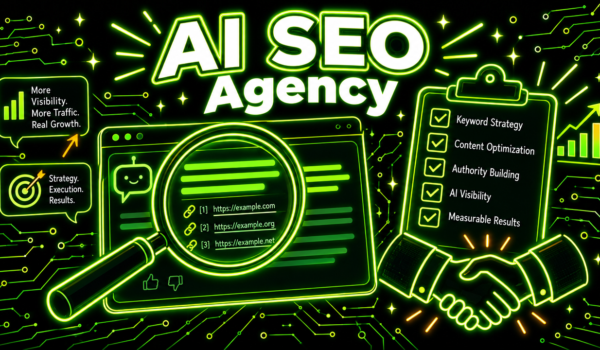
An AI SEO agency helps a business show up in AI-written answers, such as ChatGPT, Perplexity, Claude and Google’s AI Overviews, as well as in regular search results. The good ones audit how AI tools describe you today, fix the technical and content problems that keep you out, and build mentions on the sites those tools read. None of them can guarantee a recommendation, and the ones that promise one are the first to cross off your list.
This guide is for business owners and marketers deciding whether to hire an AI SEO agency and how to pick one. It covers what the work involves, what you can do yourself, the questions that separate a real specialist from a renamed SEO shop, the red flags, and how to judge results once you have signed.

What is an AI SEO agency?
An AI SEO agency is a marketing firm that optimizes for AI search: the tools that answer a question in writing instead of showing ten links. You will also see the work called AEO (answer engine optimization), GEO (generative engine optimization) or LLM SEO. The labels differ, and the goal is the same: when your buyers ask an AI tool for advice in your category, your business should be named, described accurately and, where the tool shows sources, linked.
Most of this work grows out of traditional SEO. Google says in its guide to AI features and your website that they rely on the same fundamentals as regular search, and the other AI tools use web search to find sources, so a site that is easy to crawl and full of clear answers starts ahead. The differences are in emphasis. An AI SEO agency spends more time on how your business is described across the web, on answer-first page structure, and on tracking what AI tools actually say rather than only where a page ranks. Our guide to what AEO is explains the basics in plain words.
What does an AI SEO agency actually do?
Scopes vary, but a full engagement usually covers five areas.
1. An AI visibility audit
The agency runs a set of questions your buyers ask through ChatGPT, Perplexity, Claude, Gemini and Google, records whether you are named, how you are described and which sources are cited, and compares you with competitors. This baseline matters more than any other deliverable, because it is what every later report should be measured against. Our AI visibility audit guide shows what a good one contains.
2. Technical access
AI tools can only cite pages they can reach. The agency checks robots.txt, CDN and firewall settings for blocked AI crawlers (such as the ones in OpenAI’s crawler list), makes sure the main content loads in the page HTML, and fixes indexing gaps in Google and Bing. These fixes are often quick and can matter a great deal.
3. Content built to be quoted
AI tools look for the passage that answers a question. The agency rewrites key pages so each answers its main question in the first lines, uses question headings, adds tables for comparisons and backs claims with sources. It also fills gaps: questions your buyers ask that no page on your site answers.
4. Off-site mentions and entity work
When someone asks an AI tool which company to choose, the answer leans heavily on what other sites say: reviews, comparison articles, directories, news coverage and community threads. A good AI SEO agency works on making sure your business is described accurately and consistently in those places, and earns new mentions in sources the tools trust.
5. Tracking and reporting
The agency re-runs the same prompt set on a schedule, tracks mentions, citations, accuracy and referral traffic from AI tools, and reports changes against the baseline.
Do you need an AI SEO agency, or can you do it yourself?
Plenty of the work is within reach of a small in-house team. Before you hire anyone, it is worth trying the basics yourself for a month:
- Run ten buyer questions through ChatGPT, Perplexity and Google and write down what comes back.
- Check that robots.txt and your CDN are not blocking AI search crawlers.
- Rewrite the opening paragraph of your five most important pages so each answers its main question directly.
- Fix inconsistent business details across your profiles and directories.
- Ask happy customers for reviews on the platforms your industry uses.
Hiring an AI SEO agency makes more sense when you have a competitive category, many pages to rework, no one in-house with SEO experience, or when you have done the basics and stalled. It makes less sense if you have not yet confirmed that your buyers use AI tools to research your category. Our step-by-step guide to AI search optimization covers the in-house route in detail.
| Do it in-house | Hire an AI SEO agency | |
|---|---|---|
| Best when | Few key pages, simple category, someone with time | Competitive category, large site, no SEO skills in-house |
| Strength | You know the product and customers best | Experience across many sites, tools and testing |
| Risk | Work stalls when the team gets busy | Paying for activity that does not move results |
| What to measure | Your own monthly prompt checks | The agency’s reports against your baseline |
How to choose an AI SEO agency: 10 questions to ask
Many SEO firms added “AI” to their service pages without changing what they do. These questions help you find out which kind you are talking to.
- “Show me a recent AI visibility audit.” Ask for a real, anonymised example. You want to see prompts, the answers each AI tool gave, cited sources and a clear list of fixes.
- “Which AI tools do you track, and how?” A specialist can explain how they test ChatGPT, Perplexity, Claude, Gemini and Google’s AI features, how often, and how they handle answers that change from one run to the next.
- “What will you change in the first 30 days?” Good answers name specific technical checks, pages and off-site sources. Vague answers about “strategy” are a warning.
- “How do you decide which off-site sources matter?” They should talk about the sources AI tools actually cite in your category, which they find by looking at answers, not a generic list of directories.
- “What do you not do?” Honest agencies are clear about their limits: some focus on content, some on technical work, some on reputation and communities.
- “How do you handle review sites and communities like Reddit?” You want to hear about transparency, disclosure and the platforms’ rules, never fake reviews or undisclosed accounts.
- “What will you report, and against what baseline?” Reports should compare mentions, citations, accuracy and AI referral traffic with the starting audit.
- “Who will do the work?” Ask whether the people in the pitch will work on your account, and how much is done by junior staff or software.
- “How do you use AI to write content?” Using AI tools is fine. Publishing unedited AI copy is not, because pages that read like everyone else’s give AI tools no reason to cite you.
- “What happens if results do not move?” Look for a clear review point and a plan for changing course, rather than a long lock-in.

Red flags when hiring an AI SEO agency
Walk away, or at least slow down, if you hear any of these:
- Guaranteed placements. No one controls what ChatGPT or Google writes. AI tools build answers fresh each time, and providers do not sell organic placement. Our guide on how to rank in ChatGPT explains why guarantees are not possible.
- Secret tricks or “AI markup”. Google says there is no special markup for its AI features. Hidden text aimed at AI models is more likely to hurt than help.
- Fake reviews or sock-puppet accounts. These break platform rules, can break consumer protection law, and damage trust when exposed.
- Reports with no baseline. Charts of activity, such as pages written or links built, without any measure of what AI tools now say about you.
- One tactic for every client. If the plan is the same regardless of your category, the agency is selling a package, not solving your problem.
- Long contracts before any audit. A credible AI SEO agency is usually willing to start with a defined audit or short first phase.
How AI SEO agencies charge
Pricing models fall into a few patterns, and the right one depends on how much work your site needs:
- One-off audit: a fixed fee for an AI visibility audit and a prioritised fix list, which your team then carries out.
- Monthly retainer: ongoing tracking, content, technical work and off-site outreach for a set monthly fee.
- Project fee: a defined piece of work, such as rewriting a set of pages or a technical clean-up.
- Hybrid: an audit first, then a retainer if the audit shows enough opportunity.
Costs vary widely with the size of the site, the competitiveness of the category and how much content and outreach is included. Rather than comparing headline prices, compare what each AI SEO agency will deliver in the first 90 days and how it will prove the work moved your results.
AI SEO agency vs AI SEO software
A growing number of tools promise to track or improve AI visibility on their own. They fall into two groups. Tracking tools run prompts through AI assistants on a schedule and report mentions, citations and share of voice. Content and audit tools scan your pages for technical problems and suggest rewrites.
Software is good at repetition: running the same hundred prompts every week, spotting a crawler block, flagging a page with no clear answer. It is weak at judgment: deciding which buyer questions matter, writing a page an expert would respect, or earning a mention in a trade publication or a Reddit thread. An AI SEO agency should use tools for the first group of tasks and people for the second. If an agency’s whole offer is a dashboard, you may be better off buying the tool directly. If a tool’s whole offer is automated rewriting, check the output closely before anything goes live.
For a small business, a sensible pattern is to start with a monthly manual prompt check, add a tracking tool once you know which prompts matter, and bring in an AI SEO agency for the parts that need skill and time: content, technical clean-up and reputation work.
Questions an AI SEO agency should ask you
The discovery call works both ways. A good agency will want to know:
- Who your best customers are and how they describe the problem you solve.
- Which competitors come up most often in sales conversations.
- Where your buyers research: Google, AI assistants, review sites, Reddit, industry forums.
- What your site runs on and who can make changes to it.
- Which results would make the work worth it to you within a year.
If an agency pitches a plan without asking any of these, the plan was written before it met you.
Where Reddit and online communities fit
For many categories, community discussions are among the sources AI tools lean on most when people ask for recommendations. Threads where real customers compare options often rank on Google, which puts them in front of the AI tools that search the web before they answer. If your buyers talk on Reddit or in industry forums, an AI SEO agency that ignores those places is leaving out a source that may shape what AI tools say about you.
The work there looks different from link building. It means finding the threads that already rank for your category, taking part openly as a real person who discloses who they work for, following each community’s rules, and being useful before ever mentioning a product. Our Reddit marketing strategy and how to mention your brand on Reddit guides cover how to do it without getting removed. When you interview an AI SEO agency, ask how it approaches communities. Answers that involve fake accounts or bought votes are an immediate no.
How to measure an AI SEO agency’s results
Agree on the measures before work starts, so reports answer the questions you care about:
- Mentions: how often you are named across the prompt set, by tool.
- Accuracy: whether the description of your business is correct and current.
- Citations: how often your own pages are linked as sources.
- Share of voice: your mentions compared with named competitors for the same prompts.
- AI referral traffic: visits from chatgpt.com, perplexity.ai and similar sources in your analytics.
- Business results: leads or sales from those visits, and any change in branded search.
Give it time. Technical fixes can show up within weeks once pages are recrawled; reputation and off-site work usually takes months. A reasonable first review point is 90 days after the baseline audit.
What a good first 90 days looks like
A credible AI SEO agency should be able to describe something close to this:
- Weeks 1 to 2: baseline audit across the main AI tools and Google, competitor comparison and a prioritised fix list.
- Weeks 3 to 6: technical fixes, rewrites of the most important pages and corrections to inconsistent business details.
- Weeks 7 to 10: new pages for unanswered buyer questions and the first off-site work on reviews, directories and communities.
- Weeks 11 to 13: repeat of the audit, report against the baseline and a plan for the next quarter.
If an agency cannot describe its first 90 days in this level of detail, ask why before you sign.
Frequently asked questions
What is the difference between an SEO agency and an AI SEO agency?
A traditional SEO agency focuses on rankings in Google’s list of results. An AI SEO agency also works on how AI tools describe and cite your business, which puts more weight on answer-first content, off-site reputation and tracking AI answers directly.
Can an AI SEO agency guarantee my business will appear in ChatGPT?
No. AI tools build each answer fresh from many sources, and no provider sells organic placement. An agency can improve your odds and measure progress, but a guarantee is a reason to walk away.
How long does it take to see results from an AI SEO agency?
Technical fixes and page rewrites can show up within weeks of being recrawled. Changes to how you are described across the web usually take several months.
Is an AI SEO agency worth it for a small business?
It can be, if your buyers use AI tools to research your category and you lack the time or skills to do the work. Many small businesses get far by doing the basics themselves first, then hiring help for the parts they cannot cover.
What should an AI SEO agency report each month?
Mentions, accuracy, citations and share of voice across a fixed prompt set, AI referral traffic, the work completed, and what is planned next, all compared with the baseline audit.
What should I prepare before talking to an AI SEO agency?
Write down ten questions your buyers ask before they purchase, run them through two or three AI tools, and save the answers. Add your top competitors and the results you would count as success. That one page makes every agency call more useful and gives you a baseline of your own to check their claims against.
Does an AI SEO agency still do regular SEO?
Most do, because the foundations overlap. Crawlable, fast pages with clear answers help in Google’s regular results and in AI answers alike.
Want to see where your customers are already asking? Get a free Reddit Opportunity Report showing which Reddit threads already rank for your keywords.