AI search optimization is the work of making your business show up in answers from AI tools such as ChatGPT, Claude, Perplexity, Gemini and Google’s AI Overviews. In practice it means letting AI crawlers reach your site, answering customer questions clearly, keeping your business facts consistent, earning mentions on the sites and communities AI tools read, and tracking a fixed set of questions every month.
This guide turns AI search optimization into ten steps a small team can follow, with a page-level checklist, the myths worth ignoring and a simple way to measure results.

What is AI search optimization?
AI search optimization covers everything you do to be found, understood and recommended by AI-powered search. That includes chat assistants that search the web, AI search engines like Perplexity, and the AI layers Google has added to its own search, AI Overviews and AI Mode.
You will also see this work called generative engine optimization (GEO), answer engine optimization (AEO) or LLM SEO. The names overlap heavily. If you want the definitions first, read What is AEO? and What is generative engine optimization?. This guide focuses on what to do.
How do AI search engines find and choose content?
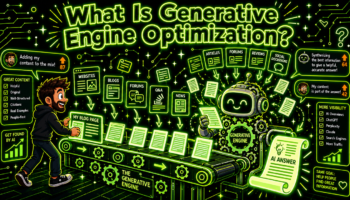
AI search engines find content by searching the web when a question needs current or specific information, then choosing a handful of passages to build an answer from. They tend to pick passages that answer the question directly, come from sources they trust, and agree with other sources.
Two consequences shape every step below. First, your pages have to be reachable and readable, or they never enter the running. Second, your own site is only one of the sources a tool weighs. Reviews, directories, articles and community discussions about you shape the answer too. Our explainer on generative engine optimization walks through the process step by step.
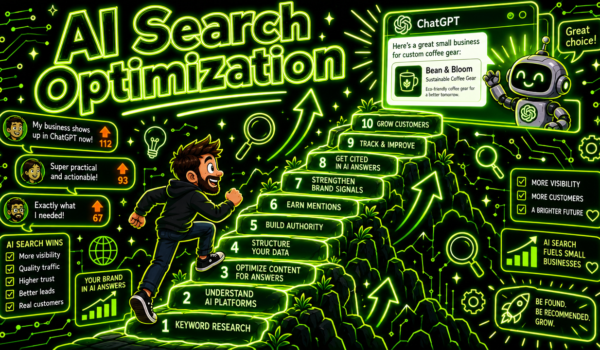
10 steps to AI search optimization
Work through these in order. The early steps make the later ones count.
1. List the questions your customers ask
Start with real questions, not keywords. Pull them from sales calls, support tickets, emails, reviews and the threads where your customers talk. Aim for twenty to fifty, written the way people say them: “How much does it cost to replace a water heater?” rather than “water heater cost”.
Group them by stage. Some are early (“do I need an accountant as a freelancer?”), some compare options (“Xero vs QuickBooks for freelancers”), and some are ready to buy (“accountant for freelancers in Leeds”). AI search optimization works best when you cover all three.
2. Check how AI tools describe you today
Run your most important questions in ChatGPT, Claude, Perplexity, Gemini and Google. For each, record whether you are named, what is said about you, which competitors appear and which sources are cited. This baseline tells you where to focus. Our AI visibility audit guide includes a simple scoring sheet.
3. Let AI crawlers reach your site
Open your robots.txt file and check it does not block the crawlers AI tools use to search. OpenAI lists its crawlers on its crawler overview page: OAI-SearchBot powers ChatGPT search, GPTBot collects training data and ChatGPT-User fetches pages when a user asks. Other providers publish similar lists.
Also check your firewall or CDN. Some security services offer settings that block AI bots, and these are easy to switch on without realising what they affect. If you want to appear in AI answers, allow at least the search crawlers.
4. Rewrite your key pages answer-first
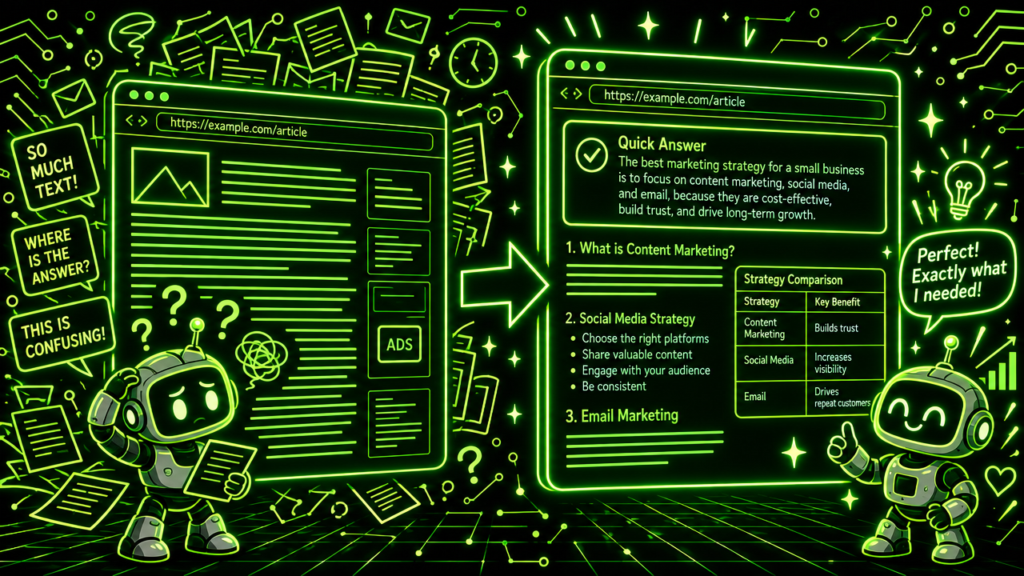
Take your ten most important pages, usually the home page, main service or product pages and top articles. Put a direct, complete answer to the page’s main question in the first two or three sentences. Then add the detail.
A tool looking for a passage to quote will find it at once. A reader skimming on a phone will too. This single change helps featured snippets, AI Overviews and chat assistants at the same time.
5. Use question headings and self-contained sections
Phrase headings as the questions people ask, and answer each in the first sentence underneath. Keep every section readable on its own, because an AI tool may quote one section without the rest of the page. Avoid sections that only make sense if you have read the one before.
6. Add structured data where it fits
Structured data, or schema markup, labels the facts on a page: your organisation, address, opening hours, products, prices, reviews and FAQs. Google’s structured data documentation explains the formats. Google says structured data is not required for its AI features, but it helps search engines read your facts correctly. Only mark up what is visible on the page.
7. Keep your business facts consistent everywhere
Check your name, description, address, phone, service area, prices and main products across your website, Google Business Profile, Bing Places, industry directories, social profiles and review sites. AI tools cross-check sources. Where they disagree, the tool may pick the wrong version or skip you.
8. Publish original information others will cite
AI tools and the writers they read are drawn to information they cannot find elsewhere: survey results, pricing benchmarks, how-to guides from real experience, clear comparisons. One useful resource can earn mentions on other sites for years, and each mention adds to how AI tools understand you.
9. Earn mentions in communities and reviews
Ask happy customers for reviews on the sites your buyers check. Offer useful information to writers and podcasters in your field. Take part in the communities where your customers ask questions, as yourself and with your connection disclosed. These outside sources are a large part of AI search optimization, and the part most plans skip.
10. Track a fixed set of questions every month
Re-run the questions from step 2 once a month in the same tools. Record mentions, accuracy and cited sources in the same sheet. AI answers vary from day to day, so the trend over several months matters far more than any single result.
How to optimize content for AI search
Use this checklist on every page you want AI tools to use:
| Check | What good looks like |
|---|---|
| Lead answer | The first 40 to 60 words answer the page’s main question on their own |
| Headings | Phrased as real questions, each answered in its first sentence |
| Sections | Each section makes sense if quoted alone |
| Specifics | Numbers, names and examples instead of vague claims |
| Sources | Claims link to credible sources; statistics carry a date |
| Format | Lists and tables where they help comparison |
| Facts | Business details match every other listing |
| Access | Page loads without logins, pop-up walls or heavy scripts hiding the text |
Content written this way tends to serve readers better too. The checklist removes the friction that stops anyone, human or machine, from finding the answer.
How do Reddit and community mentions fit into AI search optimization?
Reddit and community mentions fit in at step 9, and they matter because AI tools often draw on discussion threads when people ask for recommendations. A thread where several users compare tools and explain what worked is exactly the material a tool needs to answer “what should I use for X?”
How much each tool cites Reddit changes over time, and our post Does ChatGPT use Reddit? tracks the published studies with their dates. Whatever the current share, the approach that works is the same: find the communities where your buyers ask questions, take part regularly as a real person, and mention your business only when it answers the question, with your connection made clear.
Our Reddit marketing strategy guide shows a weekly routine a small team can run in about two hours, and how to mention your brand on Reddit covers how to do it without sounding like an ad.
AI search optimization myths to ignore
AI search optimization attracts a lot of confident advice. These claims come up often and do not hold up.
Myth: you need special markup or files for AI
Google’s guidance on AI features says there are no extra requirements to appear in AI Overviews or AI Mode, and no special schema or AI text files to add. Normal SEO best practices are what count.
Myth: llms.txt is a ranking factor
llms.txt is a proposed standard for a file that points AI tools to a site’s key pages. It is harmless to add, but major AI providers have not said they use it to choose sources. Do not expect it to change your visibility on its own.
Myth: repeating keywords helps AI tools find you
The academic GEO research found keyword stuffing did little for visibility in generative answers, while adding sources, quotations and statistics helped more. Write naturally and be specific.
Myth: someone can guarantee you a spot in ChatGPT
No one controls what an AI tool says. Answers vary by user, wording and model version. Treat guarantees as a red flag. We explain why in how to rank in ChatGPT.
Myth: AI search makes SEO pointless
AI tools that search the web depend on pages they can find and trust, which is what SEO produces. Our comparison of SEO vs GEO vs AEO covers what carries over.

Common AI search optimization mistakes
A few mistakes undo a lot of good work:
- Blocking AI crawlers by accident. A security setting or an old robots.txt rule can keep search crawlers out. Check both before anything else.
- Hiding answers behind scripts or logins. If the text only appears after heavy JavaScript runs, or sits behind a sign-up wall, many crawlers will not see it.
- Writing for the tool instead of the reader. Pages stuffed with phrases or written in a stiff question-and-answer pattern read badly and are less useful to quote.
- Letting old facts linger. Out-of-date prices, closed locations or discontinued products on directories and old pages can end up in AI answers.
- Spamming communities. Dropping links in threads gets removed and damages how people, and the tools that read those threads, see your brand.
- Measuring once. A single check tells you little, because answers vary. Use the same question set every month.
How to measure AI search optimization
Measure AI search optimization with a small set of numbers you check monthly:
| Metric | Where to find it | How often |
|---|---|---|
| Mention rate | Your fixed question set, run in each AI tool | Monthly |
| Accuracy of description | The same runs, noting errors or outdated facts | Monthly |
| Cited sources | Source links shown in Perplexity, AI Overviews and ChatGPT search | Monthly |
| AI referral traffic | Analytics, filtered for sources such as chatgpt.com, perplexity.ai and gemini.google.com | Monthly |
| Self-reported source | “How did you hear about us?” on forms and calls, with AI assistants as an option | Ongoing |
| Search performance | Google Search Console impressions and clicks | Monthly |
Keep the question set the same from month to month so the numbers are comparable. Add new questions in a separate section if your business changes.
A 30-day AI search optimization plan
If you want a starting schedule, this plan covers the first month for a small team working a few hours a week.
- Week 1: questions and baseline. Collect 20 to 50 customer questions. Run the top 15 in ChatGPT, Claude, Perplexity, Gemini and Google. Record mentions, descriptions and cited sources in a sheet.
- Week 2: access and facts. Check robots.txt and any CDN or firewall bot settings. List every place your business is described online and fix inconsistent names, addresses, hours and descriptions.
- Week 3: your top pages. Rewrite your five most important pages answer-first, with question headings and self-contained sections. Add structured data for your organisation and main products or services.
- Week 4: outside mentions. Ask ten recent happy customers for reviews. Find three community threads where your customers ask questions you can answer, and answer them well. Pitch one useful piece of information to a writer or podcast in your field.
From month two, repeat the monthly check, rewrite five more pages each month and keep a steady rhythm of reviews and community participation. AI search optimization rewards consistency more than bursts of effort.
AI search optimization for different kinds of business
The ten steps apply to everyone, but the emphasis shifts with what you sell.
Local businesses. AI tools answering local questions lean on your Google Business Profile, Bing Places, review sites, local directories and local community threads. Keep hours and service areas accurate, collect reviews that mention specific services, and answer local questions on your site.
Online stores. Product questions draw on product pages, comparison articles, reviews and discussion threads. Publish full product specifications, honest comparison pages and buying guides, and make sure product facts match across marketplaces.
B2B and software. Buyers ask AI tools for shortlists and alternatives. AI answers draw on comparison pages, documentation, review platforms and practitioner communities. Keep documentation public and crawlable, publish fair comparison pages and take part in the communities your buyers use.
How long does AI search optimization take?
Changes to your own pages can start showing in AI answers within a few weeks, once the tools recrawl them. Off-site work such as reviews and community mentions builds over months. Most businesses should expect a gradual climb in mention rate over three to six months, with ups and downs along the way as answers vary.
AI search optimization: frequently asked questions
How do I rank a website in AI Overviews?
Follow normal SEO best practices, since Google says AI Overviews rely on them. Answer questions clearly near the top of the page, use question headings, keep pages crawlable and build a strong reputation across the web.
How do I optimize for AEO?
Write answer-first pages with question headings, keep sections self-contained, let AI crawlers in, keep business facts consistent and earn outside mentions. AEO and AI search optimization use the same steps.
Is AI search optimization different from SEO?
It builds on SEO. The foundations are the same, but AI search optimization puts more weight on direct answers, outside mentions and tracking how AI tools describe you, since many answers produce no click.
Do I need llms.txt?
No. It is an optional proposed file that major AI providers have not said they rely on. Focus on crawler access, clear pages and outside mentions first.
Can I track traffic from AI search?
Partly. Visits from AI tools appear in analytics as referrals from sites such as chatgpt.com and perplexity.ai. Many AI answers produce no click, so also track mentions and ask leads how they found you.
Does AI search optimization work for small businesses?
Yes. Many of the questions people ask AI tools are local or niche, where a small business with clear pages, accurate listings and good reviews can be named alongside much larger competitors.
Which AI tools should I optimize for?
Start with the ones your customers use most, usually ChatGPT, Google’s AI Overviews and AI Mode, Gemini, Perplexity and Claude. The same steps help across all of them, so you rarely need tool-specific work at the start.
What is the most important step in AI search optimization?
For most businesses, rewriting key pages answer-first and earning accurate outside mentions make the biggest difference. Crawler access comes first, because nothing else works if AI tools cannot read your site.
Want to see where your customers are already asking? Get a free Reddit Opportunity Report showing which Reddit threads already rank for your keywords.