To appear in Google AI Overviews, your page has to be indexed and eligible to show a snippet in normal Google Search, and it has to answer the question more clearly than the other pages Google can choose from. Google says there is no special markup, file or setting that opts a page into AI Overviews. Clear answers near the top of the page, accurate facts, a good page experience and signs that people trust your site do the work.
This guide is for site owners who want their content cited in the answer box at the top of Google, not for people trying to switch AI Overviews on or off in their own browser. It explains how to appear in Google AI Overviews step by step: how Google picks the pages it cites, which controls you have, eight practical steps, and how to measure the result.

What are Google AI Overviews?
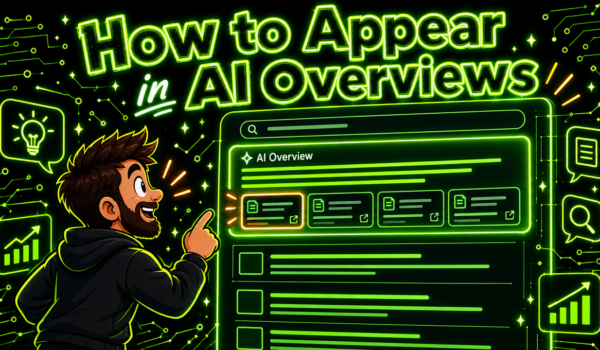
AI Overviews are the AI-written summaries Google shows above the regular results for some searches. Google’s Gemini models write a short answer and show links to the pages that support it. Those links are the prize: they appear at the very top of the page, before any organic result.
Google also runs AI Mode, a separate tab where people can ask longer questions and follow-ups. Google treats both the same way for site owners, so everything here about how to appear in Google AI Overviews applies to AI Mode as well.
Not every search gets an AI Overview. Google shows them when it thinks a written summary will help, which in practice means many informational and how-to questions, and fewer simple navigational searches like a brand name.
How does Google choose sources for AI Overviews?
Google explains the basics in its guide to AI features and your website. The short version has three parts.
The page must be eligible for normal search
Google says a page has to be indexed and eligible to be shown in Google Search with a snippet to be used as a supporting link. There are no extra technical requirements. If a page is blocked from crawling, marked noindex or set to show no snippet, it cannot be cited.
Google searches more than the original query
Google describes a technique called query fan-out: to build an answer, it may run several related searches across subtopics and gather results from each. That is why a cited page is not always one of the top ten organic results for the exact query. A page that ranks well for a related sub-question can be pulled in.
The best supporting passage wins
Once Google has candidate pages, it looks for passages that support the points in its answer. A page that states the answer plainly, with facts it can check against other sources, is easier to use than a page that hides the answer under a long introduction.
None of this is a secret ranking formula. Google’s own advice is that the same SEO practices that help in regular search help in AI features: helpful, reliable content written for people, a technically sound site and a good page experience.
Can you opt in or out of AI Overviews?
There is no opt-in. You cannot add a tag that asks Google to include you, and no setting covers how to appear in Google AI Overviews on demand. You can only make yourself eligible and then be the best available source.
There are ways to limit how your content is used, and each comes with a cost:
| Control | What it does | Cost |
|---|---|---|
| noindex | Removes the page from Google Search entirely | No organic traffic and no AI Overview citations |
| nosnippet | Stops Google showing any text snippet from the page | The page cannot be used in AI Overviews and loses its snippet in regular results |
| max-snippet:[number] | Limits how many characters Google may show | Shorter snippets everywhere, including AI features |
| data-nosnippet | Excludes a specific section of a page from snippets | That section cannot be quoted; the rest of the page still can |
Details for each are in Google’s robots meta tag documentation.
A common mistake is to think the Google-Extended setting controls AI Overviews. Google’s documentation on its crawlers says Google-Extended governs whether your content is used to train and ground Gemini models outside Search; it does not affect your inclusion in Google Search. Blocking Google-Extended will not keep you out of AI Overviews, and allowing it will not get you in.
How to appear in Google AI Overviews: 8 steps
These steps follow the order in which problems usually show up when a business works out how to appear in Google AI Overviews. Fix eligibility first, then the page, then your reputation.
1. Make sure the page is indexed and snippet-eligible
Open Google Search Console and run the URL Inspection tool on the page. It should say the URL is on Google. Then check the page source for noindex, nosnippet or a very low max-snippet value, and check robots.txt is not blocking Googlebot from the page or the files it needs to render. This is the first thing to check whenever someone asks how to appear in Google AI Overviews, because a page that fails here has no chance at all.
2. Answer the question in the first 40 to 60 words
Write the answer first and the background second. If the page is about how long a kitchen remodel takes, the first sentence should give a range and what drives it. AI Overviews pull supporting passages, and the opening of a page or section is the most likely passage to be used.
3. Cover the follow-up questions on the same page
Because of query fan-out, Google looks for answers to the sub-questions around a topic. Look at People Also Ask and the related searches for your main query, and answer the follow-ups under their own headings. A page that covers cost, time, steps and common problems has more passages Google can use than a page that covers one of them.
4. Use clear headings, lists and tables
Phrase headings as the questions people type. Use numbered lists for steps and tables for comparisons. Structure helps Google find the exact passage that matches a sub-question, and it helps readers who land from the AI Overview find what they came for.
5. Show who wrote it and why they know
Google’s guidance on helpful content asks whether a page shows first-hand experience and expertise. Name the author, say what qualifies them, and include details only someone who has done the work would know: real numbers, photos, mistakes you have seen. Generic pages that repeat what every other site says give Google no reason to prefer you.
6. Keep facts current and dated
If your page quotes prices, rules, specifications or statistics, give each one a source and the date it was checked, and review the page on a schedule. A page with stale numbers is a risky source for an AI answer, and other pages with fresher facts will be preferred.
7. Add structured data that matches visible content
Google says structured data is not required for AI features, but it helps Google understand a page. Use the schema types that fit, such as Article, Product, LocalBusiness, HowTo where supported, or Organization, and make sure every value matches what a visitor can see on the page. Markup that contradicts the page does more harm than good.
8. Earn mentions and links from sites Google trusts
AI Overviews draw on pages Google already trusts for a topic. Links and mentions from respected sites in your field, accurate listings in your industry’s directories and a strong review profile all build that trust. This is slow work, and it is also the part your competitors cannot copy in an afternoon.

Why Reddit threads show up in AI Overviews
Search for almost any product comparison or “what do people recommend” question and you will often see Reddit in the results, both in the regular listings and in the discussions and forums section. When we pulled the results for “how to appear in google ai overviews” for this article, a Reddit thread ranked in the organic results and a discussions box showed two more threads. Pages that rank well for the sub-questions around a topic are candidates for AI Overview citations, and forum threads are often among them.
If you are working out how to appear in Google AI Overviews for recommendation questions, that means two things. If people discuss your category on Reddit, those threads may shape the answer Google writes, so it is worth knowing what they say about you. And taking part in those discussions, as a real person who discloses who they work for and follows each subreddit’s rules, is one more way to be present in the sources AI Overviews draw on. Our guide to finding Reddit threads that already rank shows how to find them, and Reddit SEO covers how to take part without breaking the rules.
How to track AI Overview visibility
Google includes clicks and impressions from AI features in the Performance report in Search Console, under the Web search type. It does not split them out into a separate AI Overviews report, so you will not see a filter for them. What you can do:
- Watch your target queries. Track impressions, clicks and average position in Search Console for the questions you rewrote pages for.
- Spot-check manually. Search your target questions in a clean browser session once a month and record whether an AI Overview appears and which sites it cites.
- Use a rank tracker that records AI Overviews. Several SEO tools now note whether a query triggers an AI Overview and which URLs it cites. Pick one and stick with it so the numbers are comparable.
Our AI visibility audit guide has a template for recording these checks alongside ChatGPT and Perplexity.
How to appear in Google AI Overviews for different kinds of pages
The eight steps apply everywhere, but the emphasis shifts with the type of page.
Local service pages
For a plumber, dentist or accountant, the questions that trigger AI Overviews are usually about cost, timing and what to expect. Put a realistic price range and the factors that change it near the top, name the towns you serve, and keep your Google Business Profile, website and directory listings in agreement. Reviews that mention specific services give Google more to work with than a page of five-star ratings with no text.
Product and ecommerce pages
Product questions lean on specifications, comparisons and real use. Publish full specs in text, not only in images, add a comparison table against the alternatives buyers consider, and answer the common objections in a short FAQ. Product schema that matches the visible price and availability helps Google read the page correctly.
Guides and blog posts
For informational questions, the page that wins is usually the clearest one, not the longest. Open with the answer, cover the follow-up questions under their own headings, and cut sections that repeat what every other article says. When you are working out how to appear in Google AI Overviews with a blog, update your best existing posts before writing new ones; an older page with links and history often has a head start.
A quick checklist before you publish
Run through this list for any page you want cited. If you can tick every line, you have done what Google says matters for how to appear in Google AI Overviews:
- The page is indexed, with no noindex, nosnippet or restrictive max-snippet value.
- The first 40 to 60 words answer the main question on their own.
- Follow-up questions have their own headings and direct answers.
- Steps are numbered and comparisons sit in tables.
- The author is named, with a reason to trust them.
- Every fact that can go out of date has a source and a date.
- Structured data matches what the visitor sees.
How do AI Overviews differ from featured snippets?
People often ask whether learning how to appear in Google AI Overviews is different from winning a featured snippet. A featured snippet quotes one page, word for word, in a box above the results. An AI Overview writes its own summary and links to several supporting pages. The work to win both is similar: a direct answer near the top, clear structure and a trusted page. The difference is that an AI Overview can cite you even when your page is not the single best match, because it combines passages from several sources.
Common mistakes when trying to appear in Google AI Overviews
- Blocking snippets by accident. A nosnippet tag left over from a site redesign removes a page from AI Overviews completely.
- Thin answers. A page that answers one question in one sentence and stops gives Google little to work with on follow-ups.
- Chasing “AI markup”. There is no special tag. Time spent hunting for one is better spent on the page itself.
- Burying the answer. Long introductions, pop-ups and stock photos before the first real sentence make the passage harder to use.
- Ignoring page experience. Slow pages and intrusive ads hurt in regular search and in AI features alike.
Is it worth trying to appear in AI Overviews?
AI Overviews change how people click. Some searchers read the summary and leave, which means fewer clicks for every result on the page. The pages that are cited still get seen at the top of the screen, and the visitors who click through have usually read the summary and want more detail.
For most businesses, the question is less “should we try” and more “can we afford to be left out”. If your competitors are cited and you are not, the summary at the top of Google is describing your market without you. Learning how to appear in Google AI Overviews mostly means doing good SEO with a sharper focus on direct answers, so the effort pays off in regular results as well. For the wider picture across ChatGPT, Claude and Perplexity, see our guide to AI search optimization and the basics in what is AEO.

Frequently asked questions
How do I get my website in Google AI Overviews?
Make sure the page is indexed and allowed to show a snippet, answer the question in the first lines, cover the follow-up questions, and build trust with mentions and links from respected sites. Google says there are no extra technical requirements beyond normal SEO.
Do I need schema markup for AI Overviews?
No. Google says structured data is not required to appear in AI features. It can help Google understand your page, so use it where it fits, and keep it consistent with the visible content.
Can I stop my site appearing in AI Overviews?
Yes, with nosnippet, data-nosnippet, max-snippet or noindex. Each one also limits how your page appears in regular search, so use them only where the trade-off makes sense.
Does Google-Extended block AI Overviews?
No. Google’s documentation says Google-Extended does not affect inclusion in Google Search. It controls use of your content for Gemini models outside Search.
Do AI Overviews reduce clicks?
They can, because some searchers get what they need from the summary. Cited pages still gain visibility at the top of the results. Watch your own Search Console data for the queries that matter to you. Industry averages say little about your own queries.
How long does it take to appear in AI Overviews?
Fixes to eligibility, such as removing a nosnippet tag, can take effect once Google recrawls the page. Rewriting pages and building trust takes weeks to months, the same as regular SEO.
How to appear in Google AI Overviews as a small site?
Pick narrow questions where you have real experience and the current sources are weak, answer them better than anyone else, and make sure the pages are technically eligible. Small sites are cited often for specific, practical questions where big publishers have nothing first-hand to say.
Why is a competitor cited when I rank higher?
Because AI Overviews pull from searches for related sub-questions, not only the main query. Your competitor may answer a follow-up question more directly, or have a passage that fits one point of the summary better. Compare their page section by section and fill the gaps on yours.
Want to see where your customers are already asking? Get a free Reddit Opportunity Report showing which Reddit threads already rank for your keywords.