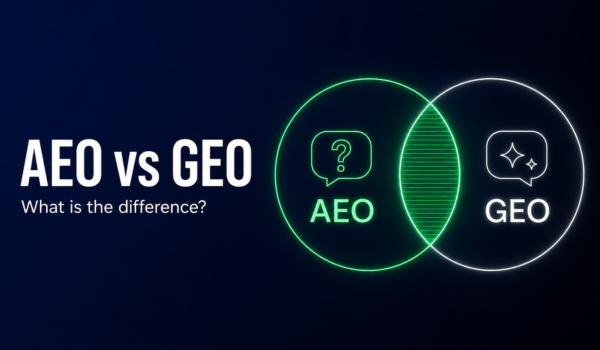
AEO and GEO mean nearly the same thing in practice. Answer engine optimization (AEO) is the broader term for getting your content chosen as the direct answer to a question, whether that answer is a Google featured snippet, a voice assistant reply or a ChatGPT response. Generative engine optimization (GEO) is the narrower term for getting your brand cited inside AI-generated answers that blend several sources. Most agencies sell the same work under both names, so judge a proposal by what it does, not by the label.
The short answer
| AEO | GEO | |
|---|---|---|
| Stands for | Answer engine optimization | Generative engine optimization |
| Covers | Any system that gives a direct answer: featured snippets, People Also Ask, voice assistants, AI Overviews, AI chat | AI systems that write a new answer from several sources: ChatGPT, Perplexity, Gemini, Google AI Overviews and AI Mode |
| Older roots | Featured snippets and voice search | A 2023 research paper that named the field |
| Main goal | Be the answer | Be cited or recommended inside the answer |
| How success is measured | Snippets won, mentions, citations, referral traffic | Mentions, citations and share of AI answers for a set of prompts |
What AEO means
AEO grew out of featured snippets and voice search, where a search engine reads out or displays one answer instead of ten links. The IONOS guide to answer engine optimization describes it as optimizing for systems that give direct answers, and lists the surfaces it covers: featured snippets, People Also Ask, voice assistants, Google AI Overviews, Google AI Mode and generative AI chats such as ChatGPT, Gemini and Perplexity.
AEO work leans on clear question-and-answer content, short definitions near the top of a page, structured data and pages that match the way people phrase questions. Our guide to AEO covers the basics.
What GEO means
GEO is younger. Researchers from Princeton, IIT Delhi and elsewhere named it in the paper GEO: Generative Engine Optimization, first posted in November 2023 and accepted to KDD 2024. They described generative engines as systems that gather and summarize information from several sources to answer a query, and they reported that optimization methods could raise a source’s visibility in those answers by up to 40%.
Because generative answers draw on many sources at once, GEO puts more weight on what other sites say about you: reviews, roundup articles, forum threads and news coverage. It also tracks visibility across a fixed set of prompts rather than one keyword at a time. Our explainer on what generative engine optimization is goes deeper.
Where AEO and GEO overlap
Nearly everything a buyer pays for sits in the overlap:
- Finding the questions your buyers ask and the answers AI tools give today.
- Writing pages that answer those questions plainly and early.
- Making your site easy for search and AI crawlers to read.
- Earning mentions on the third-party pages that answers cite.
- Tracking which tools name you, which name competitors, and why.
IONOS makes the same point: the boundaries between the terms are not clearly drawn, so it advises naming the system you want to show up in and the output you want, rather than arguing over labels.
Other names you will hear
- LLMO (large language model optimization): focuses on how language models understand and repeat facts about your brand. Mostly a subset of GEO.
- AIO or AI SEO: loose marketing terms for the same bundle of work.
- AI search optimization: the plain-English version many agencies now use.
- SEO: still the base layer. Most AI tools pull from pages that already rank or are easy to crawl. See our comparison of SEO vs GEO.
Which one do you need?
If your buyers mostly search Google and read short answers, the classic AEO tasks (snippets, People Also Ask, structured answers) pay off first. If your buyers ask ChatGPT or Perplexity for a shortlist of providers, products or tools, GEO tasks matter more, especially third-party mentions and reviews. Most companies need both, which is why most providers sell them as one service.
What to ask a provider, whatever they call it
- Which AI tools and search features will you track?
- Which prompts will you track, and can I add my own?
- How much of the work is on my site and how much is off-site?
- How will you report mentions, citations and competitor share each month?
- What will you not do? Fake reviews and undisclosed paid mentions should be a firm no.
To see which buyer questions your company is missing from today, get a free AI Search Opportunity Report.
Frequently asked questions
Is AEO the same as GEO?
Close to it. AEO is the broader term covering snippets and voice answers as well as AI chat. GEO focuses on AI-generated answers. The day-to-day work is mostly the same.
Is GEO replacing SEO?
No. GEO builds on SEO. AI tools still rely on pages that search engines can crawl and trust, so weak SEO usually means weak AI visibility.
Which term should I use when hiring?
Use whichever your team understands, then ask the provider to list the platforms, prompts and deliverables. The scope matters more than the name.
Who coined GEO?
The term comes from the 2023 research paper by Pranjal Aggarwal, Vishvak Murahari and colleagues, published at KDD 2024.