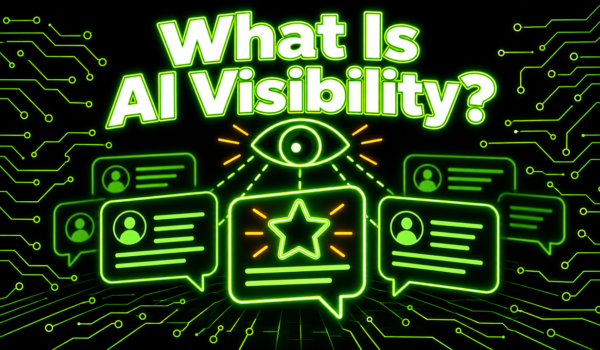
AI visibility is how often, how prominently and how accurately your brand appears in answers from AI assistants such as ChatGPT, Google AI Overviews and AI Mode, Perplexity, Gemini and Claude. A brand with strong AI visibility gets named when people ask for recommendations in its category, is described correctly, and has its own pages cited as sources. A brand with weak AI visibility is missing from those answers, described with outdated or wrong details, or mentioned only after competitors. As more buyers start their research by asking an AI assistant, AI visibility has become a core part of how people discover and choose brands.
This guide explains what AI visibility means, why it matters, what shapes it, how to measure it and how to improve it.
AI visibility in plain terms
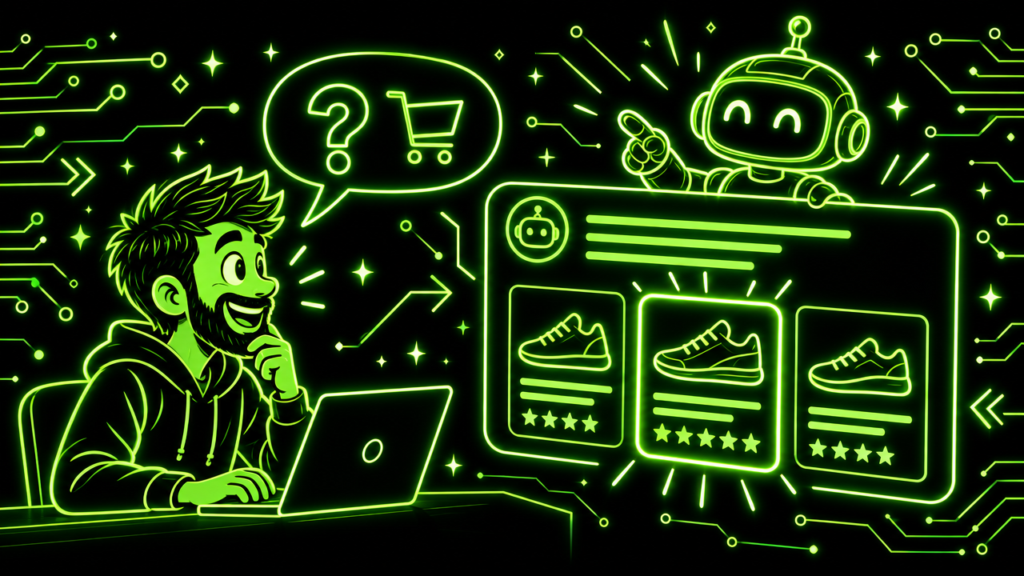
Think of AI visibility as your brand’s presence inside AI-written answers. In classic search, visibility meant ranking on page one. In AI search, the answer is a short piece of writing that may name a few brands and cite a few sources. AI visibility asks four simple questions about that answer:
- Are you mentioned?
- Where are you mentioned, first or last?
- Is the description accurate and positive?
- Is your own site cited as a source?
Each of those can be tracked over time, which turns AI visibility from a vague idea into something you can manage.
Why AI visibility matters
Buyers ask AI assistants questions they used to type into Google, often in longer, more specific form: “best accounting software for a three-person design studio” or “is this brand reliable for same-day repairs?”. The answer usually names a few options. Brands outside that shortlist may never get considered.
AI visibility also affects people who never click. Many AI answers satisfy the question on the spot. If your brand is named positively, the buyer may remember you and search for you later, even without visiting from the AI answer itself. That shows up as branded search or direct traffic rather than as a referral.
Finally, AI answers spread descriptions. If an assistant consistently describes your pricing wrongly or repeats an old complaint, that framing reaches every buyer who asks. Managing AI visibility includes managing accuracy.
AI visibility vs SEO visibility
| Factor | SEO visibility | AI visibility |
|---|---|---|
| Where you appear | Ranked list of links | Inside a written answer |
| Main unit | Pages and rankings | Brand mentions and citations |
| How many winners | Ten or more results per page | Often two to five brands named |
| Off-site influence | Links and authority | Reviews, articles, community threads and links |
| How to measure | Rank tracking and Search Console | Prompt tracking across AI tools |
The two overlap heavily, because most AI tools retrieve pages from search indexes before writing answers. Strong SEO supports AI visibility, but it is not the whole picture. Our guide to AI search ranking factors explains where they diverge.
What shapes your AI visibility
Crawl access
AI tools reach the web through crawlers and search partners. If you block search crawlers such as Googlebot, OAI-SearchBot or PerplexityBot, your pages may never be read.
Search rankings
Many AI tools search the web before answering. Google explains in its guide to AI features and your website that its AI features draw on its search index and may run several related searches for one question. Ranking for those narrow searches raises your AI visibility.
Clear, quotable content
Pages that answer questions directly, with specific facts, are easier for AI tools to quote and cite.
Third-party mentions
Reviews, comparison articles, news coverage and community threads heavily influence recommendations. AI tools trust what independent sources say about you more than what you say about yourself.
Consistency
When your site, profiles and third-party sources agree on what you do, who you serve and what you cost, AI tools repeat that description with more confidence.
Freshness
Up-to-date prices, features and facts help, especially for questions where details change often.
How AI assistants decide what to say about a brand
When someone asks for a recommendation, the assistant usually rewrites the question into several searches, reads a set of pages and then writes an answer. It favors passages that answer the question directly and claims that several sources agree on. If three review sites, a comparison article and a forum thread all describe a product as “the easiest option for small teams”, that phrase is likely to appear in the answer.
The assistant also leans on what it learned during training: which brands are well known in a category and how they are usually described. Fresh retrieval adds current details such as prices and new features. A brand that is both widely discussed and easy to verify on the live web tends to appear most often. Our guide on how AI search works explains the full process.
Examples by business type
A B2B software company
A payroll tool appears in answers to “best payroll software for small businesses” but is described with a price from two years ago. Fixing its pricing page, updating review profiles and adding a clear comparison page brings the description up to date and moves it higher in the list.
A local service business
A plumbing company is missing from answers to “emergency plumber near downtown”. Its Google Business Profile lacks hours and service areas, and it has few recent reviews. Completing the profile and asking every customer for a review gets it named within a few months.
An ecommerce brand
A backpack brand is named for “best travel backpack” but never cited. Its product pages hide specifications in images. Moving dimensions, weight and materials into plain text, and adding product schema, gets its pages cited alongside review sites.
A professional services firm
An accounting firm wants to appear for “how to choose an accountant for an online store”. It publishes a clear guide that answers the question with a checklist and pricing ranges, then shares helpful answers in relevant communities. Its guide starts appearing as a cited source.
Related terms
- AI brand visibility: AI visibility focused specifically on brand mentions and descriptions. Our guide to AI brand visibility covers it.
- LLM visibility: the same idea framed around large language models. See our post on LLM visibility.
- AI share of voice: your mentions compared with competitors’ mentions across the same questions.
- AI visibility score: a single number that combines mentions, position, sentiment and citations.
- AEO and GEO: answer engine optimization and generative engine optimization, the practices of improving AI visibility.
Why some brands never show up
When a brand is missing from AI answers, the cause usually falls into one of a few groups.
- Technical blocks: bot protection or robots.txt rules stop search crawlers from reading the site.
- Thin content: pages describe the brand in slogans but never state who it serves, what it costs or how it compares.
- No outside proof: few reviews, no coverage in comparison articles and no presence in community discussions.
- Confusing identity: a name shared with other companies, or descriptions that differ from site to site.
- Narrow coverage: the site targets a few head terms but ignores the specific questions buyers ask.
Each group has a clear fix, which is why a short audit is the best place to start.
Presence across the buyer journey
Buyers ask different questions at different stages, and your brand needs to appear at each one.
Problem stage
Questions like “why do my clients pay invoices late?” call for helpful guides. Brands that publish clear, practical answers get cited here, long before the buyer looks for a product.
Category stage
Questions like “best invoicing tools for freelancers” call for shortlists. Reviews, comparison articles and community recommendations decide who makes the list.
Comparison stage
Questions like “Tool A vs Tool B” call for specific, fair comparisons. Detailed comparison pages and third-party reviews carry the most weight.
Decision stage
Questions like “is Tool A worth it for a two-person team?” call for accurate pricing, onboarding details and reviews from similar customers.
Tools that help
You can track everything in a spreadsheet, but software helps once you track more than about 50 questions or several brands. Look for tools that test search-enabled versions of each assistant, run each question more than once, record cited sources and let you export raw answers. Our roundup of answer engine optimization tools compares options.
Questions to ask your team
- Which buyer questions should we be named in, and are we named today?
- How do the main AI assistants describe our pricing and features?
- Which outside sources shape answers in our category, and are we in them?
- Who owns the monthly check, and who acts on what it finds?
How to measure AI visibility
AI visibility is measured by asking AI tools the questions your buyers ask and recording the answers.
- Build a list of 30 to 100 buyer questions across problem, category, comparison and brand topics.
- Run each question in the AI tools your buyers use, two or three times each, in fresh sessions.
- Record whether you are mentioned, your position, how you are described and which sources are cited.
- Calculate simple metrics: mention rate, share of voice and citation rate.
- Repeat monthly and watch the trend.
Our guides to prompt tracking and the AI visibility score walk through the method in detail.

How to improve AI visibility
1. Audit access and accuracy
Check that search crawlers can reach your key pages and that your site states clearly what you do, who you serve and what you charge. Our AI visibility audit guide lists the checks.
2. Rewrite key pages answer-first
Open each important page with a direct answer to the main question, then add detail.
3. Cover the specific questions buyers ask
Build pages or sections for comparisons, use cases, pricing and common problems. These match the narrow searches AI tools run.
4. Earn third-party mentions
Ask customers for reviews, pitch comparison articles that rank, and take part in relevant community discussions from disclosed accounts. Reddit threads are cited often across AI tools. Our post on Reddit and AI search explains why.
5. Fix inconsistencies
Update old prices and descriptions on directories, marketplaces and profiles you control.
6. Track and repeat
Measure monthly, find the gaps and choose the next three fixes.
A 90-day starting plan
Month 1: measure and fix the basics
Build your question list and record a baseline across the main AI tools. Check crawler access, update key facts on your site and correct outdated third-party profiles you control.
Month 2: improve your content
Rewrite your ten most important pages so they open with direct answers. Add pages for the comparison and use-case questions where you are missing. Add schema where it fits.
Month 3: build outside proof
Start a steady review program, pitch two or three comparison articles that already rank and begin taking part in the communities your buyers use. Rerun your question list and compare with the baseline.
Who should own the work
Most companies give ownership to the SEO or content lead, since the work overlaps with search. Product marketing owns positioning and comparison pages. Customer success can drive reviews. PR and partnerships can land mentions in cited publications. A monthly review with these teams keeps the effort moving and turns findings into actions.
Signals worth watching
- Your mention rate across tracked questions, by tool.
- How accurately assistants describe your pricing and features.
- Which third-party domains appear most often as sources in your category.
- Referral visits from AI tools in your analytics.
- Branded search trends in Google Search Console.
Connecting it to business results
Mentions in AI answers are a leading indicator, not revenue. Tie them to outcomes where you can. Compare your mention trend with branded search volume, referral traffic from AI tools, demo or contact requests, and the answers new customers give to “how did you hear about us?”. Add an “AI assistant” option to that question on forms and in sales calls. Over a few months, these sources usually show whether rising mentions are turning into real demand. Our guide to AI share of voice shows how to report the competitive side.
What good looks like
There is no universal benchmark, but strong performers share a pattern. They are named in most category questions for their niche, usually in the first or second position. Assistants describe their pricing and features correctly. Their own pages appear among the cited sources for comparison and decision questions. And the third-party sources that shape their category, such as review sites and community threads, mention them positively and often. Set your targets against your top competitors, measured with the same method, and aim to close the gap step by step.
Common misconceptions about AI visibility
“It’s the same as SEO”
SEO is a big part of it, but AI visibility also depends on reviews, community discussion and consistency across the web.
“You can buy it”
Some AI assistants sell ads, but those sit outside the answer. Being named inside the answer is earned.
“One test tells you where you stand”
AI answers vary between runs. Only repeated measurement shows real AI visibility.
“Only big brands get mentioned”
Specific, well-documented brands often win specific questions, even against larger competitors.
A quick self-check
Open ChatGPT, Perplexity and Google, and ask each one the question a new customer is most likely to ask before buying from you. Note whether your brand appears, what the answer says about your price and strengths, and which websites it cites. Then ask the same question about your closest competitor. The gap between the two answers is a fast, honest picture of where you stand today, and the cited websites show you where to focus first.
Repeat the check next month with the same questions. Small, steady changes in those answers tell you far more than any single result.
Frequently asked questions
What is AI visibility?
AI visibility is how often, how prominently and how accurately your brand appears in AI assistant answers, including whether your site is cited as a source.
How is AI visibility measured?
By running a fixed set of buyer questions through AI tools on a schedule and tracking mentions, position, accuracy and citations.
Which AI tools matter for AI visibility?
The ones your buyers use. For most brands, that means ChatGPT, Google’s AI features, Perplexity, Gemini and Claude.
How long does it take to improve AI visibility?
Fixing access and rewriting key pages can help within weeks. Reviews and third-party mentions usually take a few months to build.
Does AI visibility replace SEO?
No. Search rankings feed most AI answers, so SEO remains a foundation. The extra work is on reviews, community presence, consistent facts and answer-first content.
Can ads improve AI visibility?
Ads in AI assistants appear outside the answer, in labeled placements. They can put your brand in front of users, but they do not get you named or cited inside the answer itself. That part comes from content, reviews and third-party mentions.
How often should I check?
Monthly works for most brands. Check weekly on a smaller question set during launches or major changes.
Is AI visibility only for big companies?
No. Small and local businesses can build strong AI visibility for specific, local and niche questions.
Want to see where your customers are already asking? Get a free Reddit Opportunity Report showing which Reddit threads already rank for your keywords.