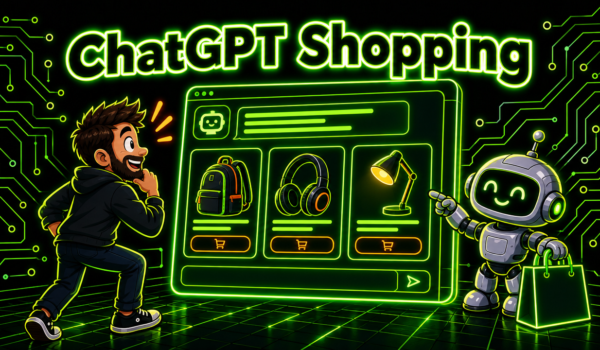
ChatGPT shopping is the set of features that lets people research and compare products inside ChatGPT, see product cards with prices and merchants, and in some cases move toward checkout without leaving the chat. When someone asks for “the quietest cordless vacuum for a small apartment” or “a gift for a four-year-old who loves art”, ChatGPT can ask follow-up questions, pull product information from across the web and build a short buyer’s guide. For brands and online stores, ChatGPT shopping is a new place where products get recommended, compared and skipped, based largely on the product data and reviews AI can find.
This guide explains how ChatGPT shopping works, how products and merchants are selected, how it relates to ChatGPT ads, and what stores can do to show up.

What is ChatGPT shopping?
ChatGPT shopping covers a few related features:
- Product results in regular answers, shown as cards with images, prices and merchant options.
- Shopping research, a dedicated mode for bigger purchase decisions that asks clarifying questions and builds a buyer’s guide.
- Merchant options and, for some eligible products and merchants, a way to complete checkout inside ChatGPT.
OpenAI introduced shopping research in November 2025 for logged-in users on Free, Go, Plus and Pro plans. It was designed for high-consideration purchases, where people care about constraints like size, budget, features and trade-offs. Checkout options have changed since launch, so the exact buying flow you see depends on the product, merchant and region.
How ChatGPT shopping works
The flow usually looks like this.
- A user describes what they want in plain language.
- For bigger decisions, ChatGPT asks follow-up questions about budget, use case and must-have features.
- It searches publicly available retail and review information across the web.
- It narrows options and presents product cards, sometimes as a structured buyer’s guide.
- When the user picks a product, ChatGPT may show a list of merchants that sell it.
- The user clicks through to buy on a merchant’s site, or uses an in-chat checkout option where one is offered.
OpenAI’s help center article on shopping with ChatGPT search explains how results and merchants are presented, including labels such as “Best price” when several merchants sell the same item.
ChatGPT shopping vs Google Shopping
Both help people find products, but the experience and the levers differ.
| Factor | ChatGPT shopping | Google Shopping |
|---|---|---|
| Format | Conversation and buyer’s guide | Grid of product listings with filters |
| Follow-up questions | Built in, narrows options by stated needs | Filters and new searches |
| Main data source | Retail sites, catalog integrations, reviews | Merchant Center feeds and Google’s index |
| Paid placements | Separate ChatGPT ads below answers | Shopping ads mixed with free listings |
| What wins | Clear fit, specific data, strong reviews | Feed quality, price, ads and relevance |
Most stores should keep Google Merchant Center healthy and treat ChatGPT shopping as an additional, growing channel that rewards the same core work: accurate data and real reviews.
How products are selected
ChatGPT shopping relies on structured product information and on what people say about products. OpenAI has said its shopping results are based on publicly available retail websites and that it does not share users’ chats with retailers. In practice, a few factors shape which products appear.
Product data
Clear titles, prices, availability, specifications and images help ChatGPT match products to a user’s needs. Products with missing or vague details are harder to recommend for specific requests.
Fit with the request
Shopping research is built to handle multiple constraints at once. A product that clearly states “weighs 2.1 kg, 65 dB, fits under a bed” matches a detailed question better than one described only as “lightweight and quiet”.
Reviews and third-party opinions
ChatGPT often draws on reviews, roundup articles and community discussions to judge quality and trade-offs. Products that real people discuss positively are easier to recommend with confidence.
Merchant information
When a product is sold by several stores, ChatGPT may list multiple merchants with price and shipping details. Accurate, consistent merchant data helps your store appear in that list.

Shopify and other platforms
Store platforms are building direct connections to AI shopping. OpenAI’s help center notes that for merchants on Shopify, product data is already integrated into ChatGPT through Shopify Catalog, helping products appear more accurately in relevant conversations without extra work from individual merchants. Other platforms and large retailers have their own integrations. If you sell on a major platform, check its settings and documentation for AI shopping or catalog sharing options.
ChatGPT shopping vs ChatGPT ads
These are separate systems, and the difference matters.
| Factor | ChatGPT shopping results | ChatGPT ads |
|---|---|---|
| How you appear | Organic product cards and recommendations | Labeled sponsored box below the answer |
| Cost | No payment for placement | Paid |
| Who sees it | Users across plans | Free and Go plan users |
| What drives it | Product data, fit, reviews, merchant info | Budget, targeting and ad relevance |
| Durability | Lasts while your data and reputation stay strong | Stops when spend stops |
Organic recommendations depend on the same signals that drive other AI answers. Our guide on how to get ChatGPT to recommend your business covers them in depth.
How ChatGPT shopping handles reviews and trade-offs
ChatGPT shopping tries to explain why a product fits, not just list it. When a buyer asks for a quiet vacuum under a set budget, the answer often notes trade-offs: one model is quieter but has a smaller bin, another has stronger suction but is heavier. Those notes come from product specs, reviews and comparison articles.
That means the language in your reviews and product pages can end up shaping how ChatGPT shopping describes you. If many reviews mention “easy to clean” or “battery lasts all week”, that detail is likely to surface. If complaints cluster around one weakness, expect it to appear as a trade-off. Fixing real product issues and encouraging detailed reviews both help.
ChatGPT shopping by product category
Electronics
Electronics questions tend to be spec-heavy: battery life, compatibility, ports, noise, screen size. Detailed spec tables and comparison pages matter most. ChatGPT shopping often cites professional review sites for this category.
Home and kitchen
Buyers ask about size, cleaning, durability and fit for small spaces. Clear dimensions, materials and care instructions help. Community threads where people share long-term experiences carry weight.
Fashion and apparel
Fit, sizing and materials dominate. Size guides, fit notes from reviews (“runs small”) and clear fabric details help ChatGPT shopping match products to body types and climates.
Beauty and personal care
Ingredients, skin types and sensitivities drive questions. Full ingredient lists, clear “suitable for” statements and plenty of reviews from different skin types make products easier to recommend.
Gifts
Gift questions are open-ended: “a gift for a dad who likes grilling, under $50”. Products with clear use cases, price points and audience descriptions are easier for ChatGPT shopping to slot into a guide.
How to get products into ChatGPT shopping results
1. Make product data complete and specific
Use descriptive titles, accurate prices, real-time availability, full specifications and clear images. State the details people filter on: dimensions, weight, materials, compatibility, battery life, noise level and warranty.
2. Add structured data
Product schema with price, availability, brand and review information helps search systems understand your pages. Our guide to schema markup for AI search explains the key types.
3. Keep search crawlers able to reach your store
Check that robots.txt and bot protection do not block search crawlers, including OpenAI’s search crawler. Our guide on blocking AI crawlers explains which bots affect search visibility.
4. Use your platform’s catalog integrations
If your store platform offers a product catalog connection to AI shopping, enable it and keep the feed accurate.
5. Write “who it’s for” content
Shopping research handles trade-offs. Explain who each product suits and who should choose something else. That honesty gives ChatGPT clear reasons to recommend you for the right request.
6. Earn reviews and roundup mentions
Ask buyers for detailed reviews. Pitch your products to review sites and “best of” articles that already rank. Take part in relevant community discussions where people compare products. Reddit threads are a common source for product opinions. Our post on Reddit and AI search explains why.
7. Keep prices and stock accurate everywhere
Mismatched prices between your site, marketplaces and feeds confuse shoppers and AI tools alike. Update all channels when prices change.

How to check whether ChatGPT recommends your products
- List 20 to 40 shopping questions your customers ask, from broad (“best espresso grinder”) to specific (“quiet grinder under $200 for pour over”).
- Run each question in ChatGPT, including shopping research for bigger purchases.
- Record which products appear, which merchants are listed and what sources are cited.
- Note how your product is described, including price and key features.
- Repeat monthly and compare.
Our guide to prompt tracking shows how to turn this into a repeatable routine.
Small stores vs big brands in ChatGPT shopping
Big brands start with more reviews, more press coverage and more product data, so they often appear in broad requests. Small stores can still win, especially on specific requests where they have the best fit. A shop that sells one excellent left-handed kitchen knife with clear specs and enthusiastic reviews can beat a large brand for “best chef’s knife for left-handed cooks”.
The practical move for a smaller store is to own niches: write product pages for specific needs, earn reviews that mention those needs and take part in communities where those buyers ask questions. ChatGPT shopping rewards clear fit more than size.
Catalog checklist for ChatGPT shopping
- Every product has a descriptive title that includes type, key feature and variant.
- Prices and stock status are accurate and update automatically.
- Specifications are in plain text, not only in images or PDFs.
- Each product page includes “who it’s for” and key trade-offs.
- Product schema includes price, availability, brand and reviews.
- Images are clear and show the product in use.
- Platform catalog integrations for AI shopping are enabled where available.
- Return policy, shipping times and warranty are easy to find.
Measuring traffic and sales from ChatGPT shopping
Visits from ChatGPT shopping often arrive with chatgpt.com as the referrer. Set up a segment in your analytics for that source and track conversion rate and order value alongside other channels. Some purchases may happen without a clear referral, for example when a shopper notes your brand and searches for it later, so watch branded search and direct traffic too. Our guide to AI referral traffic explains the setup.
Many stores find that ChatGPT shopping visitors convert well, because they arrive after reading a tailored comparison. Even modest volumes can be valuable.
What ChatGPT shopping means for online stores
Shopping research changes how some buyers move from question to purchase. Instead of clicking through ten tabs of reviews and store pages, they get a short guide with a few options. That compresses the consideration stage. Products that make the shortlist get far more attention, and products that miss it may never be seen by that buyer.
It also raises the value of honest, detailed product information. A store that explains trade-offs clearly can win specific requests even against larger brands, because ChatGPT is trying to match products to stated needs rather than to ad spend.
A worked example: one shopping question
Say a buyer types: “I need a carry-on suitcase that fits budget airline size limits, has a USB port and costs under $150.” ChatGPT shopping asks whether hard or soft shell matters and how often they travel. The buyer answers: hard shell, a few trips a year.
ChatGPT then searches retail pages, reviews and roundups. It finds many suitcases, but only some list exact dimensions, weight and port details in plain text. It favors those, checks reviews for comments about durability and the port, and builds a short guide with three options, each with a one-line reason and a note on trade-offs.
A brand whose product page says “fits most carry-on limits” without dimensions gets skipped, even if the suitcase would qualify. A smaller brand that lists “55 x 35 x 20 cm, 2.6 kg, removable USB port” and has reviews mentioning budget airline trips makes the list. That is the core lesson of ChatGPT shopping: precise, honest data wins specific requests.
If ChatGPT gets your product wrong
Sometimes ChatGPT shopping shows an old price, a discontinued variant or a wrong feature. Start by checking your own product page and feed for outdated details. Then look at the sources ChatGPT cites, such as marketplaces, review sites or old roundups, and correct what you can. OpenAI’s help center also explains how users can report errors in shopping results. Recheck the same questions a few weeks later.
Seasonal planning
Shopping questions spike before holidays and seasonal events. Update product pages, gift guides and stock information well ahead of those peaks so crawlers and catalog feeds pick up the changes in time. Seasonal “best of” lists from publishers and creators often get cited, so pitching your products for inclusion early can pay off during the busiest weeks.
Common mistakes
- Thin product descriptions that leave out the specs buyers ask about.
- Blocking search crawlers with aggressive bot protection.
- Inconsistent prices across your site, marketplaces and feeds.
- Few or outdated reviews.
- Assuming ads will put your product inside the organic recommendations.
- Never checking what ChatGPT says about your products.
Frequently asked questions
What is ChatGPT shopping research?
It is a ChatGPT mode for bigger purchase decisions. It asks clarifying questions, researches products across the web and builds a buyer’s guide with recommendations.
Are ChatGPT shopping results ads?
Product recommendations in answers are organic. ChatGPT ads are a separate, labeled placement below answers.
Can I buy products directly in ChatGPT?
For some eligible products and merchants, ChatGPT may offer a checkout option inside the chat. Otherwise, it links to merchants’ sites. Options vary by product, merchant and region.
How do I get my store listed in ChatGPT shopping?
Keep product data complete, allow search crawlers, add product schema, use your platform’s catalog integrations and build reviews and third-party mentions.
Is ChatGPT shopping available on the free plan?
Shopping research launched for logged-in users on Free, Go, Plus and Pro plans. Availability of specific features can vary by region.
How long does it take for new products to appear in ChatGPT shopping?
It depends on how quickly your product pages are crawled or your catalog feed is updated. Fast, accurate feeds and crawlable pages help new products show up sooner.
Do I need to pay to appear in ChatGPT shopping?
No. Organic product recommendations are not paid placements. Your product data, reviews and third-party mentions decide whether you appear. Paid ChatGPT ads are a separate option with their own labeled slot.
Does ChatGPT share my chats with retailers?
OpenAI has said shopping research does not share users’ chats with retailers.
Want to see where your customers are already asking? Get a free Reddit Opportunity Report showing which Reddit threads already rank for your keywords.