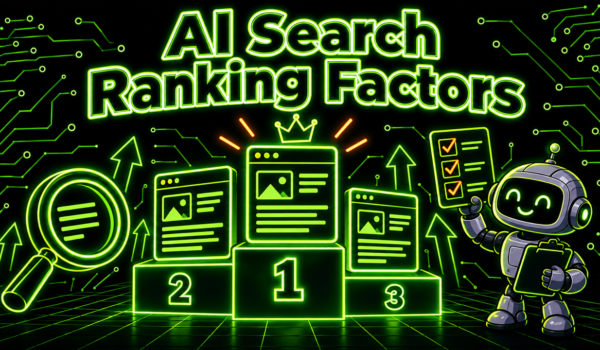
AI search ranking factors are the signals that decide which pages and brands an AI assistant reads, trusts and cites when it answers a question. No AI company publishes a full list, but documentation from Google and OpenAI, plus consistent testing across ChatGPT, Google AI Overviews and AI Mode, Perplexity, Gemini and Claude, points to the same core ranking factors: whether your page can be crawled and retrieved, how well it ranks for the searches the AI runs, how clearly it answers the question, how many other sources agree with it, how fresh it is and how often your brand is discussed by third parties. This guide breaks down each of those ranking factors and shows how to improve them.
Think of AI search ranking factors in two layers. The first layer gets your page into the set of sources the AI reads. The second layer decides whether the AI quotes you once it has read you.

How AI search ranking factors differ from Google ranking factors
Classic Google ranking factors decide the order of ten blue links. AI search ranking factors decide which handful of sources make it into a written answer, and whether your brand is named in that answer at all. There is a lot of overlap, because most AI tools retrieve pages from a search index first. Our guide on how AI search works explains that retrieve-then-write process.
The differences show up after retrieval. A page that ranks fifth in Google can be the main citation in an AI answer if it states the answer more clearly than the pages above it. A brand with no page in the top ten can still be recommended if reviews and forum threads mention it often. That is why AI search ranking factors give more weight to clarity, agreement and third-party discussion than classic SEO does.
The core AI search ranking factors
The table below summarizes the ranking factors that matter most and where each one acts.
| Ranking factor | Stage | What it means |
|---|---|---|
| Crawl access | Retrieval | The AI’s crawler or search provider can reach your page |
| Search rankings | Retrieval | You rank for the queries the AI runs behind the scenes |
| Answer clarity | Selection | Your page states the answer in a short, quotable passage |
| Source agreement | Selection | Other sources describe you the same way |
| Third-party mentions | Selection | Reviews, articles and threads discuss your brand |
| Freshness | Both | Dates, prices and facts are current |
| Entity clarity | Both | The AI understands who you are and what you do |
| Structured data | Both | Schema makes key facts easy to extract |
Retrieval ranking factors
If the AI never reads your page, nothing else matters. These ranking factors decide whether you enter the pool of candidate sources.
1. Crawl access
Each AI tool reaches the web through its own crawler, a search partner or both. Google’s AI features use Googlebot and Google’s index. ChatGPT search uses OAI-SearchBot plus third-party search providers. Perplexity uses PerplexityBot. If your robots.txt, firewall or bot protection blocks these agents, your pages drop out of the answer pool. Our guide on blocking AI crawlers explains which bots control search visibility and which only control training.
2. Rendering and page access
Content loaded only by client-side JavaScript, hidden behind logins or placed inside images may not be read. Plain HTML text is the safest format for anything you want quoted.
3. Rankings for fan-out queries
AI tools often split one question into several narrower searches. Google describes this “query fan-out” in its documentation on AI features and your website. A page that ranks for a narrow subtopic, such as “CRM with client portal”, can be pulled into an answer about the best CRM overall. Ranking for many specific long-tail queries is one of the most underrated AI search ranking factors.
4. Indexing speed
New pages need to be indexed before they can be retrieved. A clean XML sitemap, internal links to new content and a healthy crawl budget help new pages enter the pool sooner.

Selection ranking factors
Once your page is in the candidate set, these ranking factors decide whether the AI quotes it, names your brand or skips you.
5. Answer clarity
AI tools pull passages, not whole pages. A paragraph that names the subject, answers the question directly and adds a specific detail is easy to lift into an answer. A page that opens with a long story and states the answer halfway down often loses to a shorter, clearer page. Answer-first writing is one of the strongest ranking factors you fully control.
6. Self-contained passages
Passages that depend on earlier paragraphs (“this approach”, “as mentioned above”) are harder to use alone. Name the subject again in each key paragraph so any passage makes sense on its own.
7. Specificity
Numbers, steps, prices, time frames and named examples give the AI something concrete to repeat. Vague claims such as “industry-leading service” add nothing an AI can cite.
8. Source agreement
AI tools are more confident repeating claims that several sources share. If your site, your reviews, comparison articles and community threads all describe you the same way, that description is more likely to appear in answers. Conflicting information, such as different prices on different sites, lowers confidence.
9. Third-party mentions
For recommendation questions, AI tools lean heavily on what others say: review platforms, “best of” lists, news articles and forum threads, with Reddit among the most cited. Our post on unlinked brand mentions explains why a mention can matter even without a link.
10. Authority and expertise
Pages written by people with real experience, backed by original data or clear credentials, tend to be favored. Google’s guidance on creating helpful, reliable content applies to its AI features as much as to classic results.
Ranking factors that act at both stages
11. Freshness
For time-sensitive questions, current pages win. Outdated statistics, old prices and stale product details can push a page out of an answer. Update key pages on a schedule and keep dates accurate.
12. Entity clarity
AI systems work with entities: brands, products, people and places. If your brand name is ambiguous, or your site does not state clearly what you do and who you serve, the AI may confuse you with something else. Our guide to entity SEO covers how to fix that.
13. Structured data
Schema markup for organizations, products, reviews and FAQs helps search engines understand your pages, which supports retrieval in tools built on those indexes. Our guide to schema markup for AI search lists the most useful types.
14. Page experience
Fast, stable, mobile-friendly pages are easier to crawl and are favored by search engines. Slow or broken pages may be skipped during retrieval.
Ranking factors by query type
The weight of each factor shifts with the kind of question. Matching your work to the queries that matter to your business saves effort.
Informational questions
Questions like “how does payroll tax work?” reward clear explanations, authority and structure. AI tools often cite guides, documentation and educational pages. Answer clarity and expertise lead here.
Recommendation questions
Questions like “best payroll software for a small team” lean on third-party mentions, reviews and agreement across sources. Your own site matters less than what independent sources say about you.
Comparison questions
Questions like “Tool A vs Tool B” reward pages that compare fairly with specific details, such as pricing tables and feature lists. Comparison articles from third parties carry extra weight because they look neutral.
Local questions
Questions like “best dentist near me” depend on business listings, reviews and local directories. Consistent name, address and phone details across the web are among the most important signals.
Fresh or news questions
Questions about recent events, prices or releases put freshness first. Pages updated recently with dated, specific facts tend to win.
How ranking factors vary by AI tool
The same ranking factors apply everywhere, but their weight changes from tool to tool.
| Tool | Ranking factors that stand out |
|---|---|
| Google AI Overviews and AI Mode | Google rankings, query fan-out coverage, helpful content signals |
| ChatGPT search | Search provider rankings, OAI-SearchBot access, third-party reviews and lists |
| Perplexity | Its own crawl, freshness, clear factual passages |
| Gemini | Google Search signals, entity clarity |
| Claude | Search provider rankings, clear and well-sourced passages |
Because the weights differ, a brand can perform well in one assistant and poorly in another. Tracking each tool separately shows where to focus. Our guide to the AI visibility score explains how to measure that.
Ranking factors that matter less than people think
Keyword density
Repeating a phrase does little for AI answers. Clear language that matches how people ask the question matters more than exact-match repetition.
Word count alone
Long pages are not favored for being long. They help only when the extra length covers more subtopics clearly.
A single special file
Files such as llms.txt may help some tools understand a site, but they do not replace crawl access, rankings and reputation.
Self-promotional claims
Calling yourself “the best” on your own site carries little weight. AI tools look for that verdict from independent sources.

How to improve your AI search ranking factors
Work through the ranking factors in order, from retrieval to selection.
Step 1: Audit access
Check robots.txt and any bot protection for Googlebot, OAI-SearchBot, PerplexityBot and other search crawlers. Make sure key content is in plain HTML.
Step 2: Map the fan-out queries
For each important topic, list the narrower questions an AI would search for: pricing, comparisons, use cases, integrations and problems. Make sure you have a clear section or page for each one.
Step 3: Rewrite openings
Put a direct, two to four sentence answer at the top of every key page and section. Add one specific number or example to each.
Step 4: Align your facts everywhere
Check that your name, pricing, features and positioning match across your site, review profiles, directories and social profiles. Fix conflicts.
Step 5: Earn third-party mentions
Ask customers for reviews, pitch comparison articles that already rank, and take part in relevant community discussions from disclosed accounts. Reddit threads are cited often, so helpful participation there can lift several ranking factors at once. Our guide on Reddit and AI search explains why.
Step 6: Keep it fresh
Set a quarterly review for your most important pages. Update numbers, examples and screenshots, and remove outdated claims.
Step 7: Measure and repeat
Run a fixed list of buyer questions in each AI tool every month. Record whether you appear, how you are described and which sources are cited. Use the cited sources to decide which ranking factors to work on next.
How to prioritize with limited time
Most teams cannot work on every factor at once. A simple order of operations helps.
- Fix anything that blocks retrieval, such as crawler blocks or JavaScript-only content. These problems cancel out every other effort.
- Rewrite the openings of your ten most important pages so the answer comes first.
- Align facts across your site and your top third-party profiles.
- Start a steady review program and a light community presence.
- Build pages for the long-tail questions where you have real expertise.
Steps one to three often take a few days and can change results quickly. Steps four and five build value over months.
Signals you cannot control directly
Some inputs sit outside your hands. AI models generate text with some randomness, so answers vary between runs. Personalization, location and conversation history change what each user sees. Model updates can shift which sources a tool prefers overnight. You cannot fix these, but you can reduce their effect by tracking a set of questions over time and focusing on the factors you do control.
A worked example
Consider two accounting software vendors competing for the question “best accounting software for freelancers”.
Vendor A ranks second in Google for “accounting software”. Its homepage opens with a slogan and a video. Pricing sits behind a “contact us” button. It has few recent reviews and no presence in freelancer communities.
Vendor B ranks seventh for the head term but first for “accounting software for freelancers with invoicing”. Its landing page opens with one clear sentence on who it serves, a starting price and three named features. It has hundreds of recent reviews that mention freelancers, appears in two comparison articles and is recommended in several forum threads.
When an AI assistant answers the question, it runs fan-out searches that surface Vendor B’s niche page, finds a clear passage to quote and sees agreement from reviews and threads. Vendor B is named first. Vendor A may be mentioned, or may not appear at all. Vendor B wins on most of the selection ranking factors even though it loses on the head-term ranking.
Quick checklist of AI search ranking factors
- Search crawlers for Google, OpenAI and Perplexity can reach your key pages.
- Important content is in plain HTML, not only in scripts, images or PDFs.
- You have a clear page or section for each common buyer question.
- Every key page opens with a direct answer and a specific detail.
- Pricing, features and positioning match across your site and third-party profiles.
- You earn new reviews every month on the sites buyers read.
- Your brand appears in at least a few comparison articles that rank.
- You take part in relevant community discussions from disclosed accounts.
- Key pages were reviewed and updated within the last quarter.
- You track a fixed set of buyer questions across AI tools each month.
Common mistakes
- Blocking AI search crawlers by accident while trying to block training crawlers.
- Focusing only on head terms and ignoring the long-tail questions AI tools search for.
- Hiding pricing and key facts in PDFs, images or contact forms.
- Letting old prices and features live on third-party sites.
- Ignoring forums and review sites where buyers discuss your category.
- Judging progress from one prompt instead of a tracked set of questions.
Frequently asked questions
What are the most important AI search ranking factors?
Crawl access, rankings for the queries AI tools run, clear answer passages, agreement across sources and third-party mentions carry the most weight for most brands.
Are AI search ranking factors the same as Google ranking factors?
They overlap, since most AI tools retrieve from a search index. AI tools then add selection factors such as answer clarity and source agreement that decide who gets quoted.
Do backlinks still matter for AI search?
Yes, indirectly. Links help pages rank in the indexes AI tools retrieve from. Mentions without links can also influence AI answers.
How fast can I improve my AI search ranking factors?
Fixing crawl access and rewriting key pages can show changes within weeks. Building reviews and third-party mentions usually takes a few months.
Does every AI assistant use the same ranking factors?
The core ranking factors are similar, but each tool uses its own index and weights, so results differ between assistants.
Can I pay to improve AI search rankings?
There is no way to buy a place in organic AI answers. Visibility comes from being retrievable, clear and well discussed across the web.
Want to see where your customers are already asking? Get a free Reddit Opportunity Report showing which Reddit threads already rank for your keywords.