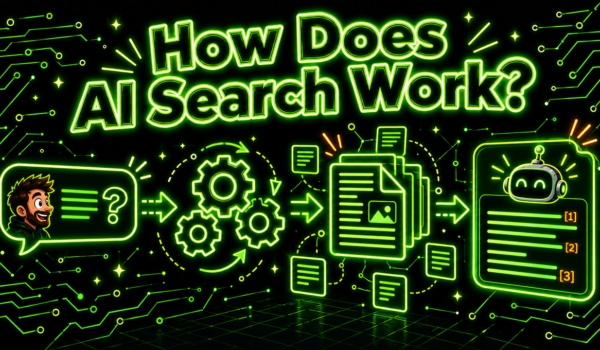
AI search works by combining a search index with a large language model. When you ask a question, the AI search system rewrites it into one or more search queries, retrieves relevant pages, reads the most useful passages and then writes a single answer, usually with citations to the sources it used. Tools like ChatGPT search, Google AI Overviews and AI Mode, Perplexity, Gemini and Claude all follow some version of this retrieve-then-write pattern, though each one uses its own index, ranking signals and model.
This guide walks through how AI search works step by step, what decides which sources get cited, and what that means for anyone who wants their brand to show up in AI answers.

What is AI search?
AI search is any search experience where a language model reads search results and writes the answer for you. Classic search shows a list of links and leaves the reading to you. AI search does the reading, summarizes what it found and shows a few sources so you can check its work.
The term covers several kinds of tools. Some are search engines with AI layers, such as Google with AI Overviews. Some are AI assistants with search built in, such as ChatGPT and Claude. Some, like Perplexity, were designed as AI search engines from the start. Our overview of AI answer engines compares the main options.
How AI search works, step by step
The details differ by product, but most AI search systems move through the same six stages.
Step 1: Understanding the question
The model first reads your question and decides what you need. It considers the wording, the conversation so far and sometimes your location or settings. It also decides whether it needs to search at all. A request like “write a poem about autumn” needs no search. A question like “which accounting software do small agencies use most?” needs fresh, specific information, so the AI search system triggers retrieval.
Step 2: Query rewriting and fan-out
Your question is often too broad or too conversational to send to a search index as written. The AI search system rewrites it into several focused queries. Google describes this in its documentation on AI features in Search, where AI Overviews and AI Mode may use a “query fan-out” technique that issues multiple related searches across subtopics. A question about the best CRM for a small agency might become separate searches for pricing, Gmail integration, client portals and reviews.
Step 3: Retrieval
Each rewritten query goes to a search index. Google uses its own index. ChatGPT search uses third-party search providers plus OpenAI’s own crawler. Perplexity runs its own crawling and indexing alongside other sources. Claude’s web search uses a search provider as well. The index returns a set of candidate pages for each query.
This stage is why traditional SEO still matters. If your page is not in the index, or ranks poorly for the rewritten queries, the AI search system will never read it.
Step 4: Reading and ranking passages
The system does not read every candidate page from top to bottom. It fetches pages, splits them into passages and scores each passage for how well it answers the question. Passages with clear, specific answers score higher. A page that hides its answer under a long intro may lose to a shorter page that states it in the first paragraph.
Step 5: Generating the answer
The best passages go into the model’s context window along with your question. The model writes an answer grounded in those passages. This approach is called retrieval-augmented generation, or RAG. It lets the model answer with current information instead of relying only on what it learned in training.
Step 6: Citing sources
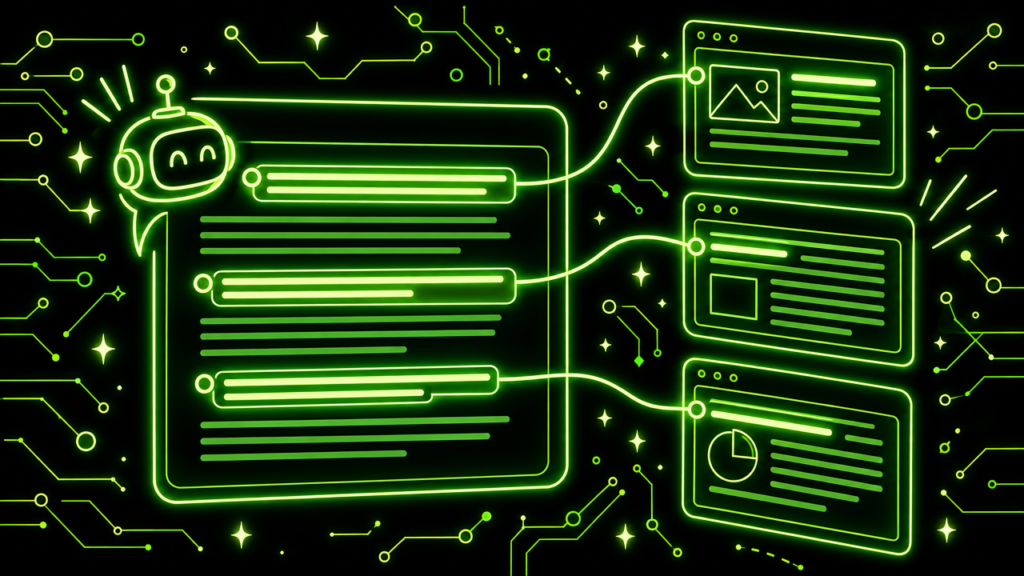
Finally, the AI search system attaches citations to the claims in its answer, linking back to the pages it used. Citation styles vary. Some tools show numbered footnotes, some show source cards and some show a list of links under the answer. Our guide on AI citations covers how each major tool displays them.
Training data vs live retrieval
Every AI search answer draws on two kinds of knowledge. The first is training data, the large body of text the model learned from before release. The second is live retrieval, the pages it fetches for your specific question.
Training data shapes the model’s general understanding: what a CRM is, which brands are well known, how categories fit together. Live retrieval adds fresh facts and citations. When a question is about current prices, recent releases or local options, live retrieval does most of the work. When a question is general, the model may answer mostly from training and cite only a few sources, or none.
For brands, both layers matter. Being widely discussed across the web helps the model know who you are. Having clear, crawlable, well-ranked pages helps you get retrieved and cited for specific questions. Our post on where ChatGPT gets its information explains this split for ChatGPT in particular.

How major AI search tools differ
The pipeline above is shared, but each tool makes different choices.
| Tool | Main index | Answer style | Notes |
|---|---|---|---|
| Google AI Overviews | Google’s own index | Short summary above regular results | Appears on many informational queries |
| Google AI Mode | Google’s own index | Longer conversational answers | Uses query fan-out across subtopics |
| ChatGPT search | Third-party providers plus OpenAI crawler | Conversational answer with inline citations | Keeps context across follow-ups |
| Perplexity | Own crawling plus other sources | Answer with numbered citations | Built around search from the start |
| Gemini | Google Search | Conversational answers | Tied into Google’s ecosystem |
| Claude | A web search provider | Answer with cited sources | Search runs when a question needs it |
A worked example: one question from start to finish
Following one question through the pipeline makes the process easier to picture. Say a shop owner types: “What’s the easiest way for a small bakery to take online preorders without paying big fees?”
The system decides to search
The question asks about current tools and fees, which change often, so the model decides it needs fresh information. A question about the history of sourdough would not trigger the same retrieval.
The question becomes several searches
The system breaks the request into narrower queries, something like “online preorder system for bakeries”, “bakery ordering software fees”, “free online ordering for small food business” and “preorder pickup tools reviews”. Each query targets one part of the original question.
Candidate pages come back
Each query returns a set of pages: vendor pricing pages, comparison articles, a few blog posts from small food businesses and a couple of forum threads where bakers compare tools. Pages that rank well for any of the narrow queries have a chance to be read.
Passages get scored
The system pulls passages from those pages. A pricing page that states “no monthly fee, 2.9% per order” in plain text scores well for the fees part of the question. A forum comment from a baker describing setup time scores well for “easiest”. A vendor page that hides pricing behind a contact form contributes nothing on fees.
The answer is written
The model writes a short answer: two or three tool suggestions, typical fee structures and a tip about pickup scheduling. Each suggestion gets a citation, perhaps one vendor pricing page, one comparison article and one forum thread.
What the vendors could learn from this
The vendor that got named had a public pricing page with a clear sentence about fees, appeared in a comparison article that ranked for one of the narrow queries and was praised by a real baker in a forum thread. A competitor with a better product but hidden pricing and no third-party mentions never entered the answer. That pattern repeats across almost every category.
What decides which sources AI search cites
No AI company publishes a full ranking formula, but testing and public documentation point to a consistent set of factors.
Retrievability
Your page has to be crawlable and indexed by the search source the tool uses. Blocking the relevant crawler, using heavy client-side rendering or hiding content behind logins can keep your page out of AI search entirely.
Ranking for the rewritten queries
Because of query fan-out, your page competes on narrow subtopic queries as well as the main question. A page that ranks for “CRM with client portal” may get cited for a broad CRM question even if it does not rank for “best CRM”.
Passage clarity
Clear, self-contained passages are easier to quote. A paragraph that names the subject, gives a direct answer and adds one or two specifics is ideal. Pronouns that depend on earlier paragraphs make passages harder to use on their own.
Authority and agreement
AI search systems tend to favor sources that other sources agree with. If many reviews, articles and forum threads describe your product the same way, the model is more confident repeating that description.
Freshness
For time-sensitive questions, recent pages win. Dated statistics and old prices can push a page out of the answer.
Third-party discussion
For recommendation and experience questions, AI search often cites forums, review sites and community threads. Reddit shows up frequently because it is full of first-hand opinions. Our guide on Reddit and AI search covers why.
Why AI search answers change from run to run
Ask the same question twice and you may get two different answers with different citations. Several things cause this. Language models generate text with some randomness. Query rewriting can produce different searches each time. Search results shift as new pages are published. Personalization, location and conversation history can change what is retrieved.
That variability matters for measurement. One test tells you little. Running the same set of questions several times and tracking how often your brand appears gives a much more reliable picture. Our post on AI share of voice explains how to do that.
What AI search means for SEO
AI search does not replace SEO. It adds a layer on top. Retrieval still depends on indexing and ranking, so technical SEO, helpful content and links remain the foundation. What changes is what happens after retrieval.
- Fewer clicks on some queries. When an AI search answer satisfies the question, the user may not click any link. Our guide to zero-click search covers how to adapt.
- More weight on being named. A brand mention inside an answer can influence buyers even without a click.
- More weight on off-site reputation. Reviews, comparisons and community threads feed the answers.
- New formatting priorities. Answer-first writing, clear headings and FAQs help models extract the right passage.
How to optimize for AI search
The steps below follow the pipeline. Each one improves your odds at a specific stage.
Make sure you can be retrieved
Check robots.txt for search crawlers such as Googlebot, OAI-SearchBot and PerplexityBot. Serve important content in plain HTML. Keep your sitemap current and fix crawl errors. Our guide to LLM SEO covers the technical checklist.
Cover the subtopics, not just the head term
Think about the fan-out queries your main question would generate. Build sections or separate pages for pricing, use cases, integrations, comparisons and common problems.
Write passages that stand alone
Start sections with a direct answer. Name the subject in each key paragraph instead of relying on “it” or “this”. Add specific numbers, steps and examples.
Keep facts current
Update prices, features and statistics on a regular schedule, and show the update in the content where it matters.
Build agreement across the web
Earn reviews, get included in comparison articles and take part in relevant community discussions. When many sources describe you consistently, AI search systems repeat that description with more confidence.
Add structured data
Schema for organizations, products, FAQs and reviews helps search engines understand your pages, which supports retrieval in tools that use those indexes.
How to test how AI search sees your brand
A simple monthly routine shows where you stand.
- Write 20 to 50 questions your buyers ask, from broad category questions to specific comparisons.
- Run each question in the AI search tools your buyers use, in fresh sessions.
- Record whether your brand appears, how it is described and which pages are cited.
- Note which third-party sources show up most often for your category.
- Repeat each month and compare trends rather than single answers.
Patterns in the cited sources tell you where to focus. If the same review site or Reddit thread appears again and again, that is where a mention will have the most effect.
Key terms to know
- Retrieval-augmented generation (RAG): a method where a model fetches documents first and writes its answer from them.
- Query fan-out: splitting one question into several related searches to cover its subtopics.
- Context window: the amount of text a model can read at once, including your question and the retrieved passages.
- Grounding: tying the generated answer to specific sources so claims can be checked.
- Citation: a link or reference that shows which source supports part of the answer.
- Crawler: the bot that fetches pages for an index, such as Googlebot, OAI-SearchBot or PerplexityBot.
- Index: the stored, searchable copy of web pages that retrieval runs against.
Common myths about how AI search works
Myth: AI search does not use search engines
Most AI search tools rely on a search index to find pages. The language model writes the answer, but retrieval still comes from an index.
Myth: You need a special file to appear in AI search
Files like llms.txt may help some tools understand your site, but they do not replace crawlability, rankings and reputation. Our guide on what llms.txt is covers what it can and cannot do.
Myth: AI search only cites big brands
AI search often cites small, specific pages that answer a narrow question well. Niche expertise can beat broad authority for the right query.
Myth: One prompt shows your AI visibility
Answers vary between runs. Track a set of questions over time to see the real picture.
Where AI search is heading
AI search tools keep adding features that pull more of the research journey into the answer: shopping results, maps, multi-step research and agents that can take actions. That makes the retrieval and citation stages even more important for brands, because more decisions happen before anyone visits a website. The fundamentals stay the same. Be easy to find, be clear about what you offer, and be discussed positively in the places these systems read.
Frequently asked questions
How does AI search find information?
AI search rewrites your question into search queries, retrieves pages from a search index, reads the most relevant passages and writes an answer grounded in them.
Is AI search the same as a chatbot?
Not exactly. A chatbot can answer from training data alone. AI search adds live retrieval from the web, which lets it cite current sources.
Does AI search use Google?
Google’s own AI features use Google’s index. Other tools use their own crawlers, third-party search providers or a mix. Each company decides its own sources.
Why does AI search cite Reddit so often?
Reddit threads contain first-hand experiences and opinions, which are useful for recommendation questions. Reddit content also ranks well in traditional search, which makes it easy to retrieve.
Can I control what AI search says about my brand?
You cannot control it directly, but you can influence it by publishing clear information, keeping facts current and earning consistent third-party mentions.
How is AI search different from traditional search?
Traditional search ranks links and leaves the reading to you. AI search reads the sources for you and writes a summarized answer with citations.
Want to see where your customers are already asking? Get a free Reddit Opportunity Report showing which Reddit threads already rank for your keywords.