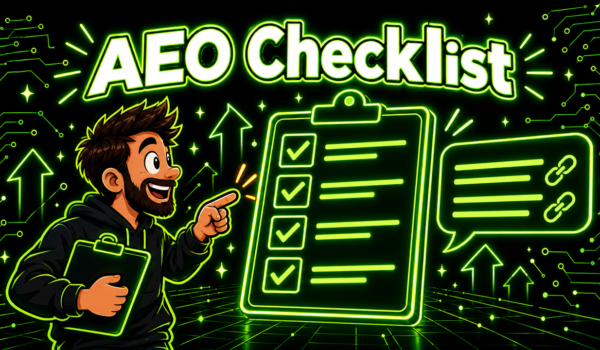
An AEO checklist is a list of the tasks that help your brand and content appear in answers from AI assistants and AI search features, such as ChatGPT, Google’s AI Overviews and AI Mode, Gemini, Perplexity, Copilot and Claude. Answer engine optimization, or AEO, combines technical access, clear answer-focused content, consistent brand information and mentions in the sources AI tools trust. This AEO checklist breaks the work into 30 concrete steps you can work through in order, whether you run a local business, a software company or a content site.
Use it as a one-time audit, then revisit it every quarter. If you are new to the topic, our guide to what AEO is explains the concepts first.

AEO checklist part 1: technical access
AI systems can only use what they can reach and read. Start here.
- Confirm important pages are indexed in Google Search Console and Bing Webmaster Tools. Several AI assistants rely on these indexes or on partners built from them.
- Review robots.txt and allow the search crawlers and user fetchers of the AI assistants you want to appear in, such as OAI-SearchBot, Claude-SearchBot and PerplexityBot. Decide separately about training crawlers. Our guide on how to block AI crawlers explains the difference.
- Make sure key content appears in the HTML without requiring heavy scripts, logins or clicks to expand.
- Check that pages load quickly and work on mobile.
- Avoid nosnippet and similar directives on pages you want quoted, since they can prevent AI features from showing your content.
- Keep an XML sitemap up to date and submitted.
- Decide whether an llms.txt file suits your site, and keep it consistent with your robots.txt choices. Our guide on what llms.txt is covers the format.
AEO checklist part 2: answer-focused content

AI answers quote content that states things clearly. This part of the AEO checklist focuses on writing.
- Collect the real questions buyers ask, from sales calls, support tickets, onsite search, Reddit threads and keyword research.
- Map each important question to a page that answers it, and fill gaps with new pages.
- Put a direct answer in the first one or two sentences of each page or section.
- Use headings phrased as the questions people ask, with the answer immediately below.
- Add specifics: numbers, steps, comparisons, examples and dates.
- Include honest comparisons with alternatives, including who your product is not a fit for.
- Add short FAQ sections for follow-up questions, written in plain language.
- Show clear authorship and expertise, with author bios and credentials where relevant.
- Update pages when facts change, and show the last updated date.
AEO checklist part 3: entity and brand clarity
AI systems need to understand who you are before they recommend you.
- Use one consistent brand name and description everywhere.
- Write an about page that explains what you do, who you serve and where you operate.
- Add Organization structured data with links to your official profiles. Our guide to schema markup for AI search covers which types help.
- Add the specific schema type for your main pages, such as LocalBusiness, Product or SoftwareApplication.
- Make your listings consistent on Google Business Profile, Bing Places, Apple Business Connect and industry directories.
- Publish clear pricing information, or an explanation of how pricing works, so assistants do not guess.
AEO checklist part 4: third-party mentions
For recommendation questions, AI tools lean heavily on what others say about you.
- Find the sources AI assistants cite for your category questions, and list them.
- Keep profiles on review platforms complete and active, and ask happy customers for detailed reviews.
- Pursue inclusion in the roundups, comparison articles and directories that keep getting cited.
- Participate in community discussions where your buyers ask for recommendations, such as relevant Reddit threads, with your role disclosed. Our guide to Reddit AI search explains why this matters.
- Earn coverage in trade publications and partner sites, since mentions count even without links. See our guide to unlinked brand mentions.
AEO checklist part 5: measurement

- Build a list of 20 to 50 buyer prompts and test them monthly across the assistants your audience uses.
- Track mention rate, share of voice, description accuracy and cited sources. Our guide to AI share of voice explains the metrics.
- Set up an AI channel in analytics to see visits from assistants. Our guide to AI referral traffic walks through GA4.
Why each part of the AEO checklist matters
Technical access
If AI systems cannot reach or read a page, nothing else on this AEO checklist can help it. Many sites accidentally block AI search crawlers while trying to block training crawlers, or hide key content behind scripts and tabs. These problems are invisible until you look, which is why technical checks come first.
Answer-focused content
AI answers are built from passages that state facts clearly. Pages that answer a question in their first lines, then support the answer with specifics, are easier to quote and summarize accurately. This part of the AEO checklist also helps human readers and traditional search rankings, so the effort pays off twice.
Entity and brand clarity
Assistants need to know what your brand is before they can recommend it for the right situations. Consistent names, descriptions, structured data and listings reduce confusion with similarly named companies and prevent outdated details from spreading.
Third-party mentions
For questions like “what is the best tool for this”, assistants rely heavily on independent sources: reviews, roundups, publications and community discussions. This is often the part of the AEO checklist with the biggest impact on recommendations, and the one teams skip most often because it happens off their own website.
Measurement
Without regular testing, you cannot see whether your work changes what AI tools say. Measurement also reveals which sources assistants cite, which tells you exactly where to focus next.
A 90-day AEO checklist rollout
- Days 1 to 15: run the measurement steps first to get a baseline, then complete the technical access steps.
- Days 16 to 45: work through the entity and brand clarity steps, and rewrite your five most important pages using the content steps.
- Days 46 to 75: start on third-party mentions: review profiles, roundups, community participation and press outreach.
- Days 76 to 90: rerun the measurement steps, compare with the baseline, and plan the next quarter.
Spreading the AEO checklist over a quarter keeps it manageable for small teams and gives each change time to show results before you judge it.
Using the AEO checklist as a team
AEO spans several roles, so assign each part of the AEO checklist to an owner:
- Technical access: developer or technical SEO.
- Answer-focused content: content and SEO team.
- Entity and brand clarity: SEO plus whoever manages listings and profiles.
- Third-party mentions: PR, partnerships, customer success and community managers.
- Measurement: one coordinator who runs tests and shares results monthly.
Keep the AEO checklist in a shared spreadsheet with columns for status, owner, date completed and notes. Review it in a short monthly meeting alongside the measurement results.
Tools for each part
- Technical access: Google Search Console, Bing Webmaster Tools, a crawler tool and your server logs.
- Content: keyword research tools, internal search data and community threads for real questions.
- Entity clarity: structured data validators and a list of every profile you own.
- Third-party mentions: brand monitoring and social listening tools.
- Measurement: a spreadsheet for manual prompt testing, or an AI visibility tool for larger prompt sets. Our guide to answer engine optimization tools compares options.
How to prioritize the AEO checklist
Thirty steps can feel like a lot. Prioritize based on where you stand:
- If assistants never mention you, start with parts 3 and 4. Brand clarity and third-party mentions usually move recommendations most.
- If assistants mention you but describe you wrongly, focus on steps 16 to 22 and on correcting the profiles assistants cite.
- If competitors’ pages get cited and yours do not, focus on part 2 and on the technical checks in part 1.
- If you have no idea where you stand, do part 5 first to get a baseline.
AEO checklist by business type
| Business | Highest-impact steps |
|---|---|
| Local service business | Listings consistency, reviews, LocalBusiness markup, service and location pages |
| Ecommerce brand | Product pages with specifics, review volume, comparison content, inclusion in roundups |
| SaaS company | Use case pages, transparent pricing, review platforms, community threads, documentation |
| Publisher or content site | Crawler policy, answer-first articles, author expertise, freshness |
| Professional services | Specialty pages, expert authors, directory profiles, trade coverage |
Examples: before and after
A local plumber
Before: the website listed “plumbing services” with no detail, the Business Profile had old hours, and only a handful of reviews existed. Assistants rarely mentioned the business for emergency questions in its area.
After working through the checklist: the site added pages for emergency repairs, water heaters and drain cleaning in each service area, with typical response times. Hours were corrected everywhere, LocalBusiness markup was added, and the owner asked every satisfied customer for a review that described the job. Over the following months, the business began appearing in answers to specific local questions.
A project management SaaS
Before: assistants described the product using an old pricing model, and comparison answers named three competitors but not this product.
After: the team published a clear pricing page, updated its profiles on review platforms, wrote honest comparison pages, and had its support lead answer questions in relevant community threads with disclosure. It also contacted authors of two outdated roundups with current details. Descriptions became accurate, and the product began appearing in more comparison answers.
Questions to ask at each review
- Which prompts now mention us that did not last quarter, and why?
- Which sources appear most often in answers for our category, and are we in them?
- Are AI descriptions of our brand accurate, and where do errors come from?
- Did any technical change, such as a site migration, break access or markup?
- What are the two or three highest-impact tasks for next quarter?
Writing the answers down each quarter creates a record that shows how your AI visibility is changing and which efforts paid off.
Common AEO checklist mistakes
- Treating AEO as a one-time project instead of a quarterly routine.
- Blocking AI search crawlers by accident while trying to block training.
- Writing for keywords instead of for the questions people actually ask.
- Focusing only on your own site and ignoring third-party sources.
- Measuring once and never again, which makes progress impossible to see.
For Google’s official guidance on AI features, see AI features and your website. For a deeper look at optimizing for AI answers, read our guide to AI search optimization.
A printable version of the AEO checklist
If you want a short version to keep next to your desk, here are the 30 steps in condensed form:
- Technical: indexed pages, AI search crawlers allowed, readable HTML, fast mobile pages, no blocking snippet rules, current sitemap, consistent llms.txt.
- Content: real buyer questions, one page per important question, answer first, question headings, specifics, honest comparisons, FAQs, visible authors, update dates.
- Brand: one name, a clear about page, Organization markup, specific schema types, consistent listings, clear pricing.
- Third-party: list cited sources, active review profiles, roundup inclusion, community participation, press and partner mentions.
- Measurement: monthly prompt tests, mention and accuracy tracking, AI referral analytics.
Print it, tick items off as you go, and date each pass through the AEO checklist so you can see progress over time.
When to bring in outside help
Most of the AEO checklist can be done in-house. Outside help makes sense when you lack technical resources for crawler and markup work, when your category is dominated by third-party sources you cannot reach on your own, or when you need to track hundreds of prompts across many assistants. Whatever help you choose, ask how they measure results, and make sure the work stays within platform rules, especially for reviews and community participation.
Keeping momentum
The hardest part of AEO is not any single step. It is keeping the work going after the first burst of effort. A few habits help:
- Put the monthly prompt test on a shared calendar with a named owner.
- Celebrate small wins, such as a corrected description or a new mention, so the team sees progress.
- Tie the work to business goals by tracking AI referral visits and leads alongside mentions.
- Revisit priorities each quarter instead of trying to do everything at once.
Treat AEO like any other ongoing marketing channel. Steady attention beats occasional sprints, because the sources AI tools read change a little every month.
Finally, keep the AEO checklist itself up to date. AI assistants add features, rename crawlers and change how they show sources. Review the steps once or twice a year against current documentation from the major AI companies and adjust the list to match what they support today.
AEO checklist FAQ
What is an AEO checklist?
It is a list of technical, content, brand and measurement tasks that help your brand appear and be described accurately in AI-generated answers.
How often should I run through the AEO checklist?
Do a full pass once, then review it quarterly. Run the measurement steps monthly.
Which AEO checklist items matter most?
For most brands, consistent brand information and mentions in trusted third-party sources move AI recommendations the most, alongside clear answer-first content.
Is AEO different from SEO?
It overlaps heavily with SEO. AEO adds emphasis on direct answers, brand clarity, third-party mentions and measuring what AI answers say.
Do I need special tools for AEO?
No. You can start with a spreadsheet and manual prompt testing. Tools help when you track many prompts and assistants.
How long does AEO take to show results?
Changes to sources that assistants retrieve live can show up within weeks. Broader changes in how models describe your brand take longer.
Does the checklist work for every AI assistant?
The foundations apply to all of them. The details differ, since each assistant uses different crawlers and search sources, so test each one your audience uses and adjust the technical steps for their crawlers.
Can a small team complete all 30 steps?
Yes, over a quarter. Many steps take an hour or less, such as checking robots.txt or fixing listings. The content and third-party steps take longer, so spread them out.
Should I hire an agency for AEO?
Consider it if you lack time or technical skills, or need help earning third-party mentions at scale. Ask any agency how they measure results and how they keep community work within platform rules.
Is AEO only for large brands?
No. Small businesses often see results faster because the questions they need to win are narrower, such as a specific service in a specific town.
Want to see where your customers are already asking? Get a free Reddit Opportunity Report showing which Reddit threads already rank for your keywords.