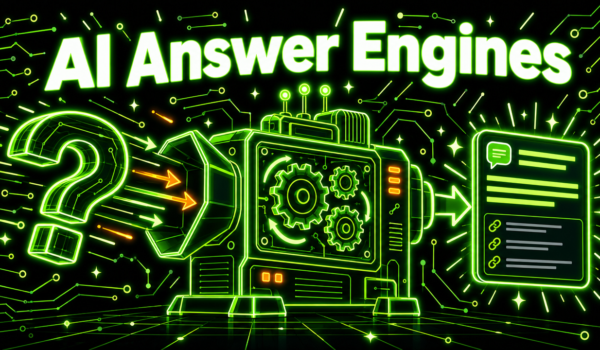
AI answer engines are tools that respond to a question with a written answer instead of a list of links. They use large language models, often combined with live web search, to read sources, summarize them and cite where the information came from. ChatGPT with search, Perplexity, Google’s AI Overviews and AI Mode, Gemini, Microsoft Copilot and Claude all work as AI answer engines for many of the questions people ask them.
This guide explains how AI answer engines work, how they differ from traditional search engines, which ones matter most, and what businesses can do to appear in their answers.

AI answer engines vs search engines
A traditional search engine matches your query to pages and shows a ranked list of links. You choose which links to open and assemble the answer yourself. AI answer engines do the assembly for you. They pull information from several sources, write a single response, and add citations so you can check the details.
| Factor | Search engine | AI answer engine |
|---|---|---|
| Output | Ranked list of links | Written answer with citations |
| Typical query | Short keywords | Full questions with context |
| Follow-up | New search | Conversation that keeps context |
| Clicks to websites | Main way users get answers | Optional, many users read the answer only |
| Brands shown | Many results to choose from | A short list inside the answer |
For businesses, that last row matters most. AI answer engines compress choice. When an answer names three options, those three get the attention. Our guide to zero-click search covers how this affects traffic.
How AI answer engines work

Most AI answer engines follow a similar process when they search the web:
- Understand the question. The model interprets what the user wants, often rewriting the question into one or more search queries.
- Retrieve sources. The engine searches an index, either its own or a partner’s, and pulls a set of relevant pages.
- Rank and select. It decides which passages best answer the question, weighing relevance, clarity and trust signals.
- Generate the answer. The language model writes a response based on the selected passages and its own trained knowledge.
- Cite. The engine links to some of the sources it used, inline or in a list.
When an AI answer engine does not search, it answers from what the model learned in training, which reflects text gathered before the model was built. Our guide on where ChatGPT gets its information explains this split in more detail.
The AI answer engines that matter most

ChatGPT
ChatGPT has the largest user base among AI assistants. When it searches the web, it shows inline citations and a source list. Many people use it for product research and recommendations. Our guide to ChatGPT SEO covers how to appear in its answers.
Google AI Overviews and AI Mode
Google’s AI Overviews appear at the top of many search results and summarize an answer with links. AI Mode is a more conversational search experience built into Google. Both draw on Google’s index, so traditional SEO strength carries over. See our guide on how to appear in Google AI Overviews.
Gemini
Gemini is Google’s standalone assistant, available in its own app and across Google products. It can use Google Search to ground answers in current information.
Perplexity
Perplexity is built around sourced answers, with numbered citations on nearly every response. It is popular with researchers and professionals who want to check sources. Our guide on how to rank on Perplexity covers it in detail.
Microsoft Copilot
Copilot draws on Bing’s index and appears in Windows, Edge and Microsoft 365. It matters for audiences who work inside Microsoft tools.
Claude
Claude can search the web and cite sources, and it is widely used by professionals and technical teams. Our guide to Claude web search explains how it finds information.
What AI answer engines look for in sources
No AI answer engine publishes a full ranking formula, but observed patterns are consistent across them:
- Direct answers. Pages that answer a question clearly near the top are easier to quote.
- Specifics. Numbers, steps, comparisons and examples give the model concrete material.
- Trust signals. Sources that rank well in search, are cited by others, or come from recognized publications tend to be favored.
- Independent opinion. Reviews, comparison articles and community discussions such as Reddit threads appear often, especially for recommendation questions.
- Freshness. For topics that change, recent pages have an edge.
- Accessibility. Pages that crawlers can reach and read as plain HTML.
Google describes how its AI features use web content in its documentation on AI features and your website.
How brands can appear in AI answer engines
Optimizing for AI answer engines is often called answer engine optimization, or AEO. Our guide to what AEO is covers the full discipline. The core steps:
Write pages that answer real questions
Collect the questions your buyers ask and give each important one a clear answer on your site. Lead with the answer, then support it with detail, examples and data. Sales calls, support tickets, onsite search logs and community threads are the best places to find the real wording. Group similar questions together so one strong page can answer a cluster of related prompts.
Make your brand easy to understand
Use consistent names and descriptions across your site and profiles, add structured data, and explain clearly what you offer and for whom. AI answer engines need to know what your brand is before they can recommend it.
Earn mentions in third-party sources
AI answer engines rely heavily on what others say. Reviews, roundups, news coverage and community threads all feed recommendations. Find the sources cited for your category questions and work to appear in them.
Keep pages crawlable and current
Check that your robots.txt allows the crawlers these engines use for search, and keep facts like pricing and features up to date. Review it whenever your site or hosting changes, since a single misplaced rule can quietly block the systems you want reading your pages. Keep a dated changelog of facts that change often, such as prices and plan names.
Measure presence over time
Track whether and how AI answer engines mention your brand using a fixed set of prompts each month. Our guide on AI share of voice explains how to compare yourself with competitors.
Why AI answer engines rely on community content
Recommendation questions are where AI answer engines lean hardest on community discussions. When someone asks which product to choose, a thread where dozens of users compare options offers exactly the first-hand evidence an engine needs. That is why Reddit threads appear so often among cited sources, and why participation in the communities your buyers read can shape how AI answer engines describe your category. Our guide to Reddit AI search explains the connection.
From featured snippets to full answers
Search engines have been moving toward direct answers for years. Featured snippets pulled a short passage from one page and showed it above the results. Knowledge panels summarized facts about people, places and companies. Voice assistants read a single answer aloud. Each step reduced the need to click through to a website for simple questions.
Large language models took the idea much further. Instead of quoting one passage, they can read many sources, combine them, and write an answer that fits the exact wording of a complex question, including follow-ups. That is the step that turned search features into full answer tools, and it changed how people research everything from software purchases to medical questions to travel plans.
How people use these tools in practice
Usage patterns vary, but a few common jobs stand out:
- Research and learning. People ask for explanations, summaries of a topic, or the pros and cons of an approach, often with several follow-up questions.
- Shopping and comparisons. Buyers ask which product suits their situation, compare two options, or ask for alternatives to something they already use.
- Local decisions. People ask for restaurants, services and places nearby with specific requirements, such as open late or good for kids.
- Work tasks. Professionals ask how to solve technical problems, which tools to use, or how others in their field handle a task.
- Checking reputations. People ask what others think of a company, product or service before committing.
The shopping, local and reputation jobs matter most for businesses, because the answer often names specific brands. A user who asks for the best payroll tool for a ten-person company may never see a list of links at all.
What changes for content and marketing teams
Several habits from traditional SEO still apply: useful pages, clear structure, fast and crawlable sites, and authority built over time. What changes is the emphasis.
- Questions over keywords. Prompts are longer and more specific, so pages that answer specific situations gain value.
- Answers up front. Burying the key point under a long introduction makes it harder for a system to extract and cite.
- Third-party reputation. What reviewers, journalists and community members say about you shapes recommendations more than your own copy.
- Mentions as well as links. A brand named in a trusted source can be recommended even when that source does not link to it.
- Measurement beyond clicks. Many users read the answer and never visit, so you need to check what the answers say, not only your traffic.
How to measure the traffic they send
When a user clicks a citation, the visit usually arrives with a referrer such as chatgpt.com, perplexity.ai, gemini.google.com, copilot.microsoft.com or claude.ai. Clicks from Google’s AI features count as Google organic traffic. You can group the identifiable sources into their own channel in your analytics, which our guide to AI referral traffic explains step by step. Pair that with regular prompt testing so you also see the influence that never turns into a click.
Questions to ask before you invest
Not every business needs the same level of effort. These questions help you decide how much to put into optimizing for AI answers:
- Do your buyers research purchases by asking questions, or do they mostly buy on impulse or by habit?
- When you ask assistants the questions your buyers ask, do competitors appear while you do not?
- Are the sources cited for your category ones you can realistically influence, such as review sites, directories and community threads?
- Does your website already answer buyer questions clearly, or would you be starting from scratch?
- Do you have someone who can own monthly measurement and follow up on the gaps it finds?
If the answers point to a real gap, start with the basics: consistent facts, clear answer pages and a plan to earn mentions in the sources that show up most. Those steps help across every assistant at once, and they also tend to improve traditional search performance.
Limits of AI answer engines
AI answer engines can make mistakes. They may combine sources incorrectly, repeat outdated information or state guesses with confidence. Answers can also vary between runs and users. For businesses, this means monitoring what engines say about you matters as much as optimizing for them, and correcting the sources behind errors is often the fastest fix. If you find an error about your business, trace it to the source the assistant cited and correct that source first. Then recheck the same prompt a few weeks later to confirm the fix reached the answers.
Which engines to prioritize
You do not need to treat every assistant equally. Prioritize based on who your buyers are and how they work.
- Consumer brands usually start with ChatGPT and Google’s AI features, since those reach the widest audiences.
- B2B and professional services should add Perplexity, Copilot and Claude, which are popular with researchers, office workers and technical teams.
- Local businesses should focus on Google’s AI features and the listings and reviews they draw on, then check ChatGPT for local questions.
- Developer and technical products should check Claude, ChatGPT and Perplexity, and watch the communities and documentation sites they cite.
Run your prompt list across your top three choices every month and expand once the process is routine.
A short glossary
- Retrieval. The step where a system searches for documents related to a question before writing an answer.
- Grounding. Basing an answer on retrieved sources rather than on the model’s memory alone.
- Citation. A link or reference to a source used in the answer.
- Training data. The text a model learned from before release, which shapes what it knows without searching.
- AEO and GEO. Answer engine optimization and generative engine optimization, two names for the practice of improving how content and brands appear in AI answers. Our guide to generative engine optimization covers the second term.
- Share of voice. How often your brand is mentioned in answers compared with competitors.
Knowing these terms makes it easier to read vendor claims, plan work with your team, and explain to leadership why visibility in AI answers needs its own measurement.
AI answer engines FAQ
What are AI answer engines?
They are AI tools that answer questions with a written response, often using live web search and citing sources, instead of returning a list of links.
Which AI answer engines are most popular?
ChatGPT, Google’s AI Overviews and AI Mode, Gemini, Perplexity, Microsoft Copilot and Claude are the main ones for most audiences.
Are AI answer engines replacing search engines?
They are taking a growing share of research questions, while traditional search remains widely used. Search engines themselves now include AI answers.
How do AI answer engines choose sources?
They retrieve pages related to the question and favor clear, specific, trusted and accessible content, with heavy use of third-party sources for recommendations.
What is answer engine optimization?
It is the practice of making your content and brand easy for AI answer engines to find, understand, trust and cite.
Can I see if AI answer engines mention my brand?
Yes. Ask them the questions your buyers ask and record whether you appear, how you are described and which sources are cited.
Do these tools send traffic to websites?
Some. Users click citations when they want details, want to buy, or want to check a claim. Many read the answer and stop there, so clicks understate how much influence the answers have.
Are answers the same for every user?
No. Answers can vary with wording, conversation history, location, personalization settings and simple randomness. That is why testing several times and tracking trends works better than judging a single answer.
Is optimizing for AI answers different from SEO?
It overlaps heavily. Clear, useful, crawlable pages and a strong reputation help in both. The extra work lies in earning mentions in the third-party sources that assistants cite and in measuring what the answers say about you.
Want to see where your customers are already asking? Get a free Reddit Opportunity Report showing which Reddit threads already rank for your keywords.